
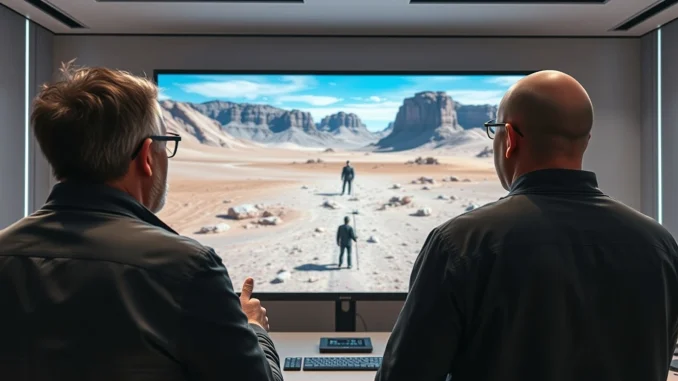
In a move signaling AI’s deeper push into content creation, Luma has launched a new production services company called Innovative Dreams. The venture, announced on April 16, 2026, is built in partnership with Wonder Project, a streaming service focused on religious films and TV shows available on Amazon Prime. This partnership aims to merge seasoned Hollywood talent with generative AI tools to produce content, starting with a new series about Moses starring Ben Kingsley.
Luma’s Strategic Shift from Tools to Production
Luma, known for its AI video generation tools, is now moving directly into production. According to a company statement, Innovative Dreams will function as a service where filmmakers from director Jon Erwin’s team work alongside Luma’s creative technologists. Their goal is to help studios realize ambitious projects. This marks a significant strategic pivot. The company is not just selling software anymore. It is embedding its technology into the creative pipeline itself.
Also read: OpenAI Limits GPT-5.6 Rollout After U.S. Government Request, Calls Restrictions a 'Short-Term Step'
Industry watchers note this is part of a broader trend. AI startups are increasingly demonstrating their tools by creating original content. For instance, AI startup Higgsfield recently launched its own sci-fi series. London’s Wonder Studios is also working on an AI-assisted documentary. Luma’s founder and CEO, Amit Jain, has argued that Hollywood’s high costs constrain creativity. He believes generative AI can make filmmaking faster and cheaper without losing quality. This thinking directly fuels the new partnership.
The “Real-Time Hybrid Filmmaking” Promise
The core of the Innovative Dreams offering is a process dubbed “real-time hybrid filmmaking.” In a promotional video, Jon Erwin described it as a fusion of performance capture (used in films like “Avatar”) and virtual production (pioneered by “The Mandalorian”). The key difference, according to Luma, is that it happens live and at a lower cost.
Also read: OpenAI, Google, and SpaceX are all building their own AI chips — here's why that matters
Traditionally, these techniques are complex and post-production heavy. Performance capture requires specialized suits and markers, with digital character creation happening later. Virtual production uses massive LED screens to create environments in real-time but involves significant physical infrastructure. Luma claims its AI agents allow creative teams to collaborate in real-time, making changes to sets, props, and lighting instantly. Human actor footage can be integrated and manipulated on the fly.
“This is a significant improvement over current processes where things come together only in post,” Luma stated. Erwin gave a specific example: filming a human actor anywhere and then transporting that performance into a photorealistic digital scene. The tools could even generate a new face mapped to the actor’s original expressions.
Why Partner with a Faith-Focused Streamer?
The choice of partner is revealing. Wonder Project, launched in 2023 by Erwin and former Netflix executive Kelly Hoogstraten, targets the global faith and values audience. Their first series, “House of David,” was released on Amazon Prime in 2025. This niche market may offer a strategic sandbox for Luma’s technology.
Faith-based films often operate with smaller budgets than major studio tentpoles but have a dedicated, sizable audience. This creates an ideal environment to test and refine AI-driven production methods where cost efficiency is paramount. The first project under this partnership, “The Old Stories: Moses,” fits this model perfectly. It is unclear if Innovative Dreams will work exclusively on faith-based content or expand later. TechCrunch reported it has reached out to the companies for clarification.
The Broader AI Film Production Debate
Luma’s announcement arrives amid intense debate about AI’s role in Hollywood. Just last week, Cristóbal Valenzuela, co-founder of competitor Runway, made a provocative suggestion. He said studios should take a typical $100 million film budget and use AI to make 50 films instead. This, he argued, would increase the odds of creating a blockbuster.
This perspective frames AI not merely as a cost-cutting tool but as a catalyst for a fundamental change in content strategy. It shifts focus from fewer, expensive bets to a larger portfolio of creative experiments. Jain has made similar arguments, highlighting the potential for AI to democratize high-quality production. The implication is a possible future where the economics of film and series production are radically different.
Technical and Creative Implications
The success of Innovative Dreams hinges on the performance of Luma Agents. These are the company’s recently launched tools designed to handle end-to-end creative work across text, image, video, and audio. The promise is a more integrated and responsive workflow.
Potential impacts include:
- Faster Iteration: Directors and designers could see changes to scenes immediately, speeding up decision-making.
- Location Flexibility: Reducing dependency on physical sets or specific shooting locations could lower costs and logistical complexity.
- New Creative Possibilities: The ability to seamlessly blend live-action and generated elements might open up storylines previously deemed too expensive or impractical.
However, this also raises questions. The technology must prove it can consistently deliver the cinematic quality audiences expect. There are also ongoing industry concerns about how AI tools are trained and their impact on traditional jobs in visual effects and production design.
What This Means for the Industry
Luma’s move is a clear signal. AI companies are no longer content to be vendors on the sidelines. They are actively entering the content arena to prove their technology’s value. For studios and streamers, partnerships like this offer a way to experiment with AI production without massive upfront investment in technology and training.
For the faith-based entertainment sector specifically, it could mean a higher volume of professionally produced content. Wonder Project’s mission to serve a global audience could be accelerated by more efficient production methods. This could signal a new phase of growth for the genre.
Data from industry analysts suggests the market for faith and values-oriented content is substantial but underserved by major studios. AI-driven production could help fill that gap more economically. What this means for investors is a closer watch on how these early partnerships perform. Their success or failure will provide critical data on the scalability and audience acceptance of AI-assisted filmmaking.
Conclusion
Luma’s launch of Innovative Dreams with Wonder Project represents a concrete step into a new era of film production. By focusing on real-time hybrid filmmaking for faith-based content, the partnership tests AI’s practical value in a specific, budget-conscious market. The initiative’s progress will be closely monitored, as it could validate a new production model for the wider entertainment industry. The success of “The Old Stories: Moses” this spring will be the first major test of this ambitious collaboration.
FAQs
Q1: What is Luma’s Innovative Dreams?
Innovative Dreams is a new production services company launched by AI video generation startup Luma. It partners filmmakers with Luma’s creative technologists to produce content using AI tools, starting with a partnership on faith-based projects with Wonder Project.
Q2: What is the Wonder Project?
Wonder Project is a streaming service launched in 2023 that produces religious films and TV series for a global faith and values audience. It is run by director Jon Erwin and former Netflix executive Kelly Hoogstraten and distributes content on Amazon Prime.
Q3: What is “real-time hybrid filmmaking”?
It’s a production process described by Luma and Wonder Project that combines techniques like performance capture and virtual production. The key claim is that Luma’s AI tools allow for changes to sets, lighting, and actor integration to happen live during filming, rather than waiting for post-production.
Q4: What is the first project from this partnership?
The first announced project is a series called “The Old Stories: Moses,” starring British actor Ben Kingsley. It is scheduled to launch on Amazon Prime Video in the spring of 2026.
Q5: Are other AI companies moving into production?
Yes. This appears to be a growing trend. For example, AI startup Higgsfield recently launched its own original sci-fi series. These moves are seen as a way for AI firms to demonstrate the capabilities of their technology in a practical, finished product.




Be the first to comment