
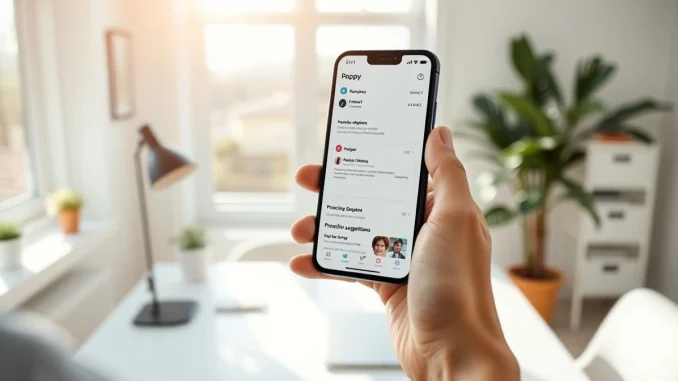
Smartphones, with their endless notifications and scattered apps, often feel more like a source of digital clutter than a tool for productivity. A new application called Poppy aims to change that by consolidating your calendar, email, messages, and other services into a single, intelligent dashboard. The app’s core premise, as described by its creator, is that “Poppy pays attention so you don’t have to.”
How Poppy Works: From Data to Proactive Suggestions
Poppy integrates with a range of everyday services, including Apple Calendar, Google Calendar, Gmail, Outlook, iCloud Mail, Apple Health, Reminders, Contacts, iMessage, WhatsApp, Uber, and Instacart. Once connected, the app uses artificial intelligence to analyze your data—such as your location, upcoming events, and past communications—to predict what is most relevant to you at any given moment.
Also read: OpenAI Limits GPT-5.6 Rollout After U.S. Government Request, Calls Restrictions a 'Short-Term Step'
At its most basic level, this means opening the Poppy app or glancing at its widgets to see your meetings and tasks. However, the app’s more advanced feature lies in its proactive suggestions. For example, if your calendar shows a 30-minute gap and your location indicates you are near a park, Poppy might suggest taking a short walk. If you are planning a brunch with a friend, and previous messages reveal their food preferences, the app could factor that into restaurant recommendations.
Users can also interact with Poppy directly by sending questions or requests, treating it like a personal assistant. It can track flights and alert you to changes, or remind you when it is time to take medication.
Also read: OpenAI, Google, and SpaceX are all building their own AI chips — here's why that matters
Founder’s Vision and Background
Poppy was developed by Sai Kambampati, who holds a Master’s degree in Computer Science with a specialization in human-computer interaction. Previously a software engineer at the AI hardware startup Humane, Kambampati has observed the industry’s efforts to rethink human engagement with technology. “I’ve always been interested in challenging what computers are able to do, especially the idea of ambient computing and computers that can proactively sense what you need and anticipate your needs,” Kambampati told TechCrunch. “I felt like with all the AI technology that we’re seeing around us, it has never been more possible to embark on something like this.”
Privacy and Data Handling
Given the app’s access to sensitive data like emails, messages, and location, privacy is a central concern. The company states that user data is encrypted when stored in its database. When using cloud-based large language models (LLMs) for generating suggestions, Poppy says it operates with a zero-retention policy. Kambampati’s long-term goal is to transition to local, on-device AI models as hardware capabilities improve. “My hope, my dream is—within two to three years from now, when our devices have much more powerful compute, and the models get much smaller, cheaper and more high quality—eventually we can have all of this running on our own devices, and there won’t even be a need to hit the servers,” he explained.
Funding and Availability
Poppy is currently available for download. The San Francisco-based startup, consisting of a four-person team, has secured $1.25 million in pre-seed funding. The round was led by Kindred Ventures, with participation from angel investors including DeepMind’s Logan Kilpatrick. The app’s reliance on a Mac app to access iMessage could present future challenges, as Apple generally restricts third-party access to its messaging service.
Why This Matters
Poppy enters a growing market of AI-powered productivity tools, but its focus on proactive, ambient intelligence distinguishes it from passive assistants. By attempting to anticipate user needs rather than simply responding to commands, it represents a shift toward more anticipatory computing. For users overwhelmed by digital noise, Poppy offers a potential path to a more organized and less distracting digital experience.
FAQs
Q1: What makes Poppy different from other AI assistants?
Poppy is designed to be proactive, using data from your calendar, messages, and location to anticipate your needs and offer suggestions before you ask, rather than just reacting to commands.
Q2: Which apps and services does Poppy work with?
At launch, Poppy integrates with Apple Calendar, Google Calendar, Gmail, Outlook, iCloud Mail, Apple Health, Reminders, Contacts, iMessage, WhatsApp, Uber, and Instacart, with plans to add more.
Q3: How does Poppy protect my privacy?
User data is encrypted at rest. For cloud-based AI processing, Poppy employs a zero-retention policy, meaning data is not stored after generating suggestions. The company’s long-term goal is to run all AI processing locally on the user’s device.


Be the first to comment