
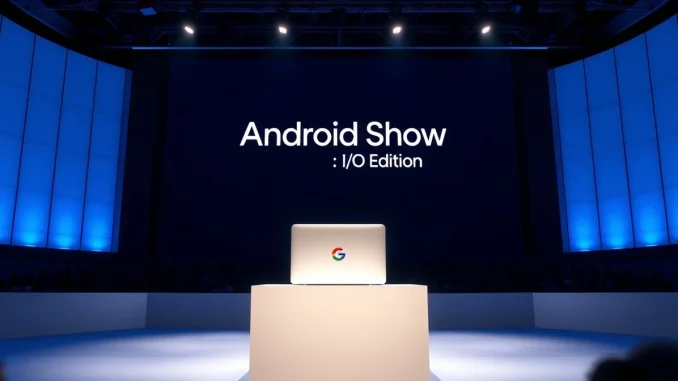
At its virtual “Android Show: I/O Edition” event on Tuesday, Google introduced a broad set of updates spanning new hardware, deeper AI integration, and refined software features. The announcements, which arrive ahead of the company’s annual developer conference, underscore Google’s push to embed its Gemini Intelligence more deeply into everyday devices and experiences. Here is a breakdown of everything revealed.
Googlebooks: A new laptop line built for Gemini
Google unveiled Googlebooks, a new line of laptops designed from the ground up with Gemini Intelligence at their core. The company is partnering with Acer, Asus, Dell, HP, and Lenovo to produce the first models, which will ship this fall. Google says these are the first laptops built to offer “personal and proactive help” through Gemini, including a new “Magic Pointer” cursor with built-in AI, smooth Android phone app compatibility, and the ability to create custom widgets. The move signals Google’s ambition to compete more directly in the premium laptop market, utilizing its AI ecosystem as a differentiator.
Also read: OpenAI Limits GPT-5.6 Rollout After U.S. Government Request, Calls Restrictions a 'Short-Term Step'
Create My Widget: Vibe-coding your home screen
A new “Create My Widget” feature allows users to build custom widgets using natural language descriptions. For example, asking for “suggest three high-protein meal prep recipes every week” generates a personalized dashboard that can be added and resized on the home screen. The feature will first launch on select Samsung Galaxy and Google Pixel phones this summer, reflecting a broader trend toward making app customization more accessible to non-technical users.
Android Auto gets a major refresh
Android Auto is receiving a redesign that brings more personalization, edge-to-edge display support, and new widgets. Media apps like YouTube Music and Spotify are getting redesigned interfaces for easier in-car use. For the first time, Android Auto will support 60fps full HD video playback from apps like YouTube in supported cars later this year, starting with brands including BMW, Ford, Hyundai, and Volvo. Gemini is also rolling out broadly on Android Auto, enabling hands-free queries, brainstorming, and even food ordering via DoorDash.
Also read: OpenAI, Google, and SpaceX are all building their own AI chips — here's why that matters
Emojis get a 3D makeover
Google announced that all 4,000 Android emojis have been refined to appear more expressive and less flat, launching later this year. The update aims to make emojis feel more true to their real-world counterparts, a subtle but noticeable quality-of-life improvement for users.
New creator tools and Instagram integration
Android is launching a “Screen Reactions” feature that records both the user and the screen simultaneously, a format popularized by TikTok and Instagram Reels. It will first roll out on Pixel devices this summer. Google also partnered with Meta to bring Ultra HDR, native stabilization, and night mode to Instagram on Android, alongside optimized capture-to-upload pipelines. Additionally, Meta’s Edit app will get exclusive Android tools like “smart enhance” for upscaling photos and “sound separation” for audio editing.
Gemini’s agentic capabilities expand
Under Gemini Intelligence, the assistant can now take data from one app and perform multistep functions across apps. For instance, users can photograph an event flyer and ask Gemini to find that event on travel sites like Expedia. The assistant can also build a shopping cart from a grocery list displayed on screen. This marks a significant step toward more autonomous AI agents that can act on behalf of users across multiple services.
Gemini in Chrome and form filling
Gemini is now available in Chrome on Android, following earlier launches on iOS and desktop. Users can summarize content or ask questions about webpages. An experimental auto-browse feature can deal with websites and complete tasks like booking tickets. Additionally, Gemini will be able to use data from Personal Intelligence to help fill out complex forms on mobile, an opt-in feature designed to reduce friction.
Dictation improvements with Rambler
Gboard’s new “Rambler” feature converts speech into cleaned-up text, removing filler words like “ums” and “ahs.” It also intelligently corrects time corrections, such as understanding “Let’s meet at 3 PM… um, 2 PM” and outputting the correct time. The feature competes with apps like Wispr Flow and Monologue.
Extended file sharing and iPhone-to-Android transfers
Quick Share, which previously allowed Pixel phones to share files with iPhones via AirDrop, will now be available on devices from Samsung, Oppo, OnePlus, Vivo, Xiaomi, and Honor. Users without compatible devices can generate a QR code for cloud-based file sharing. Quick Share will also be accessible within apps like WhatsApp. Separately, Google is introducing a more comprehensive iOS-to-Android transfer tool that imports passwords, photos, messages, contacts, eSIM, and home screen layouts. This will launch on Samsung Galaxy and Google Pixel devices this year.
Digital wellness and security updates
A new “Pause Point” feature lets users designate distracting apps and requires a 10-second break before launching them, optionally setting a timer to limit usage. On the security front, Google is expanding default-on theft protections to all Android users globally, including Remote Lock and Theft Detection Lock. Law enforcement will be able to access a device’s IMEI from the lock screen on Android 12 and higher. Pixel users with Advanced Protection Mode enabled now get Intrusion Logging to help investigate spyware attacks.
Conclusion
Google’s Android Show: I/O Edition showcased a company doubling down on AI integration across its hardware and software ecosystem. From the new Googlebooks laptop line to deeper Gemini capabilities in Android Auto and Chrome, the announcements reflect a strategic push to make AI a smooth, everyday part of the user experience. With features rolling out throughout the year, consumers can expect a steady stream of updates that prioritize personalization, convenience, and security.
FAQs
Q1: When will Googlebooks be available?
Googlebooks are expected to launch this fall, with partners including Acer, Asus, Dell, HP, and Lenovo.
Q2: What is “Create My Widget” and when does it launch?
It’s a feature that lets users create custom widgets using natural language. It launches first on select Samsung Galaxy and Google Pixel phones this summer.
Q3: Will Gemini be available on Android Auto for all users?
Yes, Gemini is rolling out broadly on Android Auto, enabling hands-free queries and tasks like food ordering via DoorDash.





Be the first to comment