
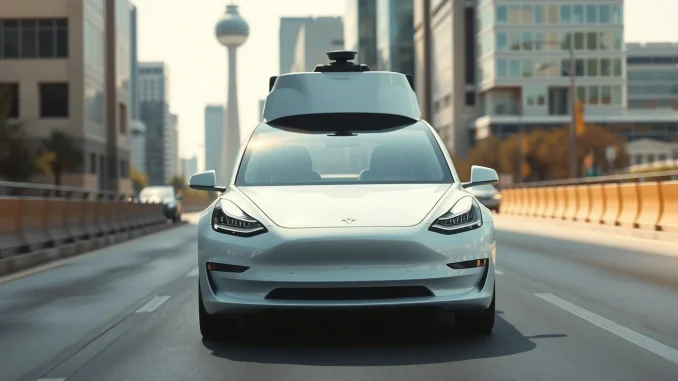
Tesla has launched its fully driverless robotaxi service in two major new markets. The company announced on April 18, 2026, that its autonomous ride-hailing network is now operating in Dallas and Houston, Texas. This expansion doubles Tesla’s operational footprint for its most advanced service, which initially launched in Austin. The move signals a deliberate, if measured, scaling of a technology that promises to reshape urban transportation.
Tesla’s Texas-First Robotaxi Strategy
According to a social media post from Tesla, “Robotaxi is now rolling out in Dallas & Houston.” The accompanying 14-second video showed Tesla vehicles operating without a human safety driver behind the wheel. This development follows the service’s debut in Austin in 2025 and the subsequent removal of safety drivers there in January 2026. Texas has become the proving ground for Tesla’s autonomous ambitions. The state’s regulatory environment is generally favorable for testing self-driving vehicles. Industry watchers note that concentrating operations in one state simplifies logistics and regulatory compliance during this early phase.
Also read: Claude is quietly winning over paying AI consumers, data shows, even as ChatGPT still dominates
Data from the crowdsourced Robotaxi Tracker website, however, suggests the rollout is starting small. As of April 19, 2026, the site logged only one active vehicle in Dallas and one in Houston. This compares to 46 vehicles tracked in Austin. The low initial fleet size indicates a cautious, incremental approach. Tesla is likely prioritizing system validation and data collection in new, complex urban environments over immediate mass availability.
Safety Record and Operational Context
The expansion comes with Tesla’s autonomous technology under close scrutiny. In a February 2026 filing with regulatory authorities, Tesla reported that its Austin robotaxis had been involved in 14 crashes since the service’s launch. The company did not specify fault in those incidents. This data point is critical for public and regulatory acceptance. For context, the National Highway Traffic Safety Administration (NHTSA) requires all manufacturers of automated driving systems to report crashes. Tesla’s disclosure is part of that mandate.
Also read: Databricks' former AI chief claims his new chip can cut AI's energy bill by 1,000x
Beyond its driverless Texas operations, Tesla runs a more limited ride service with human drivers in the San Francisco Bay Area. This two-pronged strategy allows the company to gather ride-hailing operational experience in California while pushing the technological envelope in Texas. The implication is clear: Tesla is building a commercial ride-hailing business while simultaneously refining its Full Self-Driving (FSD) software to the point where human oversight is unnecessary.
The Competitive and Regulatory Market
Tesla is not alone in the autonomous ride-hail space. Companies like Waymo and Cruise have been operating commercial services in other cities for years. Waymo offers fully driverless rides in Phoenix and San Francisco, and is expanding to Los Angeles and Austin. Cruise, a GM subsidiary, had operations in San Francisco before a major incident led to a suspension of its driverless permits nationwide in late 2023. It is working to resume services. Tesla’s entry is notable for its use of a consumer vehicle platform not originally designed as a dedicated robotaxi.
The regulatory path forward remains complex. Each city and state can set its own rules for autonomous vehicle deployment. Texas does not have a state-level permit process for testing or deployment, which has attracted many companies. However, local authorities in Dallas and Houston will be monitoring Tesla’s operations closely, especially in light of the crash data from Austin. Public perception will be a significant factor. A series of minor fender-benders or a single major incident could slow or halt expansion plans.
Technology and Business Model Implications
Tesla’s robotaxi service is the ultimate expression of its FSD software suite. The company has long argued that its vision-based approach, without reliance on lidar or high-definition maps, is the most scalable path to autonomy. Deploying in Dallas and Houston, with their distinct weather patterns, traffic densities, and road layouts, provides a massive new stream of real-world data. This data is fuel for Tesla’s neural networks. Every intervention-free mile in a new city strengthens the AI’s capabilities.
From a business perspective, the robotaxi network is central to Tesla’s long-term valuation thesis. CEO Elon Musk has repeatedly framed autonomous cars as assets that can generate income for their owners when not in personal use. The launch in two major metropolitan areas is a tangible step toward that vision. What this means for investors is a shift from evaluating Tesla solely as a car manufacturer to assessing it as a combined hardware, software, and services company. The revenue potential per vehicle over its lifetime could increase dramatically if the robotaxi model proves successful.
Challenges and Next Steps
Scaling the service presents immense challenges. Beyond the core technology, Tesla must manage vehicle maintenance, cleaning, charging infrastructure, and customer support in dispersed urban areas. The company has not detailed its operational plan for these new markets. Will it use company-owned fleets initially, or will it allow consumer-owned Teslas with FSD to join the network? The latter model, often discussed by Musk, would represent a radical departure from the centralized fleets operated by competitors.
Furthermore, economic viability is unproven. The cost of the sensor suite, computing hardware, and insurance for a fully driverless vehicle is high. Tesla must price rides competitively with Uber and Lyft while covering these costs and generating a profit. The current limited fleet size in Dallas and Houston suggests Tesla is still in a heavy investment phase, focused on learning rather than immediate profitability.
Conclusion
Tesla’s robotaxi expansion into Dallas and Houston marks a decisive moment in the company’s autonomous driving project. It moves the technology from a single-city experiment into a multi-market service, testing its robustness across different urban environments. The cautious scale of the initial rollout, coupled with the disclosed safety record from Austin, shows a company aware of the technical and public relations hurdles ahead. Success in these new Texas cities could set the stage for a national, and eventually global, driverless ride-hailing network. Failure or significant safety issues could see the ambitious timeline for autonomy extended once again. For now, all eyes are on Texas.
FAQs
Q1: How do I hail a Tesla robotaxi in Dallas or Houston?
As of April 2026, Tesla has not publicly released a dedicated consumer app for its robotaxi service in the new cities. The service appears to be in a limited early-access or testing phase. Rides are likely invitation-only or available to a small group of users as the company gathers data.
Q2: Is the Tesla robotaxi service completely driverless?
Yes, in Dallas, Houston, and Austin, Tesla is operating vehicles without a human safety driver in the front seat. This is considered a “Level 4” autonomous service, where the car handles all driving tasks within its designated operational area.
Q3: How does Tesla’s robotaxi safety record compare to human drivers?
Direct comparison is difficult due to low mileage and limited public data. Tesla’s report of 14 crashes in Austin since launch provides a baseline, but without details on miles driven, severity, or fault, a rigorous safety rate cannot be calculated. Regulators and independent researchers will require significantly more data to make a definitive comparison.
Q4: What car models does Tesla use for its robotaxi service?
Tesla has not specified, but it is widely assumed to be using later-model vehicles equipped with the Hardware 4 (HW4) sensor and computer suite. This likely includes the Model 3 and Model Y, which form the bulk of Tesla’s recent sales and are equipped with the cameras and processing power needed for full self-driving.
Q5: When will Tesla’s robotaxi service come to other states?
Tesla has not announced a timeline. Expansion beyond Texas will depend on the success of operations in Dallas and Houston, regulatory approval from other states and cities, and further validation of the FSD software. A nationwide rollout is likely years away, not months.



Be the first to comment