
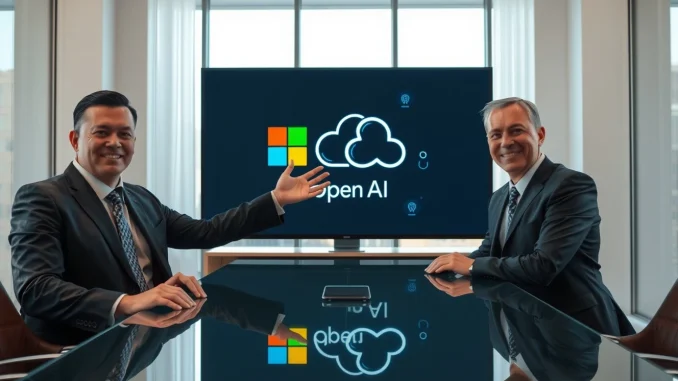
On Monday, Microsoft and OpenAI announced a significant renegotiation of their landmark partnership, a move that resolves a looming legal conflict tied to OpenAI’s up-to-$50 billion investment deal with Amazon. While some on social media framed the new terms as a win for the ChatGPT maker, the agreement is structured to benefit both companies, analysts say. The most critical outcome: the elimination of a legal threat that had hung over OpenAI since it signed its massive cloud and technology deal with Amazon in February.
What Changed in the Microsoft-OpenAI Deal
The core of the new agreement replaces Microsoft’s previous exclusive access to all of OpenAI’s intellectual property and products—a right that lasted until OpenAI achieved artificial general intelligence (AGI)—with a definitive timeline. Microsoft now holds a non-exclusive license to OpenAI’s models and products through 2032. This change directly addresses the legal ambiguity that arose when OpenAI agreed to develop exclusive technology for Amazon Web Services (AWS).
Also read: Asian AI Startups Rush to Fill Void Left by US Export Ban on Anthropic’s Mythos
Under the previous terms, Microsoft had exclusive rights to any OpenAI product accessed via an API, including the agent-building tool Frontier. When OpenAI announced in February that AWS would have exclusive rights to host Frontier and co-develop a stateful runtime technology—essential for AI agents that remember tasks over long periods—Microsoft publicly refuted those terms. The Financial Times later reported that Microsoft was considering legal action to enforce its contract.
The new deal removes Microsoft’s exclusive rights, effectively ending that legal peril. Amazon CEO Andy Jassy celebrated the development on X, confirming that OpenAI’s models will soon be available directly to customers on AWS Bedrock.
Also read: As Government Scrutiny Intensifies, AI Labs Face a Shared Regulatory Bind
Winners on Both Sides
For OpenAI, the renegotiation provides the freedom to serve its products across any cloud provider, a critical capability as it builds its own data centers with multiple partners. The company will continue to rely on Azure as its primary cloud partner for the next six years, and it has committed to purchasing an additional $250 billion in Microsoft cloud services. However, the exclusivity clause that previously locked OpenAI’s API-accessible products to Azure is gone.
Microsoft also secured meaningful concessions. The new agreement allows Microsoft to stop paying a revenue share to OpenAI, while OpenAI will continue to pay a revenue share to Microsoft through 2030, subject to a cap. Microsoft remains a major shareholder, owning approximately 27 percent of OpenAI’s for-profit entity, meaning it still benefits financially from OpenAI’s growth—even sales made on AWS.
Why This Matters for Enterprises
The biggest beneficiaries of this restructuring are enterprise customers. With OpenAI’s models now available across multiple cloud platforms—including AWS—businesses can choose the infrastructure that best suits their needs. This competitive dynamic is already playing out: Microsoft has deepened its relationship with OpenAI rival Anthropic, using its Claude AI to power agentic products on Azure. Enterprises gain flexibility, while the tech giants compete to serve them.
A Timeline of Key Developments
- October 2025: Microsoft and OpenAI announce a new agreement to address corporate structure issues raised by Elon Musk’s lawsuit, allowing OpenAI to run non-API products on other clouds.
- November 2025: OpenAI and Amazon sign a multi-year cloud contract worth $38 billion.
- February 2026: Amazon announces an up-to-$50 billion investment in OpenAI, contingent on exclusive technology development and hosting for Frontier and stateful runtime.
- February 2026: Microsoft publicly refutes AWS exclusivity claims, asserting its own exclusive license remains in effect.
- March 2026: The Financial Times reports Microsoft is considering legal action.
- April 2026: Microsoft and OpenAI announce a new deal with a calendar end date for exclusivity, ending the legal threat.
Conclusion
The renegotiated Microsoft-OpenAI partnership resolves a high-stakes legal dispute while preserving the financial and strategic interests of both companies. By replacing an indefinite exclusivity clause with a fixed timeline and allowing OpenAI to operate across multiple clouds, the deal reflects the evolving reality of the AI industry—where flexibility and multi-cloud strategies are becoming essential. For enterprises, the outcome means more choice, more competition, and ultimately, more control over how they deploy AI.
FAQs
Q1: Does Microsoft still have exclusive access to OpenAI’s technology?
No. The new agreement grants Microsoft a non-exclusive license through 2032, replacing the previous indefinite exclusivity that lasted until OpenAI achieved AGI.
Q2: Can OpenAI now sell its products on Amazon Web Services?
Yes. The new terms explicitly allow OpenAI to serve all its products to customers across any cloud provider, including AWS.
Q3: Is Microsoft still an investor in OpenAI?
Yes. Microsoft remains a major shareholder, owning about 27 percent of OpenAI’s for-profit entity, and will continue to receive a revenue share from OpenAI through 2030.


Be the first to comment