
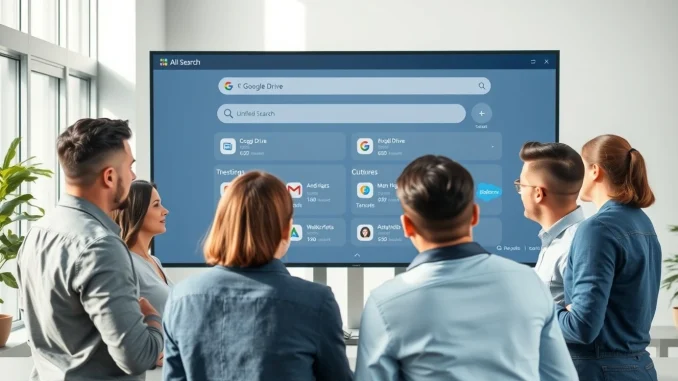
AI meeting notetaker Otter is launching a new enterprise search feature that allows users to query data across Gmail, Google Drive, Notion, Jira, and Salesforce directly from its platform. The move signals a broader shift in the AI meeting notes space, as companies like Otter, Read AI, Fireflies.ai, and Fathom race to evolve from simple transcription tools into comprehensive workplace productivity hubs.
From meeting notes to workplace search
Otter’s latest feature positions the company as a Model Context Protocol (MCP) client, meaning it can connect to and pull data from external apps using a standardized interface that AI tools are rapidly adopting. Users can now search across their meeting transcripts, emails, documents, project management tasks, and CRM data in one place, rather than jumping between applications.
Also read: Claude is quietly winning over paying AI consumers, data shows, even as ChatGPT still dominates
The company has also redesigned its AI assistant to be persistently available across the entire interface, understanding the context of whatever screen the user is viewing — whether it’s a specific meeting recap or a team channel. The assistant can answer questions and, in some cases, take actions like pushing meeting summaries to Notion or drafting a Gmail message.
Otter said it will soon add support for Microsoft Outlook, Teams, SharePoint, and Slack, broadening its reach into enterprises that rely on the Microsoft ecosystem.
Also read: Databricks' former AI chief claims his new chip can cut AI's energy bill by 1,000x
Botless meeting capture arrives on Windows
Alongside the search launch, Otter is introducing a Windows app that supports botless meeting capture — recording meetings using a device’s system audio rather than having a bot join the call. The feature, which was previously available only on Mac, aligns with a growing industry trend led by notetakers like Granola.
Otter CEO Sam Liang told TechCrunch that enterprise customers largely prefer having a bot join meetings for transparency. “When we talk to enterprise customers, most of them actually prefer the note taker that joins the Zoom meeting because it provides the transparency,” Liang said. He added that enterprise clients also prefer meeting notes to be shared with all attendees, rather than being limited to one person.
To address the potential problem of multiple bots joining the same call, Otter has implemented a deduplication feature that prevents a swarm of bots from entering a meeting simultaneously.
Why this matters for the AI productivity market
The expansion into enterprise search reflects a fundamental realization among AI notetakers: transcribing meetings and generating summaries alone does not justify their business models or valuations. By becoming a centralized search layer across workplace tools, these platforms aim to become indispensable for knowledge workers who spend significant time searching for information scattered across multiple apps.
Otter reported last year that it had 25 million users and $100 million in annual recurring revenue. The company now says it has grown to 35 million users, though it did not provide updated financial figures.
Conclusion
Otter’s enterprise search launch marks a significant step in the evolution of AI meeting notetakers from niche transcription tools into broader workplace productivity platforms. By connecting to widely used enterprise tools and enabling cross-app search, Otter is betting that users will increasingly rely on a single AI assistant to manage their fragmented digital workspace. The move also intensifies competition with other notetakers that are pursuing similar strategies, setting the stage for a consolidation phase in the AI productivity market.
FAQs
Q1: What is Otter’s new enterprise search feature?
It allows users to search across Gmail, Google Drive, Notion, Jira, and Salesforce data alongside their meeting transcripts, all from within Otter’s interface. The feature uses the Model Context Protocol (MCP) to connect to external apps.
Q2: How does Otter’s botless meeting capture work?
Botless capture records meetings using the device’s system audio instead of having a separate bot join the call. Otter first introduced this on Mac and is now launching it on Windows.
Q3: Which apps will Otter support next for enterprise search?
Otter plans to add Microsoft Outlook, Teams, SharePoint, and Slack connections soon, expanding beyond its initial integrations with Google and other tools.





Be the first to comment