
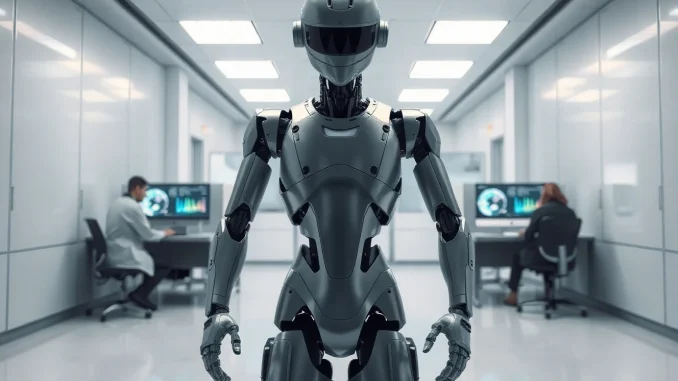
Meta has acquired Assured Robot Intelligence (ARI), a humanoid robotics startup, for an undisclosed sum. The deal signals the social media company’s push into physical world AI.
Meta acquisition of humanoid robotics startup expands AI research
A Meta spokesperson confirmed the deal to TechCrunch via email. “We acquired Assured Robot Intelligence, a company at the frontier of robotic intelligence designed to enable robots to understand, predict, and adapt to human behaviors in complex and dynamic environments,” the spokesperson said.
Also read: OpenAI Limits GPT-5.6 Rollout After U.S. Government Request, Calls Restrictions a 'Short-Term Step'
ARI’s team, including its co-founders, will join Meta’s AI unit. That unit operates under the Superintelligence Labs research division. The startup had raised an undisclosed seed round from AI seed firm Aix Ventures.
ARI built foundation models for humanoid robots. Those models were designed to perform physical labor, including household chores. The company’s technology focuses on enabling robots to learn from and adapt to human actions.
Also read: OpenAI, Google, and SpaceX are all building their own AI chips — here's why that matters
Humanoid robotics talent joins Meta’s AI unit
Co-founder Xiaolong Wang previously worked as a researcher at Nvidia. He also served as an associate professor at UC San Diego. Wang has received multiple prestigious awards for his work in robotics and AI.
Co-founder Lerrel Pinto taught at NYU before co-founding Fauna Robotics. Fauna Robotics specialized in kid-size humanoid robots. Amazon acquired Fauna Robotics in April 2026. Pinto also holds several prestigious awards.
The ARI team will help Meta with its humanoid ambitions. “This team, led by Lerrel Pinto and Xiaolong Wang, will bring a deep expertise in how we can design our models and frontier capabilities for robot control and self-learning to whole-body humanoid control,” the spokesperson added.
Meta’s long-term humanoid robotics plans
Meta researchers have worked on humanoid robotics technology for years. A leaked memo from 2025 discussed Meta’s ambitions to build a humanoid robot. That robot would include AI models and hardware aimed at consumers.
Industry watchers note that Meta’s strategy extends beyond consumer products. Even if Meta never releases a consumer humanoid product, many AI experts believe the path to artificial general intelligence (AGI) requires training AI models in the physical world. Robots learn through direct interaction rather than data alone in that environment.
AGI represents the theoretical point at which AI reaches or surpasses human-level intelligence across all domains. This acquisition suggests Meta sees physical world AI training as essential to achieving that goal.
Broader industry race for humanoid robotics
The ARI and Fauna Robotics deals reflect a broader industry sprint. Forecasts vary widely. Goldman Sachs projects the humanoid robotics market at $38 billion by 2035. Morgan Stanley estimates $5 trillion by 2050.
That spread reflects both enormous potential and uncertainty. The technology is still finding its footing. Companies like Tesla, Boston Dynamics, and Figure AI also compete in this space.
Meta’s move positions it alongside these players. The company brings deep pockets and extensive AI research capabilities. It also has a massive user base that could eventually interact with humanoid robots.
Key players in humanoid robotics
- Tesla – Developing Optimus humanoid robot for factory and domestic use
- Boston Dynamics – Atlas humanoid robot showcases advanced mobility and manipulation
- Figure AI – Raised significant funding for general-purpose humanoid robots
- Amazon – Acquired Fauna Robotics, focused on kid-size humanoids
- Meta – Acquired ARI, building foundation models for physical labor
What this means for Meta’s AI strategy
Meta’s AI ambitions have grown significantly. The company operates Superintelligence Labs, its advanced AI research division. That division now includes ARI’s team.
The implication is that Meta sees physical world AI as a key component of its long-term strategy. Training AI models in the physical world could unlock capabilities that pure data training cannot provide.
This could signal a shift in how major tech companies approach AI development. Rather than focusing solely on language models and digital applications, they may increasingly invest in robotics and physical world AI.
What this means for investors is that Meta is betting big on AI’s next frontier. The company is willing to acquire specialized startups to accelerate its progress.
Conclusion
Meta’s acquisition of Assured Robot Intelligence marks a significant step in its humanoid robotics ambitions. The deal brings top AI talent into Meta’s research division. It also signals Meta’s belief that physical world AI training is essential for achieving AGI. The broader industry race for humanoid robotics continues to accelerate, with major tech companies investing heavily in this emerging technology.
FAQs
Q1: What did Meta acquire in this deal?
A1: Meta acquired Assured Robot Intelligence (ARI), a humanoid robotics startup that builds foundation models for robots to perform physical labor.
Q2: How much did Meta pay for ARI?
A2: The acquisition price was not disclosed. ARI had previously raised an undisclosed seed round from Aix Ventures.
Q3: Who are the co-founders of ARI?
A3: The co-founders are Xiaolong Wang, a former Nvidia researcher and UC San Diego professor, and Lerrel Pinto, a former NYU professor who also co-founded Fauna Robotics.
Q4: Why is Meta interested in humanoid robotics?
A4: Meta believes training AI models in the physical world through robots is essential for achieving artificial general intelligence (AGI). The company also sees potential consumer applications for humanoid robots.
Q5: How does this deal compare to other humanoid robotics acquisitions?
A5: Amazon acquired Fauna Robotics in April 2026. Tesla, Boston Dynamics, and Figure AI are also major players. The market is projected to grow significantly, with estimates ranging from $38 billion by 2035 to $5 trillion by 2050.






Be the first to comment