
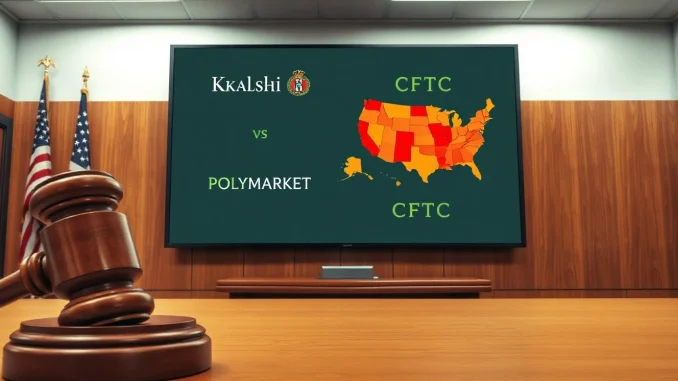
A16z has thrown its weight behind the Commodity Futures Trading Commission (CFTC) in a growing federal-state standoff over prediction markets. The venture capital firm opposes state regulators that try to shut down platforms like Kalshi and Polymarket. This legal battle could reshape how event contracts are regulated across the United States.
A16z prediction markets support for CFTC
The venture capital heavyweight submitted a letter on May 1, 2026, in response to the CFTC’s advance notice of proposed rulemaking on prediction markets. It argues that state-level crackdowns create barriers that undermine the federal agency’s mandate to provide impartial access to its markets and services. According to A16z, forcing exchanges to block users based on their state of residence directly conflicts with CFTC rules.
Also read: Botanix shutdown: Does Bitcoin DeFi have a demand problem?
Data from the CFTC shows that recent weeks have seen lawsuits filed against Illinois, Arizona, Connecticut, New York, and Wisconsin. The agency claims those states overstepped by trying to regulate markets that fall under federal jurisdiction. A16z backed that position in its filing.
Industry watchers note that this case could set a precedent for how digital asset markets interact with state and federal laws. The implication is clear: without clear federal authority, prediction market operators face a patchwork of conflicting rules.
Also read: Bitcoin Options Traders Hedge Downside as Uncertainty Lingers, Anchorage Digital Reports
CFTC prediction markets authority under fire
State attorneys general have countered that platforms offering contracts on sports outcomes and political events are running unlicensed gambling operations. A16z pushed back on that framing. The firm argued that the CFTC, not state legislatures, holds the authority to define what constitutes gaming under federal commodities law. This authority stems from decades of oversight over event contracts.
But the states are not backing down. Arizona’s attorney general said in a statement that protecting consumers from unregulated gambling is a state priority. New York regulators have issued cease-and-desist letters to multiple platforms.
What this means for investors is uncertainty. Prediction market operators like Kalshi and Polymarket now face legal risks in several jurisdictions. The CFTC’s lawsuits seek to assert federal primacy, but the outcome remains uncertain.
Event contract regulation and the law
Under the Commodity Exchange Act, the CFTC has authority over event contracts that involve commodities or futures. But state gambling laws have traditionally covered sports betting and political wagering. This creates a legal gray area.
A16z argued that the CFTC’s impartial access rules require exchanges to treat all users equally. Being forced to deny access to users in states that seek to license or prohibit certain event contracts will likely severely circumscribe available liquidity, the firm wrote. This could harm market efficiency and price discovery.
Prediction market ban states face legal challenge
The states targeted by the CFTC include Illinois, Arizona, Connecticut, New York, and Wisconsin. Each has taken action against prediction platforms. Illinois regulators issued a cease-and-desist order against Kalshi in March 2026. Arizona filed criminal charges against Polymarket executives in April.
These actions have created a compliance nightmare for platforms. They must either block users from those states or risk legal penalties. But blocking users reduces liquidity and undermines the market’s value.
Data from Token Terminal shows that monthly trading volume on Kalshi and Polymarket reached $25.7 billion in March 2026. More than 80% of users are classified as retail, trading less than $10,000 each. This suggests that ordinary people, not just institutions, use these platforms.
Kalshi Polymarket ban and retail impact
Retail traders are the backbone of prediction markets. They provide liquidity and help surface crowd intelligence. If state bans force platforms to block users, retail participation could drop sharply. This would reduce the accuracy of market prices.
Polymarket is in talks with the CFTC to lift the ban that has kept American users off its main platform since a 2022 settlement. In that settlement, the company paid a $1.4 million penalty and agreed to block US customers over unregistered event contracts. A full return would require a formal commission vote.
The process may move faster given that four of the CFTC’s commissioner seats are currently vacant. This could allow the agency to act more quickly on rulemaking. But it also means less oversight and potential for political influence.
Prediction market social value and blockchain
Beyond the jurisdictional fight, A16z also made a case for the social value of prediction markets. The firm described their pricing mechanisms as a distinct form of price discovery that surfaces crowd intelligence on uncertain outcomes. This can provide valuable information on elections, sports, and economic events.
The firm also showed support for blockchain-based platforms. It claimed that the onchain auditability of transactions makes regulatory oversight more effective. Every trade is recorded on a public ledger, making it easy for regulators to monitor activity.
But critics argue that blockchain platforms can also be used for illegal activities. Anonymity features make it harder to track users. Regulators have raised concerns about money laundering and terrorist financing.
Prediction market regulation and future outlook
The outcome of this legal battle will shape the future of prediction markets in the US. If the CFTC wins, federal law will likely preempt state bans. This would create a uniform regulatory framework. If states win, platforms may have to comply with 50 different sets of rules.
Industry experts suggest that a Supreme Court case is likely. The issue touches on federalism and the balance of power between states and the federal government. A decision could take years.
In the meantime, platforms are adapting. Some are geoblocking users from restrictive states. Others are lobbying for federal legislation that would clarify the rules. The clock is ticking.
Conclusion
The A16z prediction markets support for the CFTC marks a significant development in the ongoing battle over event contract regulation. The venture capital firm’s arguments highlight the tension between federal authority and state gambling laws. As monthly trading volumes reach billions of dollars, the stakes are high. Retail users, platform operators, and regulators all await the outcome. This case could determine whether prediction markets thrive or wither under a patchwork of state bans.
FAQs
Q1: Why is A16z supporting the CFTC in this case?
A16z argues that state crackdowns on prediction markets conflict with federal law and harm market access for ordinary users. The firm wants a clear federal framework to avoid a patchwork of state rules.
Q2: Which states are trying to ban prediction markets?
The CFTC has filed lawsuits against Illinois, Arizona, Connecticut, New York, and Wisconsin. These states have issued cease-and-desist orders or filed criminal charges against platforms like Kalshi and Polymarket.
Q3: What is the CFTC’s authority over prediction markets?
The CFTC regulates event contracts under the Commodity Exchange Act. It argues that federal law preempts state gambling laws when it comes to these financial instruments.
Q4: How do prediction markets work?
Users buy and sell contracts that pay out based on the outcome of future events, like elections or sports games. Prices reflect the crowd’s estimate of probability.
Q5: What happens if the states win this legal battle?
Platforms may have to comply with different rules in each state, increasing costs and reducing liquidity. Some platforms might exit the US market entirely.
Q6: Is Polymarket allowed to operate in the US now?
No. Polymarket settled with the CFTC in 2022 and agreed to block US customers. It is now in talks to lift that ban, but a formal commission vote is required.





Be the first to comment