
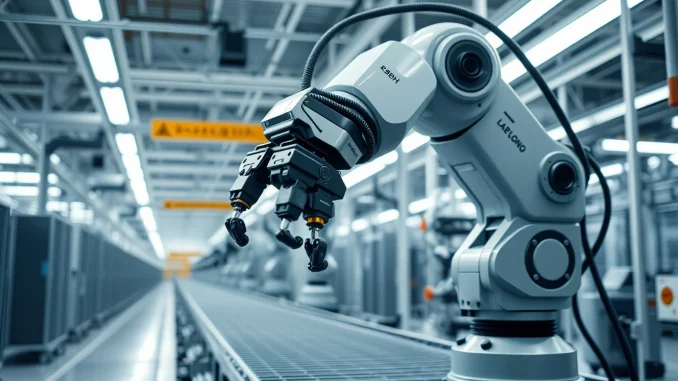
TOKYO, April 5, 2026 – In a Japanese automotive parts factory, a robotic arm fitted with advanced vision sensors sorts components with precision. No human is performing this repetitive, physically demanding task. This scene is becoming standard across Japan, not as a replacement for workers, but as a solution for positions that remain persistently empty. Driven by a demographic crisis, Japan is betting its industrial future on physical AI—robots powered by artificial intelligence that interact with the physical world. The country’s approach is distinct, born not from speculative ambition but from urgent necessity.
A Demographic Imperative Drives Adoption
Japan’s workforce is shrinking fast. Data from the Japanese government shows the population declined for the 14th consecutive year in 2024. The working-age cohort now constitutes just 59.6% of the total. Industry analysts project this segment will contract by nearly 15 million people over the next two decades. This isn’t a future problem. It’s reshaping operations today. A 2024 survey by Reuters and the Nikkei found labor shortages are the primary factor pushing Japanese firms to adopt AI and automation.
Also read: OpenAI Limits GPT-5.6 Rollout After U.S. Government Request, Calls Restrictions a 'Short-Term Step'
“The driver has shifted from simple efficiency to industrial survival,” said Sho Yamanaka, a principal with Salesforce Ventures, in an interview. “Japan faces a physical supply constraint where essential services cannot be sustained due to a lack of labor.”
This suggests a fundamental change in motivation. According to Ro Gupta, managing director at Woven Capital, physical AI is now purchased as a “continuity tool.” The core question for companies is how to maintain factory output, warehouse logistics, and infrastructure operations with fewer available people. Hogil Doh, a general partner at Global Brain, confirms this view. “From what I’m seeing, labor shortages are the primary driver,” Doh stated.
Also read: OpenAI, Google, and SpaceX are all building their own AI chips — here's why that matters
Japan’s Strategic Push and Market Ambition
In March 2026, Japan’s Ministry of Economy, Trade and Industry (METI) outlined a clear national strategy. It aims to cultivate a domestic physical AI sector and capture a 30% share of the global market by 2040. This goal builds on an existing strength. Japanese manufacturers commanded about 70% of the global industrial robotics market in 2022, METI reported. The government is backing its ambition with capital. Under Prime Minister Sanae Takaichi, Japan has committed approximately $6.3 billion to strengthen core AI capabilities, advance robotics integration, and support industrial deployment.
The shift from pilot projects to real-world deployment is accelerating. Industrial automation, especially in automotive manufacturing, remains the most advanced area, with tens of thousands of new robots installed annually. But applications are broadening. In logistics, companies deploy automated forklifts and warehouse systems. For facilities management, inspection robots monitor data centers and industrial sites.
“The signal is simple – customer-paid deployments rather than vendor-funded trials, reliable operation across full shifts, and measurable performance metrics,” Doh explained, highlighting the move beyond experimentation.
Hardware Excellence Meets Software Challenge
Japan’s historical advantage lies in the physical components of robotics: high-precision actuators, sensors, and control systems. “Japan’s expertise in high-precision components – the critical physical interface between AI and the real world – is a strategic moat,” Yamanaka noted. Controlling these components offers a significant edge in global supply chains.
But a key question remains. Can this hardware dominance translate into leadership in the AI era? Industry observers note that U.S. and Chinese firms are moving faster to develop full-stack systems that integrate hardware, software, and data. Issei Takino, CEO and co-founder of Japanese robotics software firm Mujin, pointed out a critical difference. “In robotics, and especially in Physical AI, it is critical to have a deep understanding of the physical characteristics of hardware,” Takino said. “This requires not only software capabilities, but also highly specialized control technologies.”
Mujin’s approach focuses on software control platforms that make existing industrial hardware more autonomous. This model leverages Japan’s hardware strength while addressing the software challenge. Other companies are taking a full-stack approach. WHILL, a startup making autonomous personal mobility vehicles, develops an integrated platform combining vehicles, sensors, navigation, and cloud management. CEO Satoshi Sugie said the company leverages Japan for hardware refinement and the U.S. for software development and commercial testing.
A Hybrid Ecosystem Emerges
Japan’s physical AI development is not following a Silicon Valley-style, winner-take-all model. Instead, a hybrid ecosystem is forming. Large established corporations like Toyota, Mitsubishi Electric, and Honda provide manufacturing scale, deep customer relationships, and deployment muscle. Startups, meanwhile, drive innovation in specific software niches, perception systems, and workflow automation.
“The relationship between startups and established corporations is a mutually complementary ecosystem,” Yamanaka said. He emphasized that robotics demands heavy hardware development, operational know-how, and major capital expenditure. Fusing corporate assets with startup innovation strengthens Japan’s collective competitiveness.
This collaborative model is evident in defense and infrastructure. Toru Tokushige, CEO of Terra Drone, said Japan’s defense ecosystem is shifting from large-corporation dominance toward more startup collaboration. Large firms focus on platforms and integration, while startups develop smaller systems and software with greater speed.
Where Value and Competition Will Concentrate
As the technology matures, investors and executives see value accruing to those who solve integration and operational challenges. “The most defensible value will sit with whoever owns deployment, integration, and continuous improvement,” Doh stated. Investment is consequently flowing beyond pure hardware. More capital is allocated to orchestration software, digital twins, simulation tools, and integration platforms.
The competition is global. Analysis suggests hardware capabilities are strongest in China and Japan, with Japan particularly advanced in robot motion control. The United States currently leads in service-layer development and market creation. Historically, U.S. tech firms have excelled by building integrated businesses—strong software platforms paired with hardware sourced from Asia. Takino of Mujin questioned whether this model fully applies to physical AI, where deep hardware understanding is non-negotiable.
Conclusion
Japan’s push into physical AI is a direct response to a demographic reality. The narrative is not about machines taking jobs, but about machines filling gaps that threaten economic stability. With a strong hardware foundation, significant government investment, and an evolving hybrid corporate ecosystem, Japan is positioning itself as a central player in the next phase of industrial automation. The success of its strategy hinges on bridging its hardware mastery with advanced software and system integration. For Japan, physical AI is less a competitive luxury and more an essential tool for national continuity.
FAQs
Q1: What is “physical AI”?
Physical AI refers to artificial intelligence systems that are embodied in robots or other machines capable of interacting with and manipulating the physical world. It combines AI software for perception and decision-making with hardware for movement and action.
Q2: Why is Japan so focused on this technology?
Japan faces a severe and accelerating labor shortage due to a rapidly aging and declining population. Physical AI is seen as a critical tool to maintain industrial output, logistics, and essential services as the workforce shrinks.
Q3: How does Japan’s approach differ from the U.S. or China?
Japan’s approach is driven more by demographic necessity than market speculation. It builds on decades of dominance in precision hardware components. The U.S. often leads in software and service layers, while China demonstrates strength in rapid hardware manufacturing and full-stack system development.
Q4: What industries in Japan are adopting physical AI first?
Industrial manufacturing, particularly automotive, is the most advanced. Adoption is quickly expanding into logistics and warehousing, facilities management and inspection, and short-distance autonomous transport.
Q5: What is the Japanese government’s goal for this sector?
According to a March 2026 announcement, Japan’s Ministry of Economy, Trade and Industry aims to build a domestic physical AI sector and capture 30% of the global market by 2040, backed by billions of dollars in funding.






Be the first to comment