
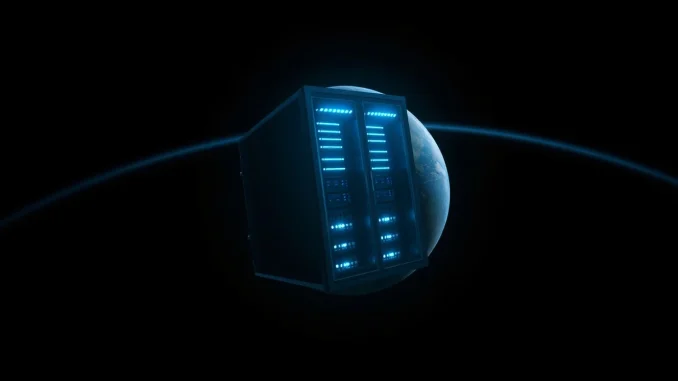
SpaceX is reportedly aiming for a valuation of $1.75 trillion. This staggering figure, tied to confidential IPO paperwork, places immense pressure on the company’s future revenue streams. While its Starlink satellite internet service is a proven business, CEO Elon Musk is pointing investors toward a more audacious frontier: orbital data centers. The question for potential shareholders is whether this vision is a viable growth engine or speculative fiction designed to support an exceptional valuation.
The $1.75 Trillion Question
According to reports, SpaceX has filed paperwork for an offering that could raise $75 billion. A $1.75 trillion valuation would instantly make it one of the world’s most valuable companies. For context, that figure surpasses the combined market capitalization of several legacy aerospace giants. This valuation isn’t based on current profits alone. It’s a bet on future dominance in space-based infrastructure. Industry watchers note that Musk has successfully used grand visions to attract capital before. Tesla’s market value long outpaced its automotive output, fueled by promises of autonomy and energy ecosystems. SpaceX now appears to be following a similar playbook, but on a cosmic scale. The implication is clear: Earth-bound revenue from launches and Starlink may not be enough. Investors are being asked to buy into the next phase before it’s built.
Also read: OpenAI Limits GPT-5.6 Rollout After U.S. Government Request, Calls Restrictions a 'Short-Term Step'
The Orbital Data Center Vision
Musk has identified orbital data centers as a core part of SpaceX’s future. The concept involves deploying computing infrastructure on satellites in low Earth orbit. This isn’t a solitary endeavor. A startup formerly called Starcloud, which recently raised $170 million and achieved unicorn status, is pursuing a similar goal. Jeff Bezos’s Blue Origin and Amazon’s Project Kuiper are also in the race. This suggests a growing belief among space industry leaders that computing will eventually migrate off-planet. The engineering challenges are profound. Tim Fernholz, reporting for TechCrunch, has detailed the physics constraints, including heat dissipation in a vacuum, power supply, radiation hardening, and the need for ultra-reliable autonomous operation. Sean O’Kane of TechCrunch noted on the Equity podcast that the trend has formed rapidly. “It feels like it wasn’t happening a year ago,” he said.
The Terrestrial Pushback
One driver for this space-based thinking is growing resistance on Earth. “There’s a lot of opposition happening around the country to data centers in general,” O’Kane observed. These facilities face local pushback over their massive energy consumption, water use for cooling, and land footprint. For executives like Musk and Bezos, the calculus may be shifting. As O’Kane put it, “The engineering challenge may be less than the social challenge back here.” Building in space sidesteps local zoning boards and environmental regulations. It also creates a powerful narrative. Kirsten Korosec, also on the Equity podcast, highlighted the strategic angle. A company going public while working on space data centers “signals the future,” she said. This generates excitement and allows markets to focus on potential rather than immediate constraints.
Also read: OpenAI, Google, and SpaceX are all building their own AI chips — here's why that matters
SpaceX’s Unique Advantage
Analysts point to a critical factor that separates SpaceX from other contenders: vertical integration. SpaceX is primarily a launch company. Data from its manifests shows it dominates global launch capacity. Every satellite destined for an orbital data center, whether built by SpaceX or a competitor, could represent a launch contract. “They are the vehicle that gets the data centers to space,” O’Kane noted. “They get to book that as revenue for SpaceX.” This creates a circular business model. Promoting the orbital data center concept drives demand for launch services, which improves SpaceX’s financials as a public company. What this means for investors is a company with two potential revenue streams from the same megatrend: building the infrastructure and providing the ride to orbit.
Technical and Market Hurdles
The vision faces significant skepticism. The first hurdle is pure compute scale. Anthony Ha, TechCrunch’s weekend editor, questioned the capacity. “It feels like just a drop in the bucket…compared to what they want to build out on Earth,” he said. Current plans for orbital clusters pale in comparison to the millions of square feet of data center space being developed globally. They would likely serve niche applications requiring ultra-low latency for specific global routes or extreme data sovereignty. The second hurdle is economic. The capital expenditure for developing, launching, and maintaining orbital servers would be astronomical. They would need to command premium pricing to justify the cost, a tough proposition if terrestrial AI compute demand fluctuates. Finally, the timeline is long. Major tech development and regulatory approval for such novel infrastructure would take years, if not decades.
The Competition Heats Up
The field is getting crowded. Below is a comparison of key players in the emerging orbital data center sector.
| Company | Primary Vehicle | Key Advantage | Status |
|---|---|---|---|
| SpaceX | Starship / Falcon 9 | Launch provider, Starlink network experience | Concept phase |
| Blue Origin / Amazon | New Glenn, Project Kuiper | AWS cloud integration, significant funding | Early research |
| Starcloud (Startup) | Third-party launch | Focused solely on the concept, recent $170M raise | Active development |
This competition validates the market interest but also ensures SpaceX won’t have the field to itself. Execution risk is high for all involved.
Conclusion
The reported $1.75 trillion valuation for SpaceX is a monumental figure that demands revolutionary growth stories. Orbital data centers represent the most ambitious of those stories. While the concept tackles real problems like terrestrial opposition and offers SpaceX a synergistic revenue loop, the technical and economic barriers remain immense. For investors, the pitch will hinge on faith in Musk’s execution track record and a tolerance for long-term, high-risk bets. The orbital data center vision may not need to be fully realized to support the valuation in the short term. But it must appear credible enough to maintain the narrative momentum that such an extraordinary price tag requires. The coming years will test whether this is the foundation of a new industry or the outer limit of market speculation.
FAQs
Q1: What is an orbital data center?
An orbital data center is a proposed computing facility built on satellites in space. It would house servers and networking equipment to process and store data, operating in the vacuum and microgravity of low Earth orbit.
Q2: Why would anyone put a data center in space?
Proponents cite several potential reasons: to bypass local opposition and regulations on Earth, to reduce latency for specific global communications by using orbital paths, and to serve markets with extreme data sovereignty requirements.
Q3: Is SpaceX the only company working on this?
No. While SpaceX is the most prominent, other entities are involved. These include Jeff Bezos’s Blue Origin, Amazon’s Project Kuiper team, and startups like the recently funded Starcloud.
Q4: What are the biggest technical challenges?
The main hurdles are managing heat dissipation without an atmosphere, providing sufficient and continuous power, protecting hardware from cosmic radiation, and ensuring completely autonomous operation and repair with minimal human intervention.
Q5: Could orbital data centers replace ground-based ones?
Most analysts say no, at least for the foreseeable future. The scale and cost of orbital compute would be prohibitive for most applications. They are viewed as a potential supplement for niche uses, not a replacement for terrestrial cloud infrastructure.





Be the first to comment