
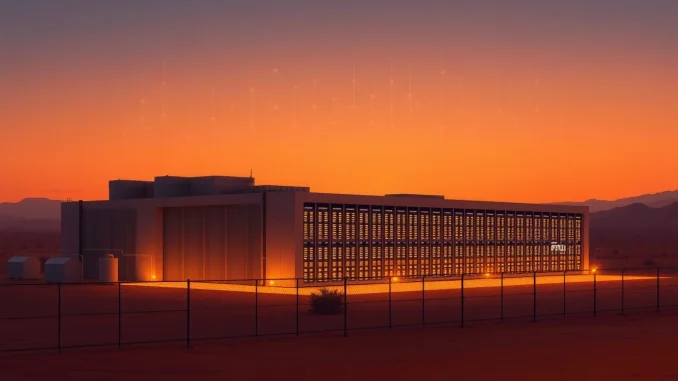
DUBAI, United Arab Emirates — April 7, 2026: A $500 billion artificial intelligence project has become the latest flashpoint in a dangerous confrontation. Iran has explicitly threatened the “Stargate” AI data centers, a joint venture by OpenAI, SoftBank, and Oracle, warning of retaliatory strikes if the United States attacks Iranian civilian infrastructure. This marks a significant escalation where state-of-the-art technology assets are now direct targets in a simmering regional conflict.
Iran’s Explicit Threat to Stargate AI Infrastructure
According to a video released by Iran’s military and widely circulated on Sunday, spokesperson Ebrahim Zolfaghari issued a stark warning. The video graphically illustrated the threat. It showed a globe zooming in on the Stargate data center location in the United Arab Emirates. A message superimposed on the imagery read: “nothing stays hidden to our sight, though hidden by Google.” This suggests Iran claims sophisticated intelligence-gathering capabilities against hardened digital infrastructure.
Also read: OpenAI Limits GPT-5.6 Rollout After U.S. Government Request, Calls Restrictions a 'Short-Term Step'
The threat is not theoretical. Iranian missiles have already struck Amazon Web Services data centers in Bahrain and an Oracle facility in Dubai since hostilities escalated in February. Last week, Iran also named tech giants Nvidia and Apple in its warnings. Industry watchers note this represents a strategic shift. “We are witnessing the weaponization of digital infrastructure,” said a security analyst specializing in cyber-physical threats who requested anonymity due to the sensitivity of the topic. “Data centers are no longer just economic assets; they are now pawns in a geopolitical standoff.”
The Stargate Project’s High-Stakes Gamble
Announced in January 2025, the Stargate initiative is one of the most ambitious private tech ventures in history. OpenAI, SoftBank, and Oracle pledged to build a network of massive AI data centers globally. The project’s reported $500 billion price tag underscores its scale. Its goal is to provide the immense computational power required for next-generation artificial intelligence models.
Also read: OpenAI, Google, and SpaceX are all building their own AI chips — here's why that matters
But Stargate has faced hurdles from the start. Reports from financial analysts in late 2025 indicated funding challenges and complications from international tariffs. The consortium’s plan to expand with new international data centers was a core part of its strategy to distribute risk and computing load. The current geopolitical crisis now presents an existential threat to that very plan. Building in a volatile region offered potential advantages like energy access and geographic positioning. The downside—acute physical security risk—has now been catastrophically realized.
Key Stargate Project Details:
- Lead Partners: OpenAI, SoftBank Group, Oracle Corporation
- Announced: January 2025
- Reported Total Investment: $500 billion
- Primary Goal: Construct a global network of supercomputing data centers for advanced AI training
- Known Challenge: Funding complexities and tariff-related costs
- Current Status: Physical infrastructure under direct military threat
The Strait of Hormuz: Choke Point for Global Trade and Tech
The immediate catalyst for Iran’s threat is a looming U.S. ultimatum. U.S. President Trump has threatened to strike Iranian civilian infrastructure—including power plants and water desalination facilities—if Iran does not reopen the Strait of Hormuz by the end of Tuesday, April 9. This narrow sea passage is a vital artery for global oil shipments. Since Iran effectively choked the strait in February 2026, supply chain traffic has been severely disrupted, contributing to global economic pressure.
Iran’s response, to target U.S.-linked energy and tech infrastructure in the region, is a classic asymmetric retaliation strategy. But the inclusion of specific, high-value tech projects like Stargate is new. Data from maritime tracking services shows a 68% drop in tanker traffic through the strait compared to February 2025. The economic implications are vast. The tech sector’s reliance on stable energy supplies and secure data routing makes it uniquely vulnerable to this kind of geographic conflict.
Analysis: Why Tech Infrastructure is Now a Target
The targeting of data centers represents a calculated escalation. For Iran, these facilities are symbols of U.S. and Western technological dominance and economic influence in the Middle East. They are also tangible, high-value assets whose destruction would cause significant financial and operational damage. Unlike cyberattacks, which can be denied, a kinetic missile strike is a unambiguous act of aggression with immediate physical consequences.
This suggests a broader trend in modern conflict. Critical digital infrastructure is losing its perceived neutrality. What this means for investors is a fundamental reassessment of risk. Building billion-dollar data centers in geopolitically sensitive regions may become untenable. The insurance costs alone for such projects could skyrocket. Furthermore, the resilience of the global AI development pipeline, which depends on concentrated computing hubs, is now in question.
Broader Implications for the Global Tech Industry
The direct threat to Stargate sends a shockwave through the tech sector. Companies like Nvidia, which produces the advanced chips powering AI data centers, and Apple, with its own cloud infrastructure, are also in the crosshairs. The implication is clear: multinational tech firms are now seen as extensions of state power and are vulnerable during international disputes.
This could signal a move towards greater fragmentation of the internet and cloud computing—a “splinternet” driven not just by regulations, but by physical security concerns. Companies may accelerate plans to localize data storage and computing in what they deem to be “safer” territories, potentially leading to a less efficient, more balkanized global tech ecosystem. The cost of AI progress, already immense, would grow even higher.
Historical Context and Escalating Pattern
The conflict has been building for months. The war that began in February 2026 set the stage. The initial strikes on AWS and Oracle facilities demonstrated Iran’s capability and willingness to hit tech targets. Each round of threats and counter-threats has raised the stakes. The U.S. threat against civilian infrastructure crossed a red line, prompting Iran to publicly identify specific retaliation targets like Stargate.
This pattern is dangerous. It creates a ladder of escalation where both sides feel compelled to respond in kind. The involvement of multibillion-dollar private infrastructure, essential for future technologies, adds a complex economic dimension to a military and diplomatic crisis. The world is watching a precedent being set: how nations treat privately-owned, globally-critical tech assets during war.
Conclusion
The threat to the Stargate AI data centers is more than a regional incident. It is a central test case for the security of global technological infrastructure in an age of renewed geopolitical rivalry. The $500 billion venture, central to the ambitions of OpenAI and its partners, finds itself caught in a standoff over the Strait of Hormuz. Iran’s explicit warning underscores a harsh new reality: data centers are strategic targets. The outcome will influence where and how the world builds the foundational computing power for the AI era. The safety of these digital fortresses is no longer just a security concern—it is a pressing international issue with global economic stability hanging in the balance.
FAQs
Q1: What is the Stargate project?
A1: Stargate is a $500 billion joint venture announced in January 2025 by OpenAI, SoftBank, and Oracle. Its goal is to build a global network of advanced data centers specifically designed to train the next generation of artificial intelligence models.
Q2: Why is Iran threatening these data centers?
A2: Iran has issued the threat as a promised retaliation. The country warns it will strike U.S.-linked energy and tech infrastructure in the Middle East if the United States follows through on its own threat to attack Iranian civilian targets like power plants. The Stargate facility was explicitly shown in an Iranian military video.
Q3: Have other tech facilities been attacked already?
A3: Yes. As a result of the ongoing conflict, Iranian missiles have already struck Amazon Web Services (AWS) data centers in Bahrain and an Oracle data center in Dubai prior to this latest threat against Stargate.
Q4: What triggered the current crisis?
A4: The immediate trigger is the U.S. demand for Iran to reopen the Strait of Hormuz, a critical global shipping channel. President Trump has threatened kinetic strikes against Iranian infrastructure by Tuesday, April 9, if the strait remains closed. Iran’s threat against Stargate and other assets is a direct response to that U.S. ultimatum.
Q5: What are the broader implications for AI development?
A5: This situation highlights the physical vulnerability of concentrated, large-scale AI infrastructure. It may force tech companies to reconsider geographic risk, potentially leading to more distributed and possibly less efficient building strategies. It also raises costs and insurance premiums for projects in certain regions, potentially slowing the pace of large-scale AI training projects.






Be the first to comment