
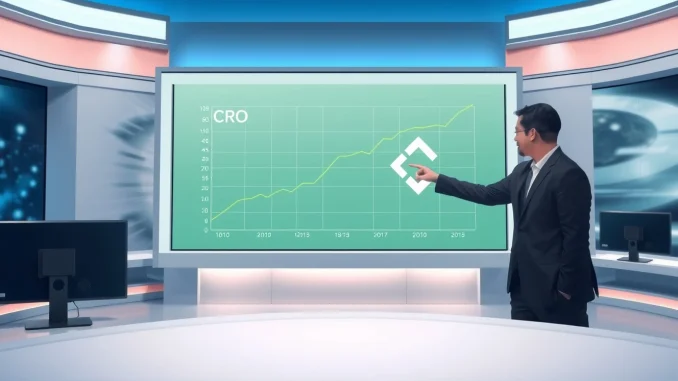
Cronos (CRO), the native token of the Cronos blockchain ecosystem developed by Crypto.com, has been a subject of sustained interest among cryptocurrency investors seeking exposure to layer-1 networks with real-world adoption. As of early 2026, CRO trades within a range that reflects both the broader market’s cautious optimism and the network’s ongoing technical developments. This article examines the factors that could influence CRO’s price trajectory through 2030, grounded in verifiable on-chain metrics, network upgrades, and market structure—rather than speculative price targets.
Understanding Cronos and Its Position in the Crypto Sector
Cronos is an Ethereum-compatible layer-1 blockchain built on the Cosmos SDK, designed to scale decentralized applications (dApps) and decentralized finance (DeFi) protocols. Its integration with the Crypto.com exchange and the Crypto.com DeFi Wallet provides a direct user base of millions. The network’s native token, CRO, is used for transaction fees, staking, and governance. Unlike many projects that rely solely on speculative narratives, Cronos benefits from the operational infrastructure of its parent company, which includes regulated crypto services in multiple jurisdictions. This structural backing provides a degree of institutional credibility that few competing layer-1 networks can claim.
Also read: Notcoin (NOT) Price Prediction 2026-2030: Can the Telegram Gaming Token Stage a Recovery?
The network has undergone several key upgrades since its mainnet launch, including the implementation of the Cronos EVM (Ethereum Virtual Machine) compatibility layer and the integration of IBC (Inter-Blockchain Communication) protocol, enabling cross-chain interoperability with other Cosmos-based chains. These technical milestones have expanded the utility of CRO beyond simple exchange utility, positioning it as a functional asset within a broader multi-chain ecosystem.
Tokenomics and Supply Dynamics
CRO has a fixed maximum supply of 30 billion tokens, with a significant portion already in circulation. The token’s distribution model includes allocations for ecosystem development, staking rewards, and strategic reserves. Unlike inflationary models that dilute holders over time, CRO’s supply cap creates a scarcity dynamic that could support long-term value appreciation if demand grows proportionally. However, the rate of token unlock and the vesting schedules of early investors and team allocations remain critical factors. As of 2026, the majority of unlocked tokens have been absorbed by staking and DeFi applications, reducing circulating supply pressure.
Also read: Monero (XMR) Price Prediction 2026–2030: Can Privacy Coins Sustain Momentum?
Staking participation rates on Cronos have remained above 60% for the past two years, indicating strong holder conviction and a network that prioritizes security and decentralization. High staking rates also reduce the liquid supply available for trading, which can act as a price support mechanism during bearish market phases.
Network Growth and Adoption Metrics
Adoption metrics provide a more reliable basis for price analysis than price predictions alone. Cronos has consistently ranked among the top 10 blockchain networks by total value locked (TVL) in DeFi protocols, with peaks exceeding $5 billion during favorable market conditions. The network hosts a diverse range of dApps, including decentralized exchanges (DEXs), lending platforms, and NFT marketplaces. Daily active addresses and transaction counts have shown steady growth, with periodic spikes correlated to major protocol launches or marketing campaigns.
The Cronos ecosystem also benefits from the Crypto.com brand’s global marketing reach, including sponsorship deals with major sports leagues and entertainment properties. While these marketing efforts do not directly determine token price, they contribute to brand awareness and user acquisition, which can translate into network activity over time.
Market Context and Regulatory Space
Cryptocurrency markets remain highly sensitive to macroeconomic factors, including interest rate policies, inflation data, and regulatory developments. In 2026, the regulatory environment for digital assets in major jurisdictions such as the United States, the European Union, and parts of Asia has become more defined, with frameworks for stablecoins, exchange licensing, and DeFi protocols taking shape. Cronos, through its association with Crypto.com, has maintained a compliance-first approach, which may provide a competitive advantage as regulators increase scrutiny on less compliant networks.
Price predictions that ignore regulatory risk are inherently incomplete. The potential for classification of CRO as a security by certain regulators could impose trading restrictions or listing delistings, negatively impacting liquidity and price. Conversely, clear regulatory clarity that classifies CRO as a utility token could remove uncertainty and attract institutional capital.
Technical Analysis and Price Patterns
From a technical perspective, CRO has exhibited cyclical price behavior that correlates closely with Bitcoin’s four-year halving cycles, though with higher volatility. The token’s price action since its all-time high of approximately $0.96 in November 2021 has been characterized by a prolonged accumulation phase, with higher lows forming on the weekly chart. Breakout attempts above the $0.20 resistance level have been met with selling pressure, but each retest has shown diminishing volume, suggesting weakening supply.
Key support levels to watch include $0.08 (the 2022 bear market low) and $0.12 (the 2023 accumulation range). Resistance levels at $0.20, $0.35, and $0.50 represent psychological barriers that would require significant volume and positive catalysts to overcome. A sustained move above $0.20 with high trading volume could signal the start of a new bullish phase, while a breakdown below $0.08 would indicate a structural bearish shift.
Long-Term Outlook: 2027–2030
Looking toward 2030, the price trajectory of CRO will depend less on short-term trading patterns and more on the network’s ability to maintain relevance in an increasingly competitive layer-1 arena. The emergence of faster, cheaper, and more scalable alternatives—such as Solana, Aptos, and Sui—poses a direct challenge to Cronos’s market share. However, Cronos’s integration with the Cosmos ecosystem and its access to Crypto.com’s user base provide a defensible moat that pure technology plays may lack.
Adoption of real-world asset (RWA) tokenization and institutional DeFi could serve as major catalysts. Cronos has positioned itself as a compliant platform for tokenized securities and regulated DeFi products, which could attract institutional liquidity. If these use cases gain traction, CRO’s utility as a gas token and staking asset could see increased demand, supporting higher price levels.
Notably that price predictions extending to 2030 carry significant uncertainty. The cryptocurrency market is still nascent, and unforeseen technological breakthroughs, regulatory shifts, or macroeconomic crises could dramatically alter the space. Investors should treat any specific price target with skepticism and focus on the underlying fundamentals of the network.
Conclusion
Cronos (CRO) presents a mixed picture for long-term investors. On one hand, its association with a regulated, globally recognized brand, a fixed supply cap, and a growing DeFi ecosystem provide a solid foundation. On the other hand, intense competition from other layer-1 networks, regulatory risks, and the inherent volatility of cryptocurrency markets mean that price appreciation is far from guaranteed. The most realistic outlook for CRO through 2030 is one of gradual, use-case-driven growth, with price levels that reflect actual network adoption rather than speculative hype. Investors should monitor on-chain metrics, staking rates, and regulatory developments as more reliable indicators than price predictions alone.
FAQs
Q1: What is the maximum supply of CRO?
CRO has a fixed maximum supply of 30 billion tokens. As of 2026, the majority of tokens are already in circulation, with remaining tokens subject to vesting schedules for ecosystem development and team allocations.
Q2: Does Cronos have a real-world use case beyond speculation?
Yes. CRO is used for transaction fees on the Cronos blockchain, staking to secure the network, and governance voting. It also provides utility within the Crypto.com ecosystem, including fee discounts and rewards for using Crypto.com products.
Q3: How does Cronos compare to other layer-1 blockchains like Ethereum or Solana?
Cronos is Ethereum-compatible, meaning it supports many of the same dApps and tools as Ethereum, but with lower fees and faster transaction times. It is built on the Cosmos SDK, which enables interoperability with other Cosmos-based chains. While it has a smaller developer ecosystem than Ethereum, it benefits from the user base and marketing power of Crypto.com.




Be the first to comment