
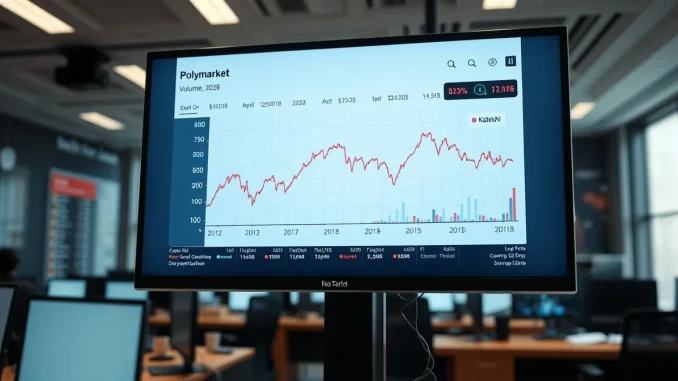
Polymarket, the leading crypto-based prediction market platform, recorded its first monthly trading volume decline since August 2025 in April, as competition from rival Kalshi intensified and U.S. regulatory scrutiny of the sector deepened. Data from Dune Analytics shows Polymarket and its U.S.-focused app generated approximately $10.2 billion in volume during April, an 8.9% drop from March’s $11.2 billion.
Competition heats up as Kalshi surges
While Polymarket’s numbers slipped, rival platform Kalshi posted a 13% month-over-month increase, reaching about $14.8 billion in April volume, according to Dune. The broader prediction market sector continued to expand, with total monthly volume rising to roughly $29.8 billion in April from $26.5 billion in March — a 12.4% gain. This divergence suggests Polymarket is losing market share even as the overall category grows.
Also read: DCG-backed Yuma launches institutional fund targeting Bittensor ecosystem
New entrants are also challenging the incumbents. Prophet, an AI-native prediction market platform, launched its first live trading tranche last week, using an artificial intelligence model as the counterparty with real capital. Earlier this week, fintech firm MoonPay introduced an AI-powered tool designed to help users develop trading strategies on prediction markets.
Regulatory headwinds mount
Polymarket’s volume decline comes at a time of heightened legal and regulatory pressure on the prediction market industry in the United States. The platform is seeking to re-establish a U.S. presence after exiting the market in 2022 as part of a settlement with the Commodity Futures Trading Commission (CFTC), which barred it from serving U.S. residents on its main global exchange. In December 2025, Polymarket launched a dedicated app for U.S. customers, though it remains siloed from the global platform’s liquidity.
Also read: Securitize expects $400M war chest as tokenization platform prepares for NYSE debut
In March, Senator Elizabeth Warren and more than 40 members of Congress sent a letter to the CFTC demanding a ban on government insiders using prediction markets to profit while in office. The lawmakers argued that event contracts fall under the CFTC’s jurisdiction and that federal employees must comply with existing insider trading restrictions.
Separately, Wisconsin Attorney General Josh Kaul filed lawsuits in April against Kalshi, Polymarket, and other prediction market operators, accusing them of violating state sports betting laws.
Why this matters for traders and the industry
The decline in Polymarket’s volume signals a potential shift in market dynamics. For short-term traders, the rise of alternatives like Kalshi and AI-native platforms may offer different liquidity profiles and trading experiences. For the industry as a whole, the combination of regulatory crackdowns and new competition could reshape the prediction market sector, particularly in the U.S. where legal uncertainty remains high. The outcome of the Wisconsin lawsuits and the CFTC’s response to congressional pressure will be key developments to watch.
Conclusion
Polymarket’s first monthly volume drop since August 2025 reflects growing competitive pressure from Kalshi and new AI-driven platforms, alongside increasing regulatory scrutiny from U.S. lawmakers and state attorneys general. While the prediction market sector continues to grow overall, Polymarket faces a critical test as it works to regain a foothold in the U.S. market while addressing legal challenges and shifting trader preferences.
FAQs
Q1: Why did Polymarket’s volume decline in April 2026?
The decline is attributed to increased competition from rival Kalshi, which saw a 13% volume increase, and the emergence of new AI-native platforms like Prophet. Regulatory uncertainty and legal actions may also have contributed to reduced activity on Polymarket.
Q2: What is the status of Polymarket’s U.S. operations?
Polymarket launched a dedicated U.S. app in December 2025, but it remains separate from the global platform’s liquidity. The company is still restricted from offering its main exchange to U.S. residents under a 2022 CFTC settlement.
Q3: How are U.S. regulators approaching prediction markets?
U.S. lawmakers, led by Senator Elizabeth Warren, have called for a ban on insider trading by government officials using prediction markets. The CFTC is under pressure to enforce existing rules, and state attorneys general, such as Wisconsin’s Josh Kaul, have filed lawsuits alleging violations of sports betting laws.




Be the first to comment