
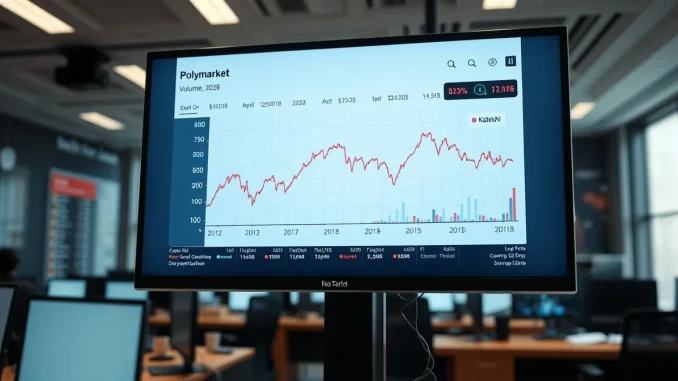
Polymarket’s monthly trading volume fell by approximately 8.9% in April, marking the first month-over-month decline since August 2025, as rival platform Kalshi captured a larger share of the rapidly expanding prediction market sector. Data from Dune Analytics shows Polymarket and its US-focused application generated just over $10.2 billion in volume last month, down from more than $11.2 billion in March.
Kalshi surges as competition intensifies
While Polymarket experienced its first contraction in months, Kalshi’s April trading volume jumped by roughly 13%, reaching about $14.8 billion, according to Dune data. The divergence highlights a shifting competitive market in prediction markets, a sector that has attracted a wave of new entrants and increased trader interest since the 2024 US elections.
Also read: DCG-backed Yuma launches institutional fund targeting Bittensor ecosystem
Despite Polymarket’s decline, the overall prediction market ecosystem continues to grow. Total monthly trading volume across all platforms rose to approximately $29.8 billion in April, up 12.4% from $26.5 billion in March, indicating that trader demand remains strong even as individual platforms jostle for position.
Regulatory headwinds intensify
Polymarket’s volume dip coincides with its efforts to reintegrate US markets after a 2022 settlement with the Commodity Futures Trading Commission (CFTC) forced it to block US residents from its global exchange. The company launched a dedicated US customer app in December 2025, but the platform remains siloed from Polymarket’s global liquidity pool.
Also read: Securitize expects $400M war chest as tokenization platform prepares for NYSE debut
Regulatory scrutiny has also escalated. In March, Senator Elizabeth Warren and more than 40 Congressional representatives sent a letter to the CFTC demanding a ban on government insiders using prediction markets to profit from non-public information. The lawmakers argued that event contracts fall under CFTC jurisdiction and that federal employees must comply with existing insider trading restrictions.
Wisconsin Attorney General Josh Kaul filed lawsuits against Kalshi, Polymarket, and other prediction platforms in April, alleging violations of state sports betting laws.
New competitors enter the fray
The prediction market space is drawing a growing number of entrants. Prophet, an AI-native prediction market platform, launched its first live trading tranche last week, using an AI model as the counterparty with real capital. Earlier this week, fintech company MoonPay introduced an AI-powered tool designed for trading strategies on prediction markets.
These developments suggest that while Polymarket faces near-term headwinds, the broader sector is attracting both traders and technology-driven competitors, setting the stage for further evolution in how these markets operate and are regulated.
Conclusion
Polymarket’s first monthly volume decline since August 2025 reflects a maturing prediction market sector where competition from Kalshi and new entrants is intensifying. Regulatory pressure from US lawmakers and state attorneys general adds another layer of complexity as platforms manage compliance while seeking growth. The overall market’s continued expansion, however, indicates sustained trader interest in event-based contracts, even as individual platforms face shifting fortunes.
FAQs
Q1: Why did Polymarket’s volume decline in April 2026?
A1: Polymarket’s monthly trading volume fell 8.9% to $10.2 billion, its first drop since August 2025, as rival Kalshi gained market share and regulatory scrutiny intensified. The decline occurred despite overall prediction market volume rising 12.4% to $29.8 billion.
Q2: How is Kalshi performing compared to Polymarket?
A2: Kalshi’s April volume surged about 13% to $14.8 billion, surpassing Polymarket’s $10.2 billion. Kalshi has been expanding its US presence and attracting traders amid Polymarket’s regulatory challenges.
Q3: What regulatory actions are affecting prediction markets?
A3: Senator Elizabeth Warren and over 40 lawmakers asked the CFTC to ban insider trading by government officials on prediction platforms. Wisconsin’s attorney general also sued Kalshi, Polymarket, and others for alleged violations of state sports betting laws.





Be the first to comment