
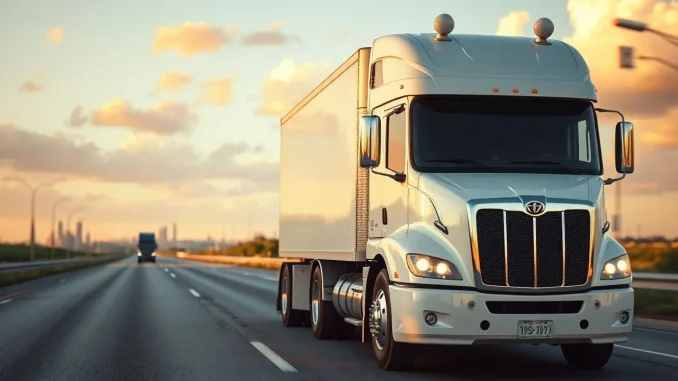
For more than a decade, self-driving technology has been perpetually ‘almost here.’ But Aurora co-founder and CEO Chris Urmson believes the moment of real commercial viability has finally arrived — at least for long-haul trucks. In a recent conversation at the HumanX conference in San Francisco, Urmson sat down with TechCrunch senior reporter Rebecca Bellan to discuss why autonomous trucking is moving from pilot programs to real-world scale.
From DARPA to driverless freight
Aurora began commercial driverless operations in April 2025, hauling freight between Dallas and Houston without a safety driver behind the wheel. The company is now planning to expand from a handful of trucks to hundreds by the end of 2026. Urmson, a veteran of the DARPA Grand Challenges and a former Google self-driving car project leader, described the journey as a long, deliberate process of building a system that can be verified and trusted at highway speeds.
Also read: OpenAI Limits GPT-5.6 Rollout After U.S. Government Request, Calls Restrictions a 'Short-Term Step'
Why trucking, not robotaxis
Urmson explained that long-haul trucking presents a more viable business case for autonomy than urban robotaxi services. Highways are more predictable environments than city streets, and the economic pressure on the trucking industry — driver shortages, rising labor costs, and 24/7 logistics demands — creates a clear market need. Aurora’s trucks operate on defined routes with well-mapped infrastructure, reducing the complexity that has stymied robotaxi deployments in cities like San Francisco and Phoenix.
Verifiable AI vs. end-to-end black boxes
A key theme of the conversation was Urmson’s emphasis on ‘verifiable AI.’ Unlike the large language models that dominate headlines, Aurora’s system is built on modular, testable components. Urmson argued that end-to-end neural networks, while powerful, are a liability when human lives are at stake. Instead, Aurora uses a combination of traditional software engineering and machine learning, where each decision can be audited and validated. This approach is designed to meet the safety standards expected by regulators and the public.
Also read: OpenAI, Google, and SpaceX are all building their own AI chips — here's why that matters
The safety triangle and a common-sense solution
Urmson also addressed what he calls the ‘safety triangle’ problem: balancing safety, cost, and operational efficiency. He described a surprisingly pragmatic solution — focusing on the most repetitive and dangerous parts of trucking, such as highway cruising, while still relying on human drivers for complex local deliveries and depot maneuvers. This hybrid model allows Aurora to deploy its technology without requiring perfect performance in every scenario from day one.
Beyond trucking: Aurora’s roadmap
While trucking is the immediate focus, Urmson hinted that Aurora’s technology platform could eventually expand to other vehicle types. He expressed genuine excitement about companies like Waymo and Nuro, which are tackling adjacent autonomy problems. However, he cautioned against overhyping timelines, noting that physical AI — systems that interact with the real world — requires far more rigorous validation than digital AI.
Conclusion
Aurora’s shift from testing to scaling marks a significant milestone in the autonomous vehicle industry. Urmson’s emphasis on verifiable AI, pragmatic deployment strategies, and a clear business case for trucking suggests that the long-promised era of self-driving freight may finally be arriving — not with fanfare, but with methodical engineering and commercial discipline. For readers tracking the autonomy space, the key takeaway is that the technology is no longer a science project; it is becoming a real logistics tool.
FAQs
Q1: When did Aurora start commercial driverless truck operations?
Aurora began commercial driverless truck operations in April 2025, initially hauling freight between Dallas and Houston without a safety driver.
Q2: Why does Chris Urmson prefer modular AI over end-to-end systems?
Urmson argues that modular, verifiable AI allows each component to be tested and audited individually, which is critical for safety in life-critical applications like autonomous driving. End-to-end systems are harder to validate and debug.
Q3: What is the ‘safety triangle’ problem in autonomous trucking?
The safety triangle refers to the trade-off between safety, cost, and operational efficiency. Aurora’s solution is to deploy autonomy on predictable highway segments while using human drivers for complex local routes, balancing all three factors.






Be the first to comment