
The growing demand for AI computing power is pushing data center developers to consider an unlikely frontier: orbit around Earth. But a fundamental problem stands in the way — there simply aren’t enough rockets to get those data centers into space, and launching them remains prohibitively expensive.
A launch capacity crunch
Most companies pursuing orbital data centers are betting on SpaceX’s Starship to eventually solve the bottleneck. The vehicle is expected to conduct its twelfth test flight as soon as this weekend, but even after it becomes operational, commercial availability could be years away. SpaceX’s own satellite business is expected to consume much of the launch capacity. Blue Origin’s New Glenn rocket, which failed to deliver a satellite during its third launch in April, faces similar delays.
Also read: OpenAI Limits GPT-5.6 Rollout After U.S. Government Request, Calls Restrictions a 'Short-Term Step'
That reality has pushed many space data center plans into the mid-2030s. Google’s Project Suncatcher, for example, targets that timeframe. Others, like Starcloud, are starting with edge processing tasks for space sensors as a more immediate step.
Cowboy Space’s in-house solution
Baiju Bhatt, CEO and founder of Cowboy Space Corporation, decided on a different approach. ‘We’re standing up our own rocket program,’ he told TechCrunch, with a first launch expected before the end of 2028. Today, the company announced the closure of a $275 million Series B round at a post-money valuation of $2 billion, led by Index Ventures. Breakthrough Energy Ventures, Construct Capital, IVP, and SAIC also participated.
Also read: OpenAI, Google, and SpaceX are all building their own AI chips — here's why that matters
Bhatt, a co-founder of Robinhood, launched the startup in 2024 under the name Aetherflux, originally focused on collecting solar energy in space and beaming it to Earth. The idea of using that electricity for orbital data centers led the company to pivot — and eventually to develop its own rocket.
‘There’s a lot of new rockets that are coming online, but as we look three, four years out, it’s still very, very scarce,’ Bhatt said. He added that many first-party rocket providers are likely to specialize in their own payloads, leaving little room for external customers.
A unique design approach
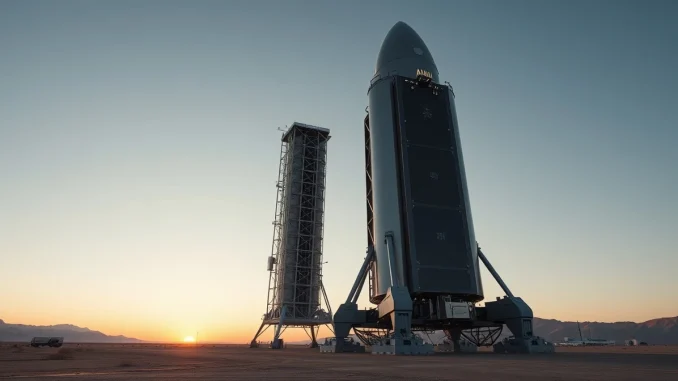
Cowboy Space plans to build its data centers directly into the second stage of its rocket, a concept reminiscent of the first U.S. satellite, Explorer 1, which was built as the final stage of a rocket. Each satellite is expected to weigh 20,000 to 25,000 kilograms and generate 1 megawatt of power for nearly 800 onboard GPUs. The rocket would be slightly more powerful than SpaceX’s Falcon 9 but smaller than Starship. Bhatt says the booster is eventually intended to be reusable.
The company has hired veterans from Blue Origin and SpaceX, including propulsion engineer Warren Lamont and former launch director Tyler Grinne. It also plans to build its own rocket engine, the most complex and expensive component of any launch vehicle. Cowboy Space is still working through key development needs, including facilities for testing, manufacturing, and launching.
Why this matters
The move puts Cowboy Space in direct competition with SpaceX and Blue Origin, the most advanced and well-funded players in the launch market. But Bhatt argues the potential market is large enough for multiple winners. ‘The prize here, and the size of this market, is big enough that there’s room for many players to succeed,’ he said. ‘I see the demand for AI getting more and more acute, and I see the options on Earth getting more and more limited.’
The new name — Cowboy Space Corporation — reflects the company’s mission to ‘power humanity from the high frontier,’ though Bhatt acknowledged with a smile that it also gives him a reason to wear a cowboy hat and grow a mustache.
Conclusion
Cowboy Space’s $275 million raise and rocket development plan represent a significant bet on the convergence of AI infrastructure and space technology. Whether the company can deliver on its ambitious timeline — and compete with established players — will depend on its ability to solve the same engineering and manufacturing challenges that have tripped up others. But the underlying logic is clear: if AI demand continues to grow and terrestrial data center capacity becomes constrained, the high frontier may become the next frontier for compute.
FAQs
Q1: Why are companies looking at space for data centers?
Terrestrial data centers face growing constraints in power availability, cooling capacity, and physical space. Space offers abundant solar energy and the ability to scale without land-use limitations, making it attractive for energy-intensive AI workloads.
Q2: What is the main challenge for orbital data centers?
The primary bottleneck is launch capacity. There aren’t enough rockets available to transport data center hardware into orbit at a cost that can compete with terrestrial alternatives. Even upcoming rockets like Starship may be years away from commercial availability for external customers.
Q3: How does Cowboy Space’s rocket design differ from traditional rockets?
Cowboy Space plans to build its data centers directly into the second stage of its rocket, rather than using a separate payload fairing. This integrated design simplifies the launch process and allows the company to control both the rocket and the data center hardware as a single system.


Be the first to comment