
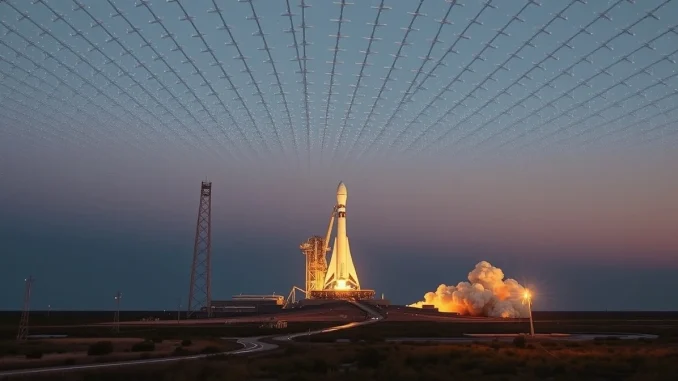
SpaceX is set to go public on Friday with a $75 billion stock offering that is reportedly deeply oversubscribed, with some institutional investors committing as much as $10 billion for a piece of Elon Musk’s empire. But beneath the excitement lies a sobering reality: the company’s bankers have valued it at nearly $1.8 trillion, a figure that two independent analyses suggest is significantly inflated.
Morningstar, the financial research firm, assigns SpaceX a fair value of about $825 billion. Aswath Damodaran, a New York University finance professor specializing in corporate valuation, pegs it at $1.2 trillion. The gap between those estimates and the IPO price, Damodaran argues, is effectively a $72 call option on Musk’s ability to deliver on a vision that emerged just 18 months ago: orbital data centers.
Also read: Sam Altman Says OpenAI IPO Will Not Happen in 2026: 'Ill-Advised'
That vision requires three simultaneous engineering breakthroughs: a fully reusable rocket, a new American chip foundry, and a satellite production line operating at twice the speed of SpaceX’s existing Starlink factory.
What investors are actually buying
The core of SpaceX’s existing business is a near-monopoly on access to space in the US and Europe, plus a global satellite internet network in Starlink. Both generate high margins and predictable revenue. The uncertainty lies in the company’s AI ambitions, which the S-1 filing frames as a $22.7 trillion market opportunity — nearly ten times larger than SpaceX’s addressable space market.
Also read: Jensen Huang Says Nvidia Could Grow Revenue 70% Next Year, Backed by Orders Growing 27% a Month
But the company’s recent deals to sell significant compute capacity to Anthropic and Google suggest SpaceX is hedging its bets. It’s acting like a neocloud provider, selling infrastructure to potential AI competitors rather than exclusively building its own models. That strategy raises a fundamental question about where value will accrue in the AI stack: is it better to own the compute or the model?
The space data center architecture
In a video released this week, Musk laid out the logic for why SpaceX is uniquely positioned to build orbital data centers. The argument hinges on three capabilities: the ability to put mass into orbit cheaply, to build large solar arrays in space, and to manufacture advanced chips at scale.
Musk claimed the company could reach an annualized production rate of one gigawatt of space AI compute by the end of next year. Based on his expected maximum power delivery of 150kW per satellite, that implies manufacturing roughly 6,666 satellites per year — or 556 per month. That’s about double the current Starlink production rate of 70 satellites per week.
Industry experts generally see space data centers at scale as being about a decade away. Musk’s timeline would compress that to roughly 18 months.
Three moonshots, one timeline
Starship reusability. A recent test flight showed progress, but the booster failed to make a controlled reentry. The company is still under FAA investigation for the mishap. NASA, which has a nearly $4 billion contract for Starship as a lunar lander, won’t commit to a test mission before late 2027.
Terafab chip foundry. Building a semiconductor fabrication facility in the US is among the hardest industrial projects in existence. Chip fabs typically cost billions of dollars and take up to a decade to complete. SpaceX plans to build one to feed its orbital compute ambitions.
Satellite production at scale. SpaceX took roughly a decade to develop its Starlink manufacturing line. Musk now wants to build a higher-rate production facility for AI satellites in 18 months, at twice the current output.
Musk used to say he wouldn’t take SpaceX public until the company reached Mars, fearing that fickle investors would lose faith along the way. Those plans may have been shelved, but the engineering challenges he’s laid out ahead of this IPO may be just as difficult.




Be the first to comment