
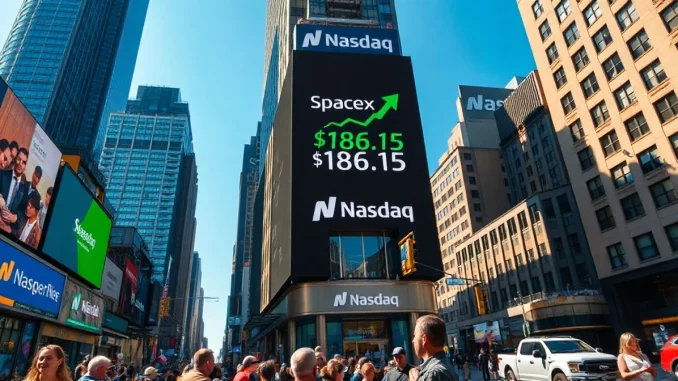
SpaceX began trading on the Nasdaq on June 12, 2026, in the largest initial public offering in history. The company priced 555.6 million shares at $135 each, raising $75 billion and making CEO Elon Musk the world’s first trillionaire on paper. By 2:30 pm ET on its first full day of trading, shares had climbed more than 15% to $186.15.
The debut marks a turning point for a company that spent 24 years as a private entity, building a reputation on reusable rockets, the Starlink satellite network, and Musk’s ambitious vision for Mars colonization. Here is a breakdown of the key developments and what they mean for investors, employees, and the broader space industry.
Also read: UK FCA Gets 123 Tokenization Responses, Plans Joint Roadmap With Bank of England
How the stock performed on day one
SpaceX shares opened at $150 on June 12, an 11% pop from the IPO price. They continued to climb through the session, hitting a midday gain of 30% before closing at $160.95, up 19%. Trading volume was heavy, with Robinhood reporting record-breaking traffic on its platform in the hours after the debut.
The strong demand triggered the “green shoe” option, a provision that lets underwriters sell up to 15% more shares than originally planned. A photo posted on X by Musk showed SpaceX insiders wearing green shoes, a nod to the mechanism. The banks, led by Goldman Sachs and Morgan Stanley, earned about $500 million in total fees, according to the Wall Street Journal.
Also read: Revolut Attackers Threaten Daily Data Leaks After Customer IDs Exposed
What the S-1 revealed about SpaceX’s finances
The registration document, known as the S-1, gave the public its first detailed look inside SpaceX. The company lost $4.9 billion on revenues of over $18 billion in 2025. Cumulative losses since inception exceed $37 billion. Revenue is heavily driven by Starlink, its satellite internet service, which now dominates the business.
The S-1 also outlined future bets, including an xAI division focused on artificial intelligence and the Starship rocket program. Starship’s path to full reusability remains uncertain, according to the filing, and the company warned investors that significant dilution could occur after going public — language that fueled merger rumors with Tesla.
Who benefits from the IPO
Elon Musk holds about 85.1% of the company’s voting power, giving him monarchical control over the publicly traded entity. His paper wealth exceeded $1 trillion after the first day of trading. According to the New York Times, about 4,400 SpaceX employees could become millionaires through their equity stakes.
Lower-tier investors who bought shares through special purpose vehicles (SPVs) face hidden fees, lengthy payout delays, and the risk of outright fraud, as their true holdings will not be known until post-IPO lock-ups lift. The biggest winners among institutional investors are those who held direct stakes.
Pre-IPO deals and the AI angle
In the months before the IPO, SpaceX locked in a series of compute deals to improve its balance sheet. Anthropic agreed to pay xAI $1.25 billion per month for compute, while Google committed $920 million per month, describing it as a short-term arrangement to meet unexpected demand for its AI products.
SpaceX COO Gwynne Shotwell told CNBC on June 12 that a merger between SpaceX and Tesla “might make Elon’s life a little easier,” adding fuel to ongoing speculation about a potential combination of the two companies.
Musk posted on X after the debut: “I love the incredible people of SpaceX beyond words.”
For ongoing coverage, including real-time price tracking and analysis, follow TechCrunch’s Equity podcast, which featured senior reporters Sean O’Kane and Russell Brandom discussing the IPO’s far-ranging implications.






Be the first to comment