
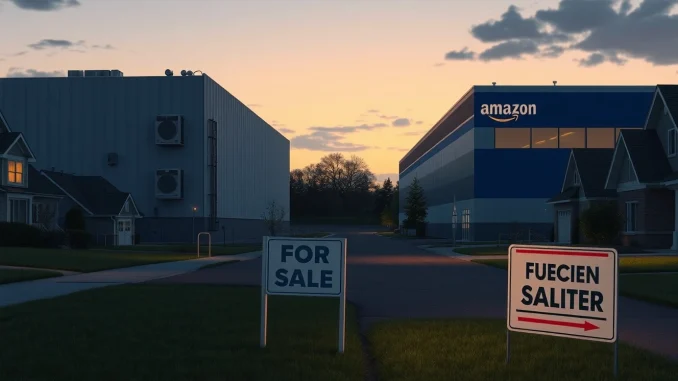
New research reveals a stark shift in American attitudes toward the engines of the digital economy. According to recent polling, a significant portion of the public would now rather have an e-commerce warehouse built near their homes than a data center. This finding signals a profound and growing community-level resistance to the infrastructure powering artificial intelligence and cloud computing.
Polling Data Exposes Deep Public Skepticism
A joint Harvard/MIT survey conducted in November 2025 asked 1,000 people about supporting various industrial facilities in their area. The results were telling. Only 40% of respondents supported a local data center project. 32% were actively opposed. When compared directly to other developments, the data center fared poorly. More people expressed a preference for an e-commerce warehouse. This sentiment is not isolated. A separate Quinnipiac University poll of 1,397 U.S. adults, published in March 2026, found even stronger opposition. 65% of Americans said they would oppose building an AI data center in their community. Just 24% were in support.
Also read: OpenAI Limits GPT-5.6 Rollout After U.S. Government Request, Calls Restrictions a 'Short-Term Step'
“These numbers are a wake-up call for the tech industry,” said Dr. Liza Norton, a professor of urban planning at the University of California, Berkeley, who studies community development. “For years, data centers were seen as quiet, low-impact neighbors. That perception has completely changed.” The data suggests the debate over where to place this critical infrastructure is intensifying, not subsiding.
The Core Drivers of Community Resistance
Analysts point to several concrete concerns fueling this opposition. The Harvard/MIT poll identified a primary fear: electricity prices. Two-thirds of respondents worried a new data center would increase their power bills. This concern is rooted in reality. Data centers are immense consumers of energy. In some regions, like Northern Virginia, their rapid expansion has strained local grids and sparked debates about utility costs for residents.
Also read: OpenAI, Google, and SpaceX are all building their own AI chips — here's why that matters
Another factor is the perceived lack of local benefit. While developers often promote job creation and economic growth, the Quinnipiac poll suggests this argument is losing its potency. “The initial construction phase creates jobs,” Norton explained. “But a fully operational hyperscale data center might employ fewer than 50 people. For a community, that’s a huge footprint for very few permanent positions.” This stands in contrast to a large distribution warehouse, which can employ hundreds of local workers in logistics and sorting roles.
Noise, Water, and the End of Invisibility
Beyond power and jobs, more visceral issues are at play. Modern data centers are not the silent boxes of the past. The cooling systems required for high-density AI servers generate a constant, low-frequency hum. They also consume vast amounts of water for cooling in many designs. A proposed data center in Mesa, Arizona, faced backlash in early 2026 over its planned water usage during a prolonged drought. These facilities have become physically and audibly present in a way they never were before.
“The ‘cloud’ has landed, and it’s loud, thirsty, and power-hungry,” noted Michael Chen, an analyst with the infrastructure research firm DC Blox. “Communities are now directly experiencing the physical cost of digital convenience and AI progress.” This tangible impact has moved data centers from the background of the digital world to the forefront of local zoning battles.
Comparative Impact: Warehouse vs. Data Center
Why does an Amazon warehouse poll as a more desirable neighbor? Industry observers cite a clearer cost-benefit analysis for residents. The table below outlines the common community perceptions of each facility type.
| Factor | Perception of Amazon Warehouse | Perception of Data Center |
|---|---|---|
| Job Creation | High. Creates hundreds of local logistics, packing, and management roles. | Low. Creates few permanent positions after construction. |
| Traffic & Activity | Predictable. Heavy truck traffic at shift changes and for deliveries. | Minimal. Very little daily vehicle traffic once operational. |
| Environmental Impact | Visible. Truck emissions and packaging waste. | Intangible but Suspected. High energy/water use, carbon footprint from electricity. |
| Community Benefit | Tangible. Employment opportunities, potential for local delivery hubs. | Abstract. Supports ‘the cloud’ and AI, but direct local link is unclear. |
| Noise Pollution | Intermittent. Truck engines, loading bay activity. | Constant. 24/7 hum from cooling systems and transformers. |
This comparison shows that while warehouses bring obvious disruptions, their community benefits are also obvious. Data center benefits are largely indirect, while their resource demands are direct and significant.
The Political and Regulatory Reckoning
The polling data has immediate implications. “Continued discontent from such a large swathe of the electorate is likely to spill over into politics,” the original analysis noted. This is already happening. In 2025 and early 2026, local governments from Georgia to Oregon have enacted moratoriums on new data center construction. Others are revising zoning codes and tax structures to account for their unique burdens.
Lawmakers are responding to constituent pressure. “We’re seeing a push for ‘community benefit agreements’ that go beyond tax payments,” said Chen. “These might include direct subsidies to offset resident electricity costs, investments in local green energy projects, or guarantees for technical training programs.” The era of data centers operating as invisible, frictionless tenants appears to be over.
A Challenge for the AI Boom
This public sentiment clash arrives at a critical moment. The artificial intelligence industry’s growth is entirely dependent on expanding data center capacity. Tech giants like Google, Microsoft, and Amazon are planning to invest hundreds of billions of dollars in new infrastructure over the next five years. Finding communities willing to host these facilities is becoming a major bottleneck.
“The industry can’t innovate faster than its ability to build the physical foundation,” Dr. Norton stated. “If every proposed site faces 65% opposition, the rollout of next-generation AI services could slow dramatically.” This suggests a coming conflict between national economic and technological ambitions and local community autonomy.
Conclusion
The polling is clear: significant data center opposition is now a mainstream American viewpoint. The preference for an Amazon warehouse over a data center highlights a public calculus that prioritizes tangible, local employment over abstract digital infrastructure. The core issues are practical—electricity costs, jobs, noise, and water. As the demand for AI computing power explodes, the industry and policymakers must address these concrete concerns. The future of technological advancement may depend on making data centers better neighbors, not just more powerful ones.
FAQs
Q1: What percentage of Americans oppose having an AI data center built in their community?
According to a March 2026 Quinnipiac University poll, 65% of Americans oppose building an AI data center in their community, with only 24% in support.
Q2: What is the main reason people oppose local data centers?
The primary concern, cited by two-thirds of respondents in a Harvard/MIT poll, is that a new data center will increase electricity prices for local residents due to its massive power consumption.
Q3: How do data centers and Amazon warehouses compare on job creation?
A large fulfillment warehouse typically creates hundreds of local jobs in logistics and operations. A modern hyperscale data center, after its initial construction phase, may employ fewer than 50 people for ongoing management and maintenance.
Q4: Are data centers really noisier than warehouses?
They create different types of noise. Warehouses generate intermittent noise from trucks and loading docks. Data centers produce a constant, low-frequency hum from 24/7 cooling systems, which some find more disruptive.
Q5: How are local governments responding to this public opposition?
Many municipalities are enacting temporary moratoriums on new data center projects, revising zoning laws, and negotiating for stronger community benefit agreements that include energy bill offsets and local infrastructure investments.






Be the first to comment