
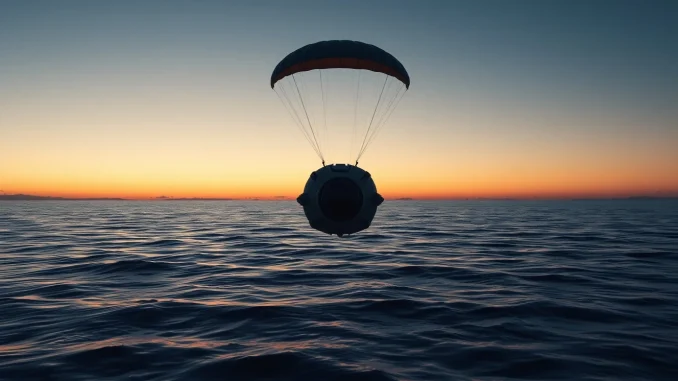
As NASA’s Orion capsule hurtled toward a Friday evening splashdown in the Pacific Ocean, a different kind of mission was unfolding on prediction market platforms. Traders on Kalshi and Polymarket weren’t just watching history—they were betting on the specific words NASA officials would use afterward. With just over $4,000 in volume on related event contracts as of April 11, 2026, the markets pointed to expectations of discussions about “president,” “radiation,” and “damage.” This activity highlights how prediction markets are moving beyond politics and sports into new, complex frontiers.
Betting on the Buzzwords of a Moon Mission
The Artemis II mission, NASA’s first crewed flight to the Moon since 1972, concluded its 10-day lunar flyby with a parachute-assisted splashdown. The crew of four returned safely. But for users on prediction market platforms, the event was just beginning. Kalshi, a regulated U.S. platform, offered contracts allowing users to bet on the content of NASA’s post-splashdown news conference.
Also read: Botanix shutdown: Does Bitcoin DeFi have a demand problem?
Data from Kalshi showed traders anticipated NASA officials would mention specific terms. Contracts tied to the words “president” or “prime minister” traded at a high probability. This suggests markets expected the mission’s success to be framed within geopolitical achievements. Another active contract centered on the word “radiation,” reflecting public and scientific concern about deep-space exposure. A contract for “damage” also saw activity, possibly related to spacecraft integrity after re-entry.
“This is a natural extension for prediction markets,” said a financial analyst who tracks the sector. “They aggregate dispersed information. The bets on specific terminology show what informed observers think the narrative priorities will be.” The total volume, while modest, indicates a niche but engaged audience testing these markets on non-financial events.
Also read: Bitcoin Options Traders Hedge Downside as Uncertainty Lingers, Anchorage Digital Reports
The Mechanics of Space Betting
Prediction markets function by letting users buy and sell contracts tied to the outcome of future events. If the event occurs, the contract settles at $1.00. If not, it settles at $0.00. The trading price represents the market’s collective probability assessment. For Artemis II, the main event—a successful splashdown—was nearly certain. So, attention shifted to subtler outcomes.
On Polymarket, a platform operating outside the U.S., contracts related to a Moon landing were also available. However, the more precise action was on Kalshi’s news-conference word contracts. This focus on post-event communication is notable. It treats official statements not as simple facts, but as measurable events influenced by policy, science, and public relations.
The table below shows a snapshot of key contracts related to the Artemis II splashdown period:
| Contract Focus | Platform | Implied Probability | Key Insight |
|---|---|---|---|
| NASA mentions “President” or “PM” | Kalshi | High | Markets expect political framing of success |
| NASA mentions “Radiation” | Kalshi | Significant | Health risks are a anticipated topic |
| NASA mentions “Damage” | Kalshi | Moderate | Concern over vehicle re-entry stress |
| Manned Moon landing by 2030 | Kalshi | 63% | Long-term confidence in Artemis program |
This move into space-related contracts follows years of growth for prediction markets in political elections and economic indicators. The Artemis bets represent a new test case. They involve technical outcomes less susceptible to the insider trading concerns that have plagued political event contracts.
Controversy and Regulatory Scrutiny
Using prediction markets for real-world events is not without controversy. According to congressional reports, platforms like Polymarket have faced criticism for allowing contracts on sensitive topics, including geopolitical conflicts. Some lawmakers have called these bets “suspicious” and pushed for legislation to prevent potential insider trading.
The concern is that individuals with non-public information could profit from contracts on tragic events. This has sparked a debate about the line between informative market signals and unethical gambling. Regulated platforms like Kalshi work within U.S. Commodity Futures Trading Commission (CFTC) guidelines, limiting contract topics. Unregulated offshore platforms operate with fewer restrictions.
“The Artemis contracts are relatively benign compared to war betting,” noted a regulatory analyst. “But they still raise questions. If a NASA engineer knew of a technical problem, could they trade on a ‘damage’ contract? The regulatory framework is still catching up.” This ongoing scrutiny forms the backdrop for the growth of these markets.
Artemis II: The Mission That Made History
The betting activity was anchored by a real, historic achievement. The Artemis II mission launched from Florida on April 1, 2026. It carried four astronauts on a journey around the Moon, testing systems for future lunar landings. The Orion spacecraft splashed down in the Pacific as planned, completing a critical step in NASA’s plan to return humans to the lunar surface by 2028.
This mission followed the uncrewed Artemis I test flight in 2022. The program’s goal is sustainable lunar exploration, serving as a proving ground for future Mars missions. The successful splashdown provided tangible results for the prediction markets to digest. It also validated the spacecraft’s design for protecting crews from the extreme heat of re-entry.
Industry watchers note that the mission’s success could influence broader market contracts. Kalshi already lists a contract for a manned NASA Moon landing before 2030, which traded at a 63% probability. A successful Artemis II likely strengthens confidence in that timeline. What this means for investors is a potential new data point for assessing the pace and reliability of major government-funded technological programs.
The Future of Prediction Markets in Tech and Exploration
The activity around Artemis II may signal a trend. Prediction markets are seeking new, information-rich domains. Space exploration, with its clear milestones and public data, offers a fertile ground. Other tech sectors, like cryptocurrency launches or AI milestones, could be next.
However, challenges remain. Liquidity on these niche contracts is often low. This can make prices volatile and less reliable as forecasting tools. Furthermore, the legal field is uncertain. The U.S. has strict laws against online gambling, and prediction markets exist in a gray area, often justified as tools for information aggregation rather than betting.
Despite this, the appeal is clear. These markets turn the public’s collective intelligence into a tradable metric. When people bet on the word “radiation” appearing in a NASA briefing, they are expressing a nuanced view about agency priorities and public communication. This could become a valuable tool for analysts and journalists trying to gauge expectations.
Conclusion
The splashdown of NASA’s Artemis II mission marked a triumph for human spaceflight. It also provided a revealing case study for prediction markets. Traders used contracts on Kalshi and Polymarket to bet on the aftermath, focusing on the specific language of NASA’s news conference. This activity, though small in volume, shows these markets expanding into complex, technical realms. While controversy surrounds their use for geopolitical events, space exploration presents a new frontier with measurable outcomes. The success of Artemis II may boost confidence in related long-term contracts, further blending the worlds of finance, technology, and exploration.
FAQs
Q1: What are prediction markets?
Prediction markets are platforms where users can trade contracts based on the outcome of future events. The price of a contract represents the market’s collective probability that the event will occur.
Q2: What were people betting on regarding the Artemis II splashdown?
On the Kalshi platform, users traded contracts based on whether NASA officials would mention specific words like “president,” “radiation,” or “damage” during the post-splashdown news conference.
Q3: Are prediction markets legal?
It depends on the jurisdiction and the platform. In the United States, Kalshi is regulated by the CFTC. Other platforms, like Polymarket, operate offshore and exist in a regulatory gray area, often facing scrutiny from lawmakers.
Q4: Why is there controversy around prediction markets?
Controversy arises when markets offer contracts on sensitive topics like geopolitical conflicts, raising concerns about insider trading and profiting from tragic events. Some lawmakers argue this necessitates new legislation.
Q5: Did Artemis II achieve its goals?
Yes. According to NASA, the Artemis II mission successfully completed its crewed lunar flyby and splashdown in the Pacific Ocean on April 11, 2026. It tested critical systems needed for future Moon landings.




Be the first to comment