
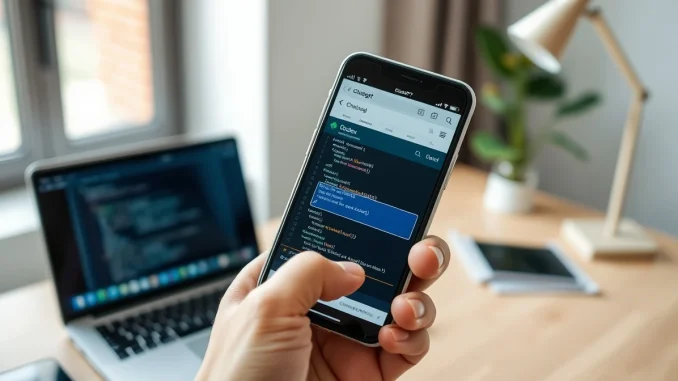
OpenAI has integrated its Codex coding agent into the ChatGPT mobile application, allowing developers to monitor and manage their development workflows remotely. The update, announced Thursday, is now available in preview across all subscription plans on both iOS and Android devices.
What the mobile integration offers
Users can now view their Codex live environments directly from their phones, review outputs, approve commands, and switch between different AI models. The feature also supports managing multiple active threads, effectively giving developers a portable command center for their coding tasks.
Also read: Google Makes Gemini’s Personalized Image Generation Free for All U.S. Users
According to OpenAI, this is more than just a remote control for a single task. The company stated that from a phone, users can work across all of their threads, review outputs, approve commands, change models, or start something new. This positions the mobile integration as a full extension of the desktop experience rather than a limited companion tool.
Background and recent updates
Codex was launched by OpenAI approximately a year ago as a specialized coding agent. Last month, the company added the ability for Codex to run autonomously in the background on desktop environments, handling tasks without constant user supervision. Earlier this month, OpenAI also introduced a Chrome extension that enables Codex to operate within live browser sessions.
Also read: Omen AI raises $31M to stop bacterial outbreaks in data center liquid cooling systems
These rapid feature releases come amid intensifying competition with Anthropic, whose Claude Code tool has gained significant traction among businesses and tech professionals over the past year. In February, Anthropic released a similar feature called Remote Control, which allows users to monitor Claude Code’s work from a distance.
Why this matters for developers
The mobile integration addresses a practical need for developers who want to stay connected to their work while away from their primary machines. Instead of needing to be physically present at a desktop to review code changes, approve deployments, or troubleshoot issues, developers can now handle these tasks from anywhere with a smartphone.
This shift toward mobile-first development tools reflects a broader trend in the software industry, where remote and hybrid work arrangements have become standard. The ability to manage complex coding workflows from a phone could reduce downtime and improve responsiveness for teams spread across different time zones.
Competitive sector
The flurry of feature releases from both OpenAI and Anthropic highlights the high-stakes competition to become the dominant AI-powered coding assistant. While OpenAI has the advantage of the widely adopted ChatGPT platform, Anthropic’s Claude Code has built a strong reputation for reliability and safety among enterprise customers.
Both companies are racing to add capabilities that make their tools indispensable for professional developers. The mobile integration from OpenAI directly counters Anthropic’s Remote Control feature, and the battle is likely to intensify as both companies continue to iterate rapidly.
Conclusion
OpenAI’s decision to bring Codex to mobile represents a significant step in making AI-powered development tools more accessible and flexible. As the competition with Anthropic heats up, developers stand to benefit from increasingly capable and portable coding assistants. The preview release on iOS and Android signals that OpenAI is prioritizing mobile as a key battleground in the AI coding assistant market.
FAQs
Q1: Is the Codex mobile feature available to all ChatGPT users?
A: The update is currently in preview and available to all subscription plans on iOS and Android. Free-tier users may have limited access depending on their plan.
Q2: Can I write new code directly from my phone using Codex?
A: Yes, the mobile integration allows users to start new tasks, review outputs, and approve commands, effectively enabling code writing and management from the phone interface.
Q3: How does this compare to Anthropic’s Remote Control feature?
A: Both features allow remote monitoring and management of coding workflows. OpenAI’s integration is built directly into the ChatGPT app, while Anthropic’s Remote Control works with Claude Code. The core functionality is similar, but the user experience and ecosystem differ.





Be the first to comment