
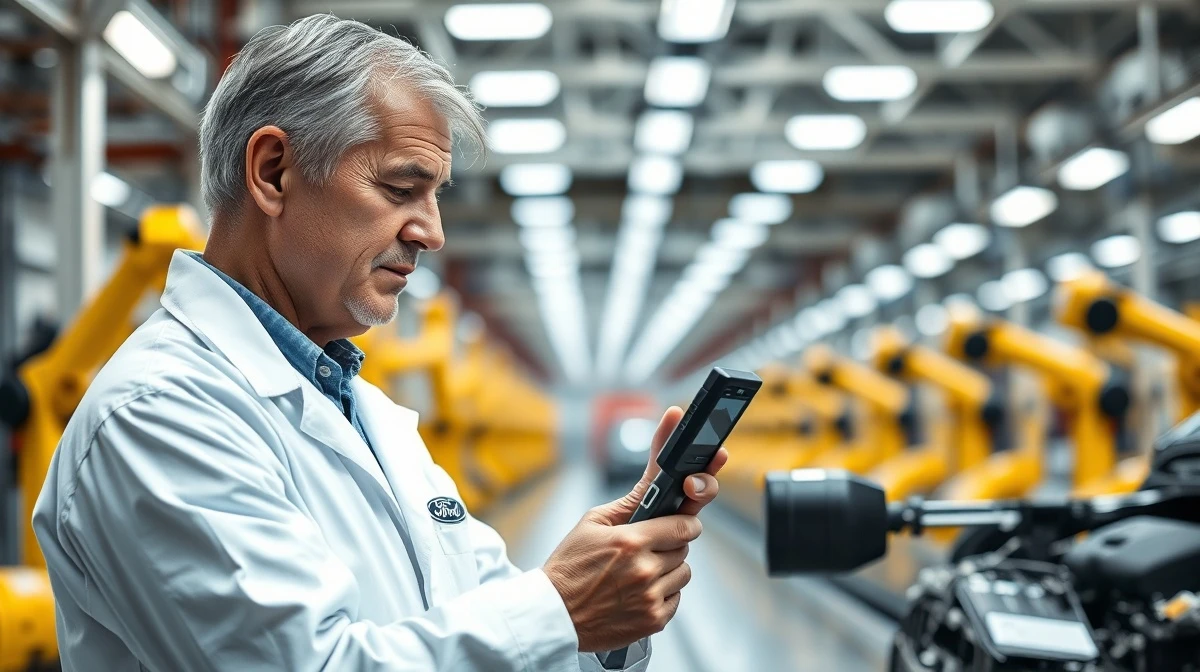
Ford Motor Company has rehired 350 veteran engineers — including former employees and specialists who had been working at supplier firms — after the automaker concluded that its artificial intelligence and automated quality systems were not delivering the expected results. The move, confirmed by Ford chief operating officer Kumar Galhotra in an interview with Bloomberg, signals a significant course correction for the company’s quality control strategy.
Why Ford’s AI quality systems fell short
Galhotra told reporters that Ford had been “relying more and more on automated quality systems” with disappointing outcomes. The company found that these systems could not replicate the nuanced failure-detection capabilities of experienced human engineers. As a result, Ford brought back technical specialists whose primary job is to “hunt for failure points before a part ever reaches the plant floor,” Galhotra said.
Charles Poon, Ford’s vice president of vehicle hardware engineering, offered a candid assessment: “Mistakenly we thought that by just introducing artificial intelligence and ingesting the design requirements that we had, that that would produce a high-quality product.”
Not an AI retreat, but a recalibration
Ford is not abandoning its AI investments. Instead, the company is using the rehired employees — referred to internally as “gray beard” engineers — to train younger staff and help reprogram its AI tools. The strategy treats human expertise as a necessary complement to automation, not a replacement for it.
Also read: Asian AI Startups Rush to Fill Void Left by US Export Ban on Anthropic’s Mythos
The early results are measurable. Ford expects the rehiring initiative to generate $1 billion in reduced costs this year. The automaker also claimed the top spot among mainstream brands in the JD Power Initial Quality Survey released this week, a notable improvement that executives linked directly to the return of experienced engineers.
Industry context and implications
Ford’s experience mirrors a broader reckoning across manufacturing industries where companies are discovering that AI and automation have limits, particularly in complex quality-control environments. While AI excels at processing large datasets and identifying patterns, it often struggles with the contextual judgment and hands-on intuition that veteran engineers bring to the factory floor.
For Ford, the lesson appears to be that technology works best when paired with deep human expertise — and that some institutional knowledge cannot be replaced by algorithms alone.
Frequently Asked Questions
Why did Ford rehire veteran engineers instead of relying on AI?
Ford’s AI and automated quality systems produced disappointing results. Executives said the systems could not replicate the failure-detection expertise of experienced human engineers, prompting the company to bring back 350 ‘gray beard’ specialists.
What are ‘gray beard’ engineers?
‘Gray beard’ engineers is an industry term for highly experienced, often older technical specialists with deep institutional knowledge. At Ford, these veterans now hunt for potential failure points in parts before they reach the assembly line.
How much money is Ford saving from this rehiring strategy?
Ford anticipates $1 billion in reduced costs this year as a direct result of bringing back veteran engineers and improving quality control processes.
Is Ford abandoning AI entirely?
No. Ford is using the rehired engineers to train younger staff and reprogram its AI tools, treating human expertise as a complement to automation rather than a replacement.
Did Ford’s quality improve after rehiring these engineers?
Yes. Ford claimed the top spot among mainstream brands in the 2026 JD Power Initial Quality Survey, a significant improvement that executives linked to the return of experienced engineers.


