
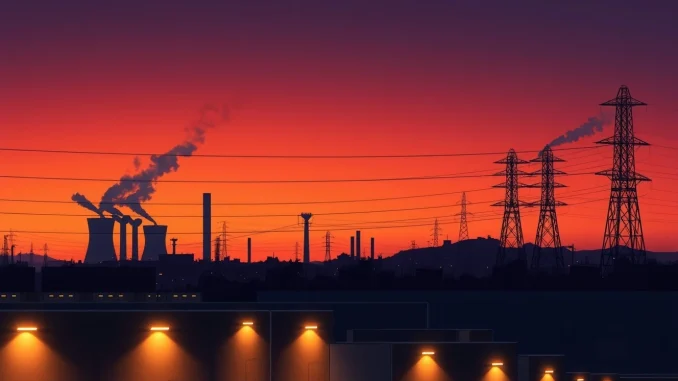
Meta’s plan to build ten natural gas power plants for a single AI data center in Louisiana will create an electricity system larger than South Dakota’s, according to company announcements and federal data. The move, which conflicts with the tech giant’s public climate goals, signals the immense energy appetite of artificial intelligence. This development, confirmed in late March 2026, places Meta’s environmental commitments under remarkable strain.
The Scale of Meta’s Hyperion Power Demand
Meta’s Hyperion data center project represents a new scale for computing infrastructure. When completed, the facility is designed to draw approximately 7.5 gigawatts of electricity. For context, the entire state of South Dakota had a total electricity generation capacity of about 7.1 gigawatts in 2024, according to the U.S. Energy Information Administration (EIA).
Also read: OpenAI Limits GPT-5.6 Rollout After U.S. Government Request, Calls Restrictions a 'Short-Term Step'
To meet this demand, Meta has committed to funding ten natural gas-fired power plants in Louisiana. The company announced the final seven plants last week, adding to three previously confirmed. This energy complex will exist primarily to feed the $27 billion data center. The power requirement is driven by the intensive computing needs of training and running advanced AI models, which use thousands of high-performance processors running constantly.
A Direct Challenge to Climate Pledges
Meta has consistently promoted its sustainability record. The company claims it achieved net-zero emissions for its global operations in 2020. It is also a founding member of the Renewable Energy Buyers Alliance and has signed numerous long-term contracts for wind, solar, and nuclear power. In 2023, Meta effectively secured the output of a nuclear power plant in Pennsylvania through a 20-year agreement.
Also read: OpenAI, Google, and SpaceX are all building their own AI chips — here's why that matters
This makes the natural gas strategy a stark contradiction. According to calculations by TechCrunch based on Department of Energy data, the ten Louisiana plants are projected to emit roughly 12.4 million metric tons of carbon dioxide annually. That figure is 50% higher than Meta’s reported total corporate carbon footprint for 2024. The company did not respond to multiple requests for comment on this discrepancy.
“When a company of Meta’s size makes an energy decision of this magnitude, it sets a precedent,” said Dr. Sarah Chen, an energy systems analyst whose research focuses on tech sector emissions. “The data suggests this single project could undo years of corporate decarbonization progress.” Chen’s analysis, published in the journal Energy Policy in February 2026, warned that unchecked data center growth could strain regional grids and increase reliance on fossil fuels.
The Persistent “Bridge Fuel” Argument
For decades, the energy industry has described natural gas as a transitional “bridge fuel.” The theory posits that gas plants can provide reliable power while renewable sources and battery storage technology mature. Meta has likely used this reasoning internally to justify the plants. However, the economics of this argument have shifted dramatically.
The levelized cost of wind and solar power has fallen by more than 70% since 2010, reports from Lazard show. Concurrently, the cost of utility-scale battery storage has dropped by nearly 90%. Meanwhile, prices for natural gas turbines have increased due to supply chain constraints and rising material costs. This convergence raises questions about the financial and environmental logic of locking in decades of gas dependency.
The Methane Problem: A Hidden Climate Cost
Carbon dioxide emissions are only part of the climate impact. The full effect of natural gas must account for methane leaks across the production and supply chain. Methane is the primary component of natural gas and has a global warming potential 84 times greater than CO2 over a 20-year period.
Even small leak rates can negate the climate advantage gas has over coal. A study by the Environmental Defense Fund published in Science in 2025 found that if more than 0.2% of produced gas leaks, its climate impact exceeds that of coal. In the United States, measured leak rates are significantly higher. Data from the EPA’s Greenhouse Gas Reporting Program and aerial surveys indicate actual methane leakage from U.S. oil and gas systems is closer to 3%.
Meta’s latest sustainability report, covering 2024, does not mention methane, natural gas, or fugitive emissions. The omission is notable given the scale of the new commitment. Accounting for a 3% methane leak rate could increase the projected climate impact of the Louisiana plants by over 40%, according to standard EPA calculation methodologies.
Industry Context and the AI Energy Crunch
Meta is not alone in facing the energy dilemma of AI. Google and Microsoft have also reported sharp increases in electricity consumption linked to artificial intelligence. A January 2026 report from the International Energy Agency (IEA) projected that global data center electricity use could double by 2028, with AI being the primary driver.
Some companies are pursuing different paths. Microsoft, for instance, is investing heavily in advanced nuclear reactor designs and long-duration energy storage. Google continues to prioritize power purchase agreements for new renewable generation, though it also relies on existing gas plants on grids where it operates. The divergent strategies highlight a lack of consensus on how to power AI sustainably.
The situation creates a tension between technological ambition and climate responsibility. AI promises breakthroughs in medicine, science, and efficiency. But its infrastructure demands vast resources. “We are building a profoundly energy-intensive digital ecosystem without a clear plan to decarbonize it,” observed Michael Ramirez, a former utility planner who now consults for tech firms on energy procurement. “The market signals for clean firm power—like advanced nuclear or geothermal—are not yet strong enough to meet this demand surge.”
Regulatory and Investor Scrutiny Looms
Meta’s move may attract increased scrutiny from regulators and shareholders. The U.S. Securities and Exchange Commission (SEC) now requires public companies to disclose climate-related risks that are likely to have a material impact on their business. Massive new emissions sources would qualify.
Furthermore, institutional investors focused on environmental, social, and governance (ESG) factors are likely to question the decision. Major asset managers like BlackRock and Vanguard have urged portfolio companies to align their business plans with a net-zero economy. A project that significantly increases a company’s carbon footprint for decades could conflict with those expectations.
Meta could attempt to offset the emissions through carbon removal credits. The company is already a significant buyer in that market. However, scaling carbon removal to cover over 12 million metric tons annually would be a monumental task. The entire global market for engineered carbon removal captured less than 1 million metric tons in 2025, according to a Carbon Brief analysis.
Conclusion
Meta’s natural gas power plan for its Hyperion AI data center reveals the stark energy reality of the artificial intelligence boom. The project’s scale—rivaling a state’s power system—underscores a fundamental challenge. Tech companies have championed climate action, but their newest and most ambitious products require immense, constant electricity. The choice of natural gas, despite falling renewable costs, suggests that when faced with the need for reliable, massive power, old energy paradigms persist. The coming years will test whether Meta and its peers can reconcile the promise of AI with the imperative of decarbonization. The Louisiana plants will be a concrete measure of that balance.
FAQs
Q1: How much power will Meta’s new data center use?
The Hyperion AI data center is designed to draw about 7.5 gigawatts of electricity. For comparison, the entire state of South Dakota had a total generation capacity of roughly 7.1 gigawatts in 2024.
Q2: Why is Meta building natural gas plants instead of using more renewables?
Natural gas plants can provide constant, dispatchable power 24/7, which data centers require. While Meta buys renewable energy, those sources like wind and solar are intermittent. Large-scale, cost-effective battery storage for multi-day periods is not yet widely deployed at the gigawatt scale needed.
Q3: What is the “bridge fuel” argument?
It’s the idea that natural gas can serve as a lower-carbon transition fuel away from coal while renewable energy and storage technologies scale up and become more reliable. Critics argue this “bridge” has extended for decades and now delays full decarbonization.
Q4: How do methane leaks affect natural gas’s climate impact?
Methane is a potent greenhouse gas. If more than 0.2% of the gas produced leaks before combustion, its total warming effect can be worse than burning coal. Measured U.S. leak rates are estimated to be around 3%, significantly worsening the climate impact.
Q5: Has Meta commented on the climate implications of these power plants?
As of early April 2026, Meta has not publicly addressed the specific emissions from the Louisiana natural gas plants. The company did not reply to multiple requests for comment from TechCrunch regarding the project’s climate footprint.





Be the first to comment