
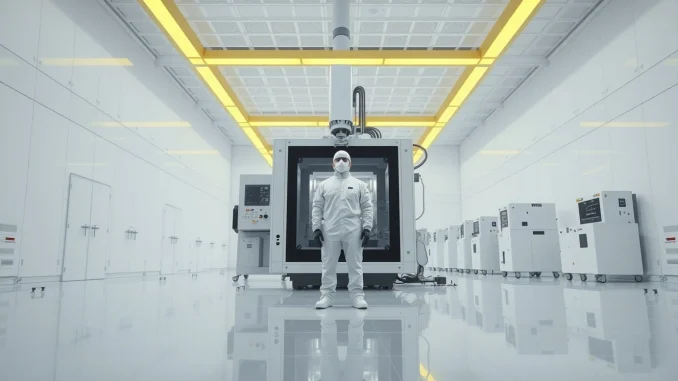
In a major strategic shift, Intel Corporation has officially joined Elon Musk’s ambitious Terafab semiconductor initiative. The move, announced on April 7, 2026, pairs the veteran chipmaker with Musk’s SpaceX and Tesla to construct a new, large-scale semiconductor factory in Texas. This partnership answers a critical question hanging over the project: who would build the complex facility. Intel stated its expertise in design, fabrication, and packaging will help accelerate Terafab’s goal of producing one terawatt per year of computing power for artificial intelligence and robotics.
Intel’s Foundry Business Gains Anchor Tenants
For Intel, the deal represents a significant win for its foundry services business, Intel Foundry. The company has aggressively pursued large, “anchor” customers to compete with Taiwan Semiconductor Manufacturing Company (TSMC) and Samsung. With SpaceX and Tesla, it now has two high-profile clients. According to Intel’s corporate post on X, the collaboration focuses on “ultra-high-performance chips at scale.” The company has not disclosed financial terms or the specific scope of its contributions. Industry watchers note this partnership could validate Intel’s renewed manufacturing push under CEO Pat Gelsinger.
Also read: OpenAI Limits GPT-5.6 Rollout After U.S. Government Request, Calls Restrictions a 'Short-Term Step'
Building a leading-edge chip fabrication plant, or fab, is a monumental task. It typically requires over $20 billion and several years. The facilities demand massive clean rooms housing thousands of precision machines. Before Intel’s involvement, analysts questioned how Tesla and SpaceX, companies with no direct semiconductor manufacturing experience, could efficiently execute such a project. “This suggests Terafab will be less of a greenfield, disruptive engineering project and more of a traditional fab build with a seasoned partner,” said a semiconductor analyst who requested anonymity because they were not authorized to speak publicly.
The Terafab Vision: AI, Satellites, and Robotics
Elon Musk first announced the Terafab project in March 2026. The goal is to develop advanced semiconductors for a range of applications across his companies. These include:
Also read: OpenAI, Google, and SpaceX are all building their own AI chips — here's why that matters
• AI Compute: Powering next-generation artificial intelligence systems.
• SpaceX Satellites & Data Centers: Supporting Starlink and a proposed space-based data center.
• Tesla Autonomy: Enabling more capable hardware for fully autonomous vehicles and the Optimus robot.
The one terawatt-per-year compute target is exceptionally ambitious. It underscores the vast processing power Musk believes will be necessary for future AI and robotics. This partnership moves the project from concept toward reality. What this means for investors is a clearer path to execution, though significant hurdles remain.
Intel’s Competitive Reckoning
This deal arrives at a decisive moment for Intel. Once the undisputed leader in U.S. chip manufacturing, the company has lost ground. Rivals like Nvidia and AMD have surged ahead in designing advanced processors. They employ a “fabless” model, outsourcing manufacturing to foundries like TSMC. Intel’s stock rose more than 3% on the news, trading at $52.28 by 2 p.m. ET on April 7. The market’s positive reaction indicates investor confidence in Intel’s strategic direction. The implication is that Intel’s manufacturing capability, once seen as a liability, is now a unique asset in the AI era.
Geopolitical and Supply Chain Context
The Terafab project aligns with broader U.S. efforts to onshore critical semiconductor production. The CHIPS and Science Act of 2022 allocated billions in incentives for domestic chip manufacturing. A new fab in Texas would bolster U.S. supply chain resilience. Data from the Semiconductor Industry Association shows the U.S. share of global chip manufacturing capacity has fallen from 37% in 1990 to about 12% today. Building advanced logic chips domestically is a national priority. This partnership could position the Terafab facility to potentially access federal funding.
But challenges are immense. TSMC’s own new Arizona fabs have faced construction delays and skilled labor shortages. Intel itself has encountered setbacks in rolling out its latest manufacturing nodes. The Terafab project’s success hinges on overcoming these industry-wide obstacles. It also depends on streamlined coordination between three companies with distinct cultures.
Market Reactions and Unanswered Questions
Intel’s share price jump reflects optimism. However, many details are still unknown. The specific location in Texas has not been announced. The planned technology node—how advanced the chips will be—remains undisclosed. It is also unclear how the intellectual property developed will be shared among the partners. Neither Intel nor SpaceX responded to requests for comment by press time. This lack of detail is common in early-stage mega-projects but leaves room for uncertainty.
The collaboration could also reshape competitive dynamics. If successful, Tesla and SpaceX would gain a measure of control over their chip destiny, reducing reliance on external suppliers like Nvidia. For Intel, it represents a chance to prove its manufacturing technology can support the most demanding customers. “This is a high-stakes proof of concept for Intel Foundry,” an industry consultant noted.
Conclusion
Intel’s entry into the Terafab chip project transforms it from a Musk-led vision into a concrete industrial plan. The partnership leverages Intel’s manufacturing expertise to pursue a terawatt-scale compute goal for AI and robotics. While significant execution risks persist, the deal marks a strategic triumph for Intel’s foundry ambitions and a critical step in U.S. efforts to reclaim semiconductor leadership. The success of the Intel Terafab collaboration will be a key indicator of whether American chip manufacturing can meet the demands of the AI age.
FAQs
Q1: What is the Terafab project?
Terafab is a semiconductor manufacturing initiative announced by Elon Musk in March 2026. It involves SpaceX and Tesla and aims to build a factory producing chips for AI, satellites, and autonomous vehicles. Intel joined as a manufacturing partner in April 2026.
Q2: Why is Intel’s involvement significant?
Intel brings decades of experience in building and operating semiconductor fabrication plants. Its participation answers the major question of who would construct the highly complex facility, giving the project immediate technical credibility.
Q3: Where will the Terafab factory be built?
The announcement specifies Texas, but an exact location has not been disclosed. Both Tesla and SpaceX have major operations in the state, suggesting a likely site near Austin or the Boca Chica launch facility.
Q4: What does “1 TW/year of compute” mean?
It refers to a manufacturing target of chips capable of delivering one terawatt of computing power per year. This is an immense amount of processing capability, highlighting the project’s focus on supplying hardware for large-scale AI and robotics workloads.
Q5: How did the stock market react to the news?
Intel’s stock price rose more than 3% following the announcement on April 7, 2026, reflecting investor optimism about the deal’s potential to boost Intel’s foundry business and future revenues.



Be the first to comment