
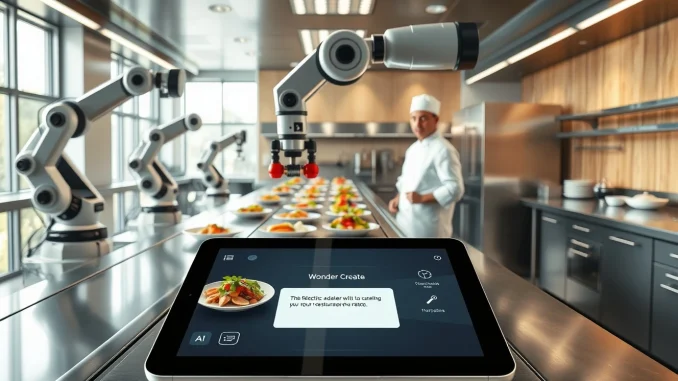
Marc Lore, the veteran e-commerce entrepreneur who sold his previous startups to Amazon and Walmart, now reveals how AI will let anyone open a restaurant in under a minute. His current venture, Wonder, is rolling out Wonder Create, an AI-powered platform that transforms food entrepreneurs, influencers, and even nonprofits into virtual restaurant owners. The system uses a simple prompt: users type what kind of restaurant they want, and AI generates the brand, recipes, pricing, and health information instantly. This development marks a significant shift in the food industry, merging artificial intelligence with physical kitchens.
How AI Restaurant Creation Works
Wonder Create operates as a Shopify-like front-end combined with an AI prompt. Users describe their desired cuisine, and the AI builds the entire restaurant concept in under 60 seconds. This includes the name, branding, description, pictures, pricing, nutritional data, and all recipes. If changes are needed, users refine the prompt until satisfied. Once finalized, the virtual restaurant goes live across Wonder’s network of programmable cooking platforms.
Also read: OpenAI Limits GPT-5.6 Rollout After U.S. Government Request, Calls Restrictions a 'Short-Term Step'
These platforms are not traditional restaurants. They are tech-enabled kitchens that can operate as 25 different types of restaurants based on cuisine. Each location has a 700-ingredient library and a staff of up to 12 people, supported by conveyors and robotic arms. The company recently acquired Spice Robotics, a maker of automatic bowl-making machines, and plans to introduce an infinite sauce machine in 2026 that can produce 80% of all sauces found in online recipes.
Marc Lore’s Vision for Virtual Restaurants
Speaking at The Wall Street Journal’s Future of Everything conference, Lore explained that the goal is to democratize restaurant ownership. He envisions a world where anyone can monetize their following or experiment with food without the overhead of a physical location. Influencers can launch their own brands, personal trainers can create specific meal bowls, and nonprofits can promote causes through food. Even Disney could use the platform to market a new movie with a themed restaurant.
Also read: OpenAI, Google, and SpaceX are all building their own AI chips — here's why that matters
Lore’s strategy builds on Wonder’s acquisitions: Grubhub for its delivery network (250 million deliveries per year) and Blue Apron for meal kit expertise. The company also buys restaurant brands, like New York City-based Blue Ribbon Fried Chicken, which it acquired for $6.5 million in February. Lore sees an arbitrage opportunity in taking a brand with 10 or 50 locations and scaling it to 1,000 overnight through Wonder’s network.
The Technology Behind Programmable Kitchens
Wonder’s kitchens are all-electric, programmable cooking platforms that use robotics to increase throughput. Currently, 120 locations operate with a capacity of 7 million meals per year using 12 staff members. Lore projects that with added robotics, throughput can reach 20 million meals from the same 2,500 square feet. By 2035, he aims to have 1,000 unique restaurant brands operating from a single kitchen location.
The system relies on a 700-ingredient library and automated cooking processes. Robotic arms handle repetitive tasks like flipping burgers and assembling bowls, while conveyors move ingredients through cooking stations. This reduces labor costs and ensures consistency across all locations. However, there are limits: the robots cannot toss pizza dough, slice sushi, or perform other complex culinary techniques. Wonder focuses on simpler fare like burgers, chicken wings, fried chicken, and bowls.
Lessons from Ghost Kitchens
The concept of virtual restaurants is not new. Ghost kitchens promised similar benefits in the early 2020s but faced significant challenges. High-profile operators like MrBeast Burger struggled with inconsistent food quality because they relied on dozens of different contracted kitchens. Customers complained about cold food, wrong orders, and long wait times. Many ghost kitchen operators scaled back or shut down entirely.
Wonder’s approach differs by using vertically integrated, programmable kitchens that ensure every dish is prepared the same way, regardless of location. The combination of AI-driven menu creation and robotic cooking aims to solve the quality control issues that plagued earlier models. However, the model remains unproven at scale, and it is unclear whether consumers will embrace AI-generated restaurant brands.
Impact on the Food Industry
AI restaurant creation could disrupt traditional food service in several ways. First, it lowers the barrier to entry for aspiring restaurateurs. Instead of investing hundreds of thousands of dollars in a physical location, users can launch a brand for a fraction of the cost. Second, it enables rapid experimentation. Chefs can test new recipes and gauge customer reactions before committing to a brick-and-mortar location. Third, it creates new revenue streams for influencers and content creators who want to monetize their audiences through food.
However, critics argue that the model may struggle to build customer loyalty. Ghost kitchens failed partly because consumers did not form emotional connections with brands that existed only on delivery apps. Wonder’s AI-generated brands face the same challenge. Without a physical storefront or human interaction, customers may view these brands as disposable or generic. Additionally, the reliance on automation raises questions about job displacement in the food service industry.
Expert Perspectives on AI in Food
Industry analysts point out that Wonder’s success depends on execution. The company must prove that its kitchens can consistently produce high-quality food at scale. If the AI-generated recipes fail to meet customer expectations, the entire model could collapse. On the other hand, if Wonder succeeds, it could redefine how food is created, marketed, and delivered.
Lore acknowledges these challenges. He admits that the system cannot handle complex dishes like sushi or artisan pizza. Instead, Wonder focuses on simpler, scalable items that lend themselves to automation. The company also plans to use customer feedback to refine AI-generated menus over time, creating a feedback loop that improves quality.
Timeline and Next Steps
Wonder currently operates 120 programmable kitchens and expects to expand to 400 locations by 2026. The company is actively acquiring restaurant brands and integrating them into its network. The infinite sauce machine is scheduled for release next year, and the Spice Robotics acquisition will enhance bowl-making capabilities. Lore’s ultimate goal is to have 1,000 unique restaurant brands operating from each kitchen by 2035.
For now, Wonder Create is in its early stages. The platform is available to select users, and the company is gathering data on customer preferences. If the model proves successful, it could pave the way for a new era of AI-driven food entrepreneurship. If it fails, it will join the ranks of ghost kitchen experiments that promised much but delivered little.
Conclusion
Marc Lore’s vision for AI restaurant creation represents a bold attempt to merge technology with food service. By allowing anyone to open a restaurant in under a minute, Wonder Create democratizes access to the food industry. The combination of AI-generated brands, programmable kitchens, and robotic cooking could address the quality control issues that plagued earlier ghost kitchen models. However, significant challenges remain, including building customer loyalty and proving the model at scale. As Wonder expands to 400 locations, the industry will watch closely to see whether AI can truly transform how we create and consume food.
FAQs
Q1: What is Wonder Create?
Wonder Create is an AI-powered platform that lets anyone design and launch a virtual restaurant brand in under a minute. Users type a prompt describing their desired cuisine, and AI generates the name, branding, recipes, pricing, and health information. The restaurant then goes live across Wonder’s network of programmable kitchens.
Q2: How does Marc Lore’s AI restaurant differ from ghost kitchens?
Ghost kitchens relied on multiple contracted kitchens to prepare food, leading to inconsistent quality. Wonder uses vertically integrated, programmable kitchens with robotic cooking to ensure every dish is prepared the same way. This approach aims to solve the quality control issues that ghost kitchens faced.
Q3: Can anyone use Wonder Create to open a restaurant?
Yes, Wonder Create is designed for anyone, including food entrepreneurs, social media influencers, personal trainers, and nonprofits. Users do not need culinary experience or a physical location. The platform handles all aspects of restaurant creation and operations.
Q4: What types of food can Wonder’s kitchens prepare?
Wonder’s kitchens focus on simpler items like burgers, chicken wings, fried chicken, and bowls. The robots cannot handle complex dishes like pizza dough tossing or sushi rolling. The system uses a 700-ingredient library and automated cooking processes to ensure consistency.
Q5: How many locations does Wonder have, and what are the expansion plans?
Wonder currently operates 120 programmable kitchen locations. The company expects to expand to 400 locations by 2026. Each location can operate as up to 25 different restaurant brands, with a goal of hosting 1,000 unique brands per kitchen by 2035.




Be the first to comment