
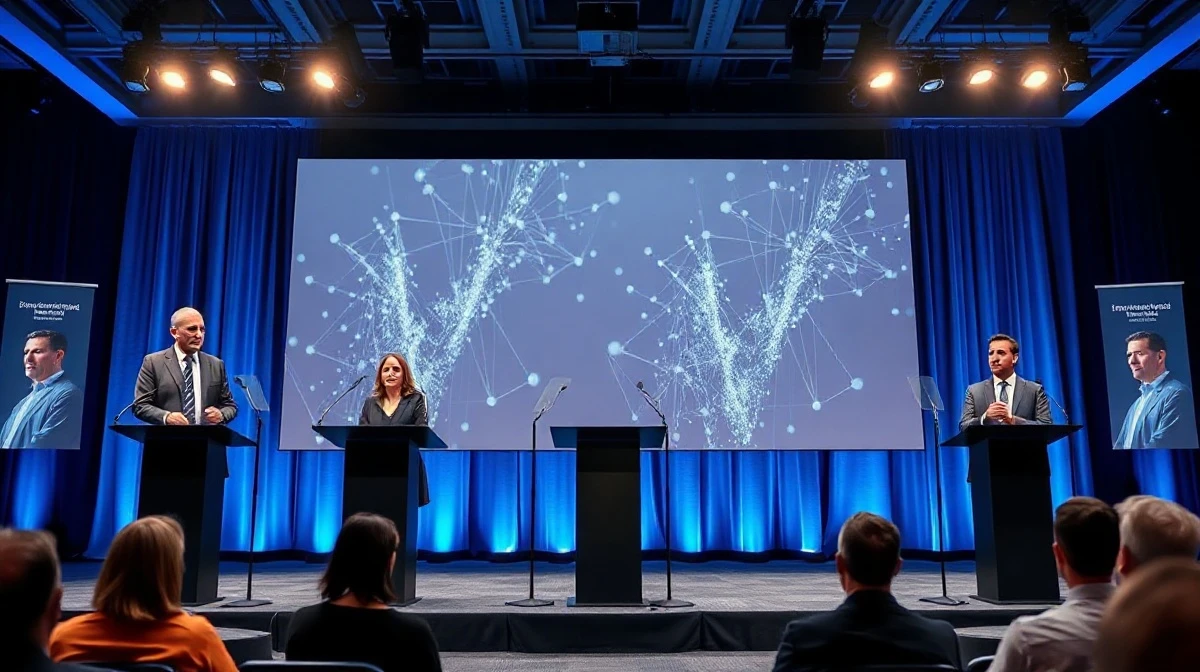
LAS VEGAS — At the Ai4 conference last week, three of AI’s most influential figures — Nobel laureate Geoffrey Hinton, World Labs CEO Fei-Fei Li, and Coursera co-founder Andrew Ng — took the stage to confront a question that has split the industry: should the most powerful AI models be freely available, or kept under lock and key?
The debate over open-weight models has intensified as major labs like OpenAI and Anthropic push for stricter controls, citing safety risks. But the three researchers, each with a distinct perspective, made a unified case for keeping AI development open — even as they disagreed on the details.
Gatekeepers vs. Global Competition
Andrew Ng framed the issue in terms of market power. He warned that if a few companies control access to AI, innovation could stagnate, drawing a parallel to the mobile operating system duopoly of Apple and Google. “I don’t want there to be gatekeepers,” Ng said. “That limits how all of us can access AI.”
Ng’s prescription was straightforward: promote openness and maintain a competitive market with multiple providers. “AI is amazing technology and I want it to be in everyone’s hands,” he said.
Also read: Hugging Face launches Microduck, a $399 open-source duck robot you can teach new tricks
But Ng also raised a geopolitical concern. He noted that China’s open-weight models are gaining traction in developing regions, which could shift global influence. “One thing I hope we do is encourage American competitiveness and open-source AI,” Ng said, warning that excessive U.S. regulation could cede the field to Chinese models.
Hinton: Open Weights Are a Done Deal
Geoffrey Hinton drew a sharp line between open-source software and open-weight models. “Open source is great. You show people the code… Open weights means you train a big model and then you give people the weights. That’s very different,” he said, noting that open weights make it easy for bad actors to fine-tune models for cyber attacks.
Despite his reservations, Hinton conceded that the battle is over. “I think that battle’s been lost. We now have open-weight models, so the barrier to lots of people getting these big models… that barrier has disappeared. It’s too late.”
Still, Hinton maintained that AI’s benefits — in productivity, education, and healthcare — outweigh the risks, and he pushed back against labeling safety concerns as fear-mongering.
Li: A False Dichotomy
Fei-Fei Li rejected the binary framing. “It’s very dangerous to make this a dichotomy between complete openness all the way to complete closedness,” she said. Drawing on nuclear physics, she noted that scientific papers are published openly while uranium is regulated — a layered approach.
Li pointed to the Human Genome Project as a model, where open knowledge became a platform for commercial and scientific progress. “We need some levels of openness… but we also will accept closed-source systems. This debate… is a false debate,” she said.
All three agreed on one point: regulation is necessary. Hinton summed it up: “What we want to do is develop AI in a direction that helps people, and regulation will help us do that. You can’t leave it to people like Elon Musk and Mark Zuckerberg to decide how AI should be done.”
As the industry moves forward, the question of how to balance openness with safety remains unresolved, but the consensus from these pioneers is clear: the genie is out of the bottle, and the focus must shift to responsible governance rather than futile attempts to restrict access.
Disclaimer: This article is for informational purposes only and does not constitute financial or investment advice. The cryptocurrency and AI markets are volatile and uncertain; readers should conduct their own research before making any decisions.


