
In this article3 sections
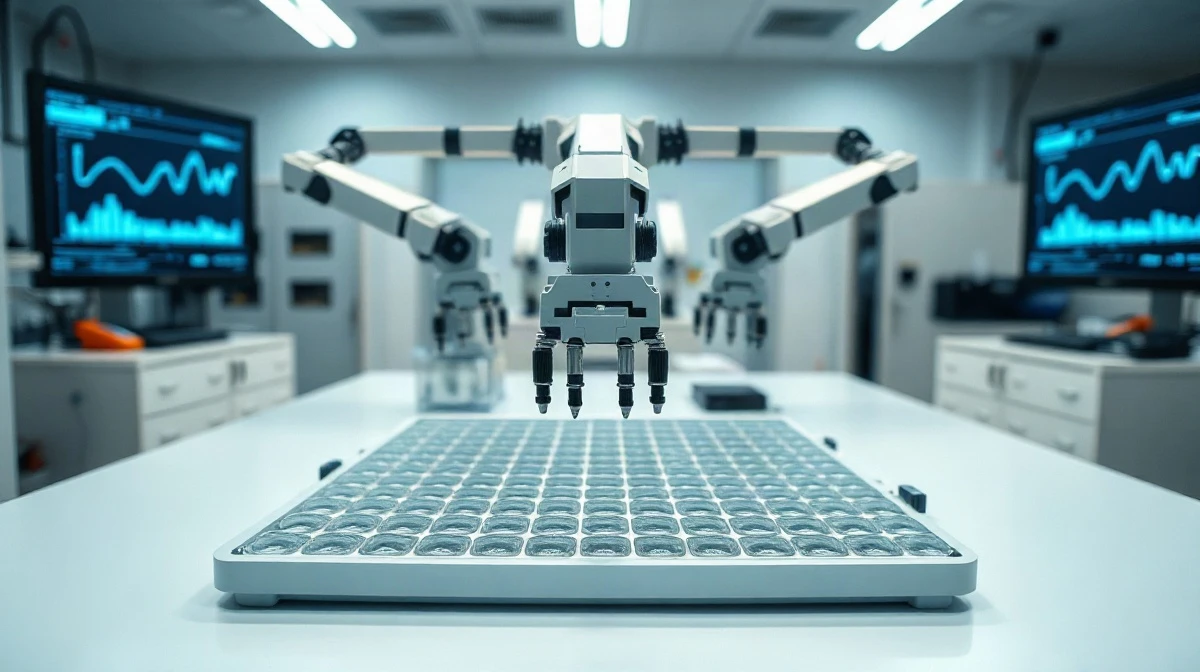
Vivodyne, a biotech startup spun out of the University of Pennsylvania in 2021, is betting that the future of AI-driven medicine hinges on a simple but elusive resource: high-quality data from living human tissue. The company, which has raised just under $80 million from investors led by Khosla Ventures, last week opened what it calls the world’s largest “human data center” outside San Francisco. Its core technology, a modular robotic lab system called HIVE, can grow 20 kinds of human tissue, then autonomously dose and monitor them, generating the kind of causal biological data that today’s AI models largely lack.
The timing is pointed. Across the tech industry, executives have repeatedly floated the idea that artificial intelligence will soon cure cancer. Anthropic CEO Dario Amodei has made such claims in the past, and OpenAI’s Sam Altman has cited curing cancer as a justification for pursuing AGI. Google DeepMind’s Demis Hassabis said last year that AI could potentially cure all disease within a decade. But the actual results have been tepid, and Amodei himself acknowledged over the weekend that the promise has become “more cliche than credible.”
Also read: Meta launches Pocket, an AI-powered app for creating and sharing mini-games, across the US
Vivodyne’s CEO and co-founder, Andrei Georgescu, puts it more bluntly. “Absent human testing, what are these models going to do?” he told TechCrunch. “They’re going to cure cancer in mice.”
The data problem at the heart of AI drug discovery
The core issue, Georgescu argues, is that most biological data used to train AI models comes from animal testing, or from studies of single cells or proteins. These sources fail to capture the complexity of human biology. A recent study published in Nature Methods found no clear data scaling laws when training generative AI models on existing cellular data. The models learn static snapshots, not the dynamic processes that lead from one cellular state to another.
Also read: Google Maps' Ask Maps gets agentic upgrades: order food, book hotels, and plan trips with AI
“All the training is done on static snapshots of these cells, and the models are not conditioned at all by how a cell got to that state,” Georgescu said. “In other words, the model learns ‘this is cell state A,’ ‘this is cell state B,’ but never ‘cell state B is the effect of inflaming cell state A.'”
This gap has real-world consequences. The pharmaceutical industry faces a staggering failure rate: 90% of drugs that succeed in animal testing fail to win regulatory approval in human trials. Vivodyne’s approach is designed to change that calculus by providing a more reliable bridge between preclinical research and human outcomes.
Building a “human data center”
Vivodyne’s HIVE machines are already at work, tracking hundreds of thousands of ongoing experiments where diseased tissue is exposed to various stimuli. The company says its tissues closely match real human organ behavior. Its liver cells have 94% predictive accuracy compared to human trials that test for toxicity; its airway tissue matches human behavior 96% of the time; and its bone marrow has achieved 100% concordance in tests of 20 different chemotherapy drugs.
Georgescu says his team is already achieving twice the throughput of all animal trials currently being conducted in the United States. The goal is to give drugmakers a better idea of what will work before they commit to clinical trials, which typically cost tens of millions of dollars. He compares the approach to automotive crash testing: an automaker is confident a car will pass NHTSA requirements before testing it, but drugmakers rarely have that same confidence entering a clinical trial.
While Vivodyne won’t name its partners publicly, it says it is working with multiple major pharmaceutical companies to address this problem.
Beyond the hype: what this means for the future of medicine
Georgescu sees a larger vision: generating the causal data needed to train new AI models on human biology. He believes this will be key not just for today’s medicine, but for a future where complex diseases require combination therapies that target multiple pathways.
“If we want combination therapies, the space that has to be searched explodes—it can’t be an experimental approach,” he said. “You have to say, ‘I want this effect to happen, so what cause should I invoke?’ Establishing causality in human biology is the basis of all of this.”
That vision is still far from the sweeping promises made by tech executives. AI-designed drugs are only beginning to enter human trials, with a few in Phase II and one in Phase III. Nobel Prize-winning AlphaFold was a major advance in understanding protein structures, but it has yet to produce a new drug. Isomorphic Labs, founded to build on AlphaFold, is expecting its first trials by the end of this year, after originally planning them for 2025.
For now, Vivodyne’s pitch is more modest: better data, better models, and eventually, better drugs. Whether that translates into the breakthroughs the industry has promised remains to be seen, but the company is betting that the path to curing cancer runs through a lab in San Francisco, not a data center full of GPUs.
This article is for informational purposes only and does not constitute financial or investment advice. The biotech and AI sectors are volatile and subject to significant uncertainty.
Source: TechCrunch