
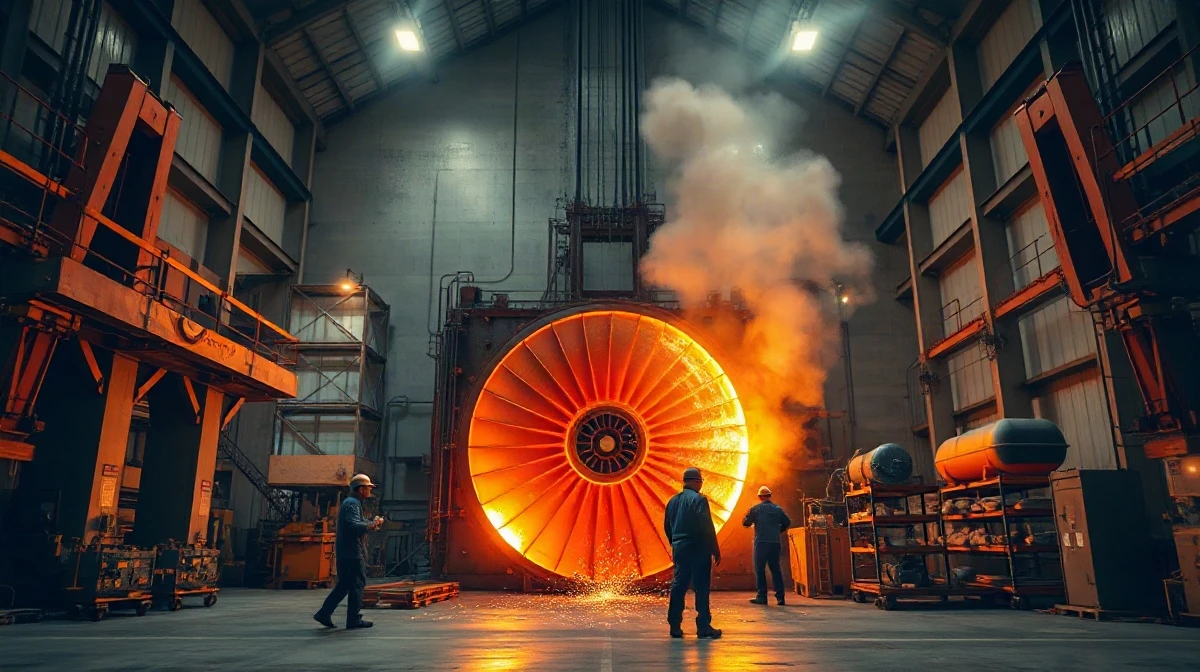
Elon Musk confirmed on Saturday that a secret SpaceX foundry in Bastrop, Texas, is being used to cast gas turbine blades and vanes — a component he called the limiting factor for natural gas turbine production. In a post on X, Musk said in-house casting could accelerate gas turbines coming online by up to 18 months, calling it a “profound turning point” for AI infrastructure. The confirmation followed a report from The Information that cited job listings for a “blades and vanes foundry” and land purchases of roughly 830 acres near SpaceX’s Starlink factory between March and June.
The move targets a critical bottleneck in the AI buildout: the physical power grid. The International Energy Agency projects global data center electricity use will roughly double by 2030, and GE Vernova, a major gas turbine maker, says it is essentially sold out through 2030 due to AI demand. Hyperscalers including Amazon, Google, Meta, OpenAI, and Microsoft have turned to building private gas-fired plants next to data centers to bypass grid delays.
Also read: SpaceX's $75B IPO rests on three near-impossible engineering feats
The casting bottleneck and why it matters
Gas turbine blades operate in the hottest section of the turbine, at temperatures around 3,000 to 3,600 degrees Fahrenheit — roughly 800 degrees hotter than the melting point of the metal alloy they’re made from. They survive only because of internal cooling channels, thermal-barrier coatings, and a precise casting process that produces each blade as a single, unbroken crystal, grown slowly in a vacuum furnace to avoid microscopic seams that could cause cracking.
Only four companies worldwide have mastered this process at industrial scale, and all are currently at capacity. The difficulty increases with the larger blades used in power-plant turbines compared to jet engines. If SpaceX succeeds, it would give Musk-controlled entities a manufacturing capability that competitors currently depend on an oligopoly for, potentially reshaping the economics of AI data center construction.
Also read: Starcloud raises $250M for orbital AI data centers as launch market tightens
Pollution concerns and community backlash
But the push for faster turbine deployment is colliding with environmental and health concerns. In Memphis, where SpaceXAI has operated gas turbines to power its Colossus data centers since 2024, the NAACP has accused the company of operating without required permits and pollution controls. The turbines emit smog-forming compounds and hazardous chemicals like formaldehyde, which are linked to asthma, respiratory disease, and certain cancers. University of Memphis researchers found air pollution grew “slightly worse” near the site, though they noted their analysis was limited.
Similar disputes are emerging elsewhere. In Virginia’s “Data Center Alley,” a study commissioned by the Piedmont Environmental Council used the EPA’s COBRA model to estimate that emissions from a single facility’s eight full-time gas turbines could reach over 2.5 million people across multiple counties, causing an estimated 3.4 to 6.5 premature deaths per year and $53 million to $99 million in annual health damages, with the heaviest impact on marginalized communities.
These findings are fueling federal lawsuits and peer-reviewed research that question whether the AI boom’s energy demands are being met at the expense of public health. For Musk, the bet is that faster turbine production outweighs these costs — but the math is getting harder to ignore as communities push back.
Disclaimer: This article is for informational purposes only and does not constitute financial advice. The cryptocurrency and AI infrastructure markets are volatile and uncertain; readers should conduct their own research before making any investment or business decisions.