
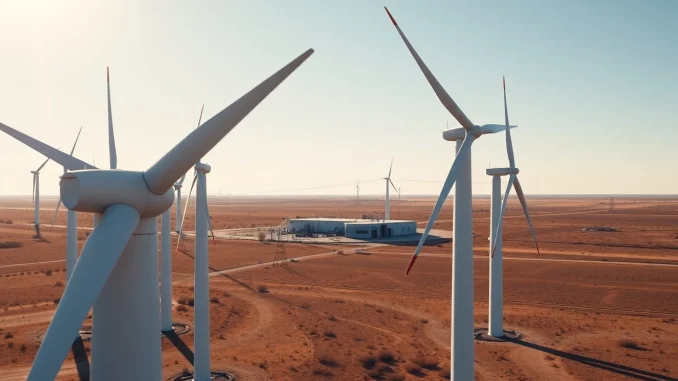
In a move that underscores a fundamental industry realignment, Bitcoin mining firm Soluna Holdings has purchased a major wind farm in Texas for $53 million. The acquisition, finalized on April 2, 2026, is designed to power a new artificial intelligence data center campus, marking a decisive pivot away from the volatile economics of cryptocurrency mining.
Soluna’s Strategic Shift from Bitcoin to AI
Soluna Holdings, a company once focused squarely on mining Bitcoin, announced the closure of its deal for the Briscoe Wind Farm. Located in Briscoe County, Texas, the facility boasts a potential capacity of 300 megawatts. Company forecasts suggest the wind-powered operation will generate between $20 million and $24.4 million in annual revenue. This transaction follows Soluna’s initial expansion into AI data center infrastructure in February 2024. The company’s share price reacted positively, rising approximately 7.6% to trade around $0.76 following the news.
This shift is not happening in a vacuum. Industry watchers note that Soluna’s strategy mirrors a broader trend among crypto miners. Faced with compressed profit margins, many are seeking more stable revenue streams. High-performance computing for artificial intelligence presents a logical alternative. It uses similar infrastructure—power-hungry processors in data centers—but often comes with longer-term contracts and different economic drivers.
The Crushing Economics of Modern Bitcoin Mining
The push toward AI is a direct response to severe pressure in the Bitcoin mining sector. Data reveals a stark picture. According to a March 2026 report from asset manager CoinShares, up to 20% of mining companies are currently unprofitable. The report stated that the fourth quarter of 2025 was “the most challenging quarter for Bitcoin miners since the April 2024 halving.”
Also read: Spain’s CNMV Chair Rules Out MiCA Deadline Extension for Crypto Firms, Impacting Binance
Several factors converged to create this squeeze. The average cost to mine a single Bitcoin surged to nearly $80,000 in Q4 2025. Meanwhile, Bitcoin’s market price has struggled to stay above that level for sustained periods. The network’s total computational power, or hashrate, continues to climb. This increases competition and energy use for each block reward. Furthermore, the October 2025 market crash saw Bitcoin’s price plummet from around $125,000 to approximately $60,000. This volatility devastated miner balance sheets.
To cover operating costs, mining companies sold over 15,000 BTC between October 2025 and early March 2026. The selling pressure has continued in recent weeks. This suggests many operations are barely covering costs, if at all.
Renewable Energy as a Lifeline
In this harsh climate, access to cheap, reliable power is no longer just an advantage—it’s a requirement for survival. This is where renewable energy projects like Soluna’s wind farm enter the equation. For companies operating data centers, whether for AI or crypto, power is the single largest operational expense. Securing a dedicated, low-cost power source provides a critical buffer against market swings.
Soluna is not alone in this approach. Other mining entities, including The Phoenix Group and Sangha Renewables, have also pursued renewable energy solutions to remain competitive. In September 2025, mining hardware maker Canaan partnered with Soluna to deploy a wind-powered Bitcoin mining facility at the same Briscoe, Texas site. That existing relationship likely facilitated the latest $53 million acquisition for AI.
The AI Data Center Gold Rush
The demand for AI compute is exploding. Tech giants and startups alike are scrambling for capacity to train and run large language models. This has triggered a rush to build and power data centers. Industry analysts suggest AI may already consume more power globally than the entire Bitcoin network. That fact isn’t lost on mining companies sitting on power contracts and infrastructure expertise.
For a firm like Soluna, repurposing its operational knowledge offers a clear path. The company understands how to manage large-scale, 24/7 computing loads. It has experience negotiating power purchase agreements and managing grid interconnectivity. Transitioning from solving cryptographic puzzles to processing AI workloads represents a technical shift, but not a foundational one. The core business—turning electricity into computed value—remains the same.
Financial Implications and Market Reaction
The market’s positive response to Soluna’s deal is telling. A 7.6% stock jump indicates investor approval of the strategic direction. The company is moving from a purely speculative asset production model (Bitcoin) to a contracted service model (AI compute). This could lead to more predictable cash flows. Project Dorothy 3, the AI campus to be powered by the wind farm, is central to this new identity.
What this means for investors is a fundamental re-rating of the company’s risk profile. Bitcoin mining revenue is directly tied to the highly volatile BTC price and network difficulty. AI infrastructure revenue, however, could be anchored by multi-year contracts with cloud providers or AI firms. The stability is attractive, even if margins in competitive AI hosting are also being compressed.
The Broader Industry Crossroads
Soluna’s acquisition is a significant data point in a larger story. The cryptocurrency mining industry is at a crossroads. The post-halving environment, combined with high energy costs and lower Bitcoin prices, has forced a reckoning. Companies must diversify or face extinction. The pivot to AI is the most prominent diversification play, but it requires massive capital expenditure and technological adaptation.
Not every miner will succeed. The move demands new customer relationships, different technical staffing, and revised financial modeling. However, for those with access to stranded or cheap power, the incentive is overwhelming. The implication is a gradual blurring of lines between crypto mining, traditional data centers, and AI infrastructure providers.
Conclusion
Soluna’s $53 million purchase of the Briscoe Wind Farm is more than a simple asset acquisition. It is a bold bet on a future where the company’s value is derived from powering artificial intelligence, not just mining Bitcoin. This move highlights the severe economic pressures facing crypto miners and underscores the vast energy demands of the AI revolution. As the industry evolves, the integration of renewable energy sources with high-performance computing will likely become the standard, not the exception. Soluna’s pivot may well become a blueprint for other miners seeking a path to sustainable profitability.
FAQs
Q1: Why is Soluna, a Bitcoin miner, buying a wind farm for AI?
Soluna is diversifying its business due to declining profitability in Bitcoin mining. The AI sector offers growing demand for computing power, and owning a wind farm provides a low-cost, dedicated energy source to run AI data centers competitively.
Q2: How bad is the current situation for Bitcoin miners?
Data from CoinShares shows up to 20% of miners are unprofitable. The average cost to mine one Bitcoin hit nearly $80,000 in late 2025, a price Bitcoin has often traded below. Many miners have been forced to sell their Bitcoin holdings to pay operating expenses.
Q3: What is Project Dorothy 3?
Project Dorothy 3 is Soluna’s planned AI data center campus in Texas. The newly acquired Briscoe Wind Farm will supply up to 300 megawatts of power to this facility, which is designed specifically for high-performance computing workloads like AI and machine learning.
Q4: Are other Bitcoin mining companies making similar moves?
Yes. There is an industry-wide trend of miners exploring AI and other high-performance computing services. Companies like Hut 8 and Core Scientific have also announced initiatives in this area, seeking more stable revenue streams.
Q5: Does AI really use more energy than Bitcoin mining?
Some analyses suggest the total power demand for AI training and inference may have already surpassed that of the Bitcoin network. The rapid growth of AI models guarantees its energy footprint will continue to expand, creating competition for affordable power.




Be the first to comment