
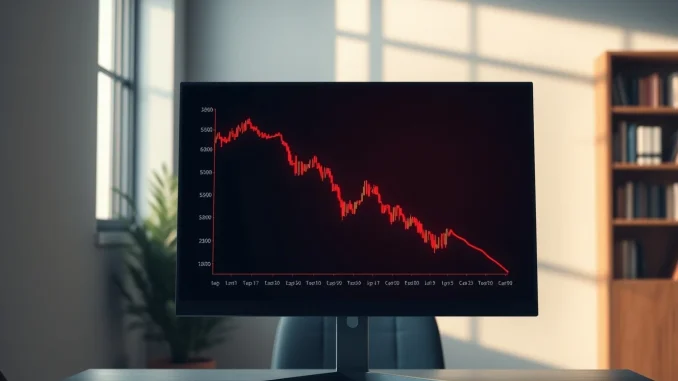
Ether faces a decisive moment in early April 2026. The cryptocurrency’s price action has reached a critical inflection point at the $2,400 level. Market data reveals mounting pressure that could push ETH to its lowest levels in over a year if current support fails to hold.
Ether’s Precarious Position at $2,400
According to trading data from Cointelegraph and TradingView, Ether has faced repeated rejections near $2,150 over the past two months. This level has acted as strong resistance on at least seven separate occasions. Despite forming a pattern of higher highs and higher lows on daily charts, the dominant trend remains constrained by this ceiling.
The immediate challenge is clear. Ether must convert the $2,150 to $2,400 range from resistance into reliable support. Failure to secure daily candle closes above this zone increases downside risk significantly. Technical analysis suggests a break below the current ascending trendline would shift focus to the $1,900 level.
That level represents liquidity near equal lows formed in early March 2026. Losing $1,900 would constitute a bearish break of structure. The implication is direct exposure to Ether’s yearly low at $1,736. What this means for investors is a potential 28% decline from current levels if the technical breakdown occurs.
Also read: Spain’s CNMV Chair Rules Out MiCA Deadline Extension for Crypto Firms, Impacting Binance
Futures Market Signals Mounting Pressure
Data from derivatives markets paints a concerning picture. CoinGlass liquidation heatmaps show a significant imbalance within a 10% range of Ether’s current price. Approximately $2.4 billion in long liquidations cluster near $1,845, while $1.7 billion in short liquidations sit near $2,255.
This skew indicates larger downside liquidity. But there’s a important nuance. The short positioning hasn’t increased dramatically despite recent price weakness. Industry watchers note this suggests passive positioning rather than conviction-driven selling. Traders appear to be waiting rather than aggressively betting on further declines.
CryptoQuant data reveals a specific event that intensified pressure. Following geopolitical developments in mid-March 2026, Ether taker sell volume on Binance spiked by $1 billion within one hour. Analyst Darkfost highlighted this surge as futures-driven sell pressure entered the market.
Macroeconomic Factors Driving Volatility
Ether’s price action continues to correlate with broader market sentiment. Global macroeconomic events and risk asset appetite remain primary drivers. The ongoing geopolitical situation involving the US and Iran has created sustained uncertainty throughout March 2026.
Market participants have responded by reducing exposure to volatile assets. This suggests traditional risk-off behavior is influencing cryptocurrency markets. The correlation between Ether and traditional risk assets appears to have strengthened during this period of tension.
Historical data shows that during similar periods of geopolitical uncertainty in 2022 and 2024, cryptocurrency markets experienced heightened volatility. The current environment follows this established pattern. What’s different now is the specific technical setup Ether faces at key support levels.
Technical Analysis: The Path Forward
Technical indicators present two clear scenarios for Ether in April 2026. The bullish case requires a sustained move above $2,150 resistance. Achieving this would open a path toward $2,400 where resistance is relatively thin according to chart analysis.
Clearing $2,400 could trigger movement toward $2,800. This zone represents an expansion area with limited trading activity over the past six months. A breakthrough here would signal a significant shift in market structure.
The bearish scenario is more immediate. Continued failure at $2,150 keeps Ether range-bound between this resistance and the $1,900 liquidity pivot. A breakdown below $1,900 introduces the possibility of testing the yearly low at $1,736. This would represent new 2026 lows for the cryptocurrency.
Key technical levels to watch:
- Immediate resistance: $2,150 – $2,400 range
- Primary support: $1,900 liquidity zone
- Critical level: $1,736 yearly low
- Bullish target: $2,800 expansion zone
Market Structure and Liquidity Dynamics
Liquidity analysis reveals where market pain points exist. The concentration of long liquidations near $1,845 creates what traders call a “liquidity grab” zone. If price approaches this level, it could trigger accelerated selling as leveraged positions get liquidated.
Conversely, the $2,255 zone holds significant short liquidations. A rapid move upward could squeeze these positions, creating upward momentum. The current compression between these levels suggests building pressure that will eventually resolve with significant movement.
This setup is typical before major price movements. The absence of extreme positioning in either direction indicates uncertainty among market participants. They’re waiting for a clear signal before committing to larger positions.
Historical Context and Market Psychology
Ether has faced similar technical setups in previous years. In 2023, the cryptocurrency tested and held critical support around $1,500 before beginning a sustained upward move. The current test at $2,400 represents a higher-level version of this pattern.
Market psychology plays a vital role at these inflection points. Repeated testing of resistance levels can exhaust buyers if breakthroughs don’t occur. Each failed attempt at $2,150 weakens bullish conviction slightly. This erosion of confidence can eventually lead to breakdowns.
The pattern of higher highs and higher lows provides some bullish context. But technical analysts emphasize that patterns alone don’t guarantee outcomes. They require confirmation through price action and volume. Currently, volume patterns show hesitation rather than conviction.
Comparative Analysis with Bitcoin
Ether’s performance relative to Bitcoin provides additional context. The ETH/BTC ratio has shown resilience despite Ether’s dollar-denominated weakness. This suggests that while Ether faces pressure against the US dollar, it’s maintaining relative strength against the leading cryptocurrency.
This divergence matters for portfolio managers. It indicates that Ether’s issues may be more about dollar strength and macro conditions than fundamental problems with Ethereum itself. Network activity and development continue at a steady pace according to on-chain data.
The decoupling between price and network fundamentals isn’t unusual in cryptocurrency markets. Historical data shows these divergences often correct over time. But in the short term, technical factors and market sentiment dominate price action.
Conclusion
Ether stands at a critical technical juncture in early April 2026. The $2,400 level represents more than just a price point—it’s a psychological barrier that will determine near-term direction. Failure to establish this zone as support opens a clear path toward testing yearly lows below $1,736.
Market structure suggests building pressure that must resolve soon. The concentration of liquidations at specific levels indicates where accelerated moves might occur. Macroeconomic conditions continue to influence cryptocurrency markets, creating headwinds for risk assets like Ether.
Investors should monitor daily closes above $2,150 for bullish confirmation. Conversely, breaks below the ascending trendline would signal increasing bearish momentum. The coming weeks will likely determine whether Ether stabilizes at current levels or experiences further declines toward its 2026 lows.
FAQs
Q1: What is the most critical price level for Ether to hold in April 2026?
The $2,150 to $2,400 range is significant. Daily candle closes above this zone would signal strength, while failure to hold it increases the risk of declines toward $1,900 and potentially $1,736.
Q2: How does futures market data influence Ether’s price action?
Data shows approximately $2.4 billion in long liquidations clustered near $1,845. If price approaches this level, it could trigger accelerated selling as leveraged positions get forced to close, creating downward momentum.
Q3: What role do macroeconomic factors play in Ether’s current price movement?
Geopolitical tensions and risk asset sentiment significantly influence cryptocurrency markets. The current environment has created correlation between Ether and traditional risk assets, with uncertainty driving reduced exposure to volatile investments.
Q4: How does Ether’s technical setup compare to historical patterns?
Similar tests of critical support occurred in 2023 around $1,500. The current test at higher levels follows established technical patterns, though each market environment has unique characteristics that affect outcomes.
Q5: What would signal a bullish reversal for Ether’s price?
A sustained move above $2,400 with increasing volume would indicate bullish momentum. Clearing this resistance would open a path toward $2,800, where limited trading activity over the past six months suggests potential for expansion.





Be the first to comment