
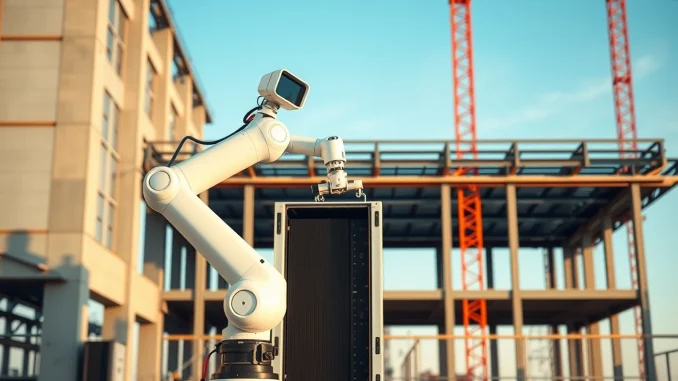
Japanese multinational SoftBank is moving aggressively into the physical infrastructure of the artificial intelligence boom. The company is creating a new robotics venture, named Roze AI, that will deploy autonomous robots to build data centers in the United States. According to reports from the Financial Times and the Wall Street Journal, SoftBank is already preparing Roze for an initial public offering, with some executives targeting a valuation of $100 billion by the second half of 2026.
What Roze AI Plans to Do
Roze AI is designed to address a critical bottleneck in the AI industry: the slow, expensive, and labor-intensive process of building the server farms that power large language models and cloud computing. The company intends to use autonomous robots to handle key construction tasks, aiming to make data center development more efficient and faster. This is not a software-only play; it is a bet on automating physical labor at scale.
Also read: OpenAI Limits GPT-5.6 Rollout After U.S. Government Request, Calls Restrictions a 'Short-Term Step'
The Wall Street Journal reports that Roze will focus on making U.S. data center construction more efficient by deploying robotics on-site. The Financial Times adds that SoftBank has already held internal discussions about a potential IPO, though some insiders have expressed skepticism about both the $100 billion valuation and the proposed timeline. TechCrunch has reached out to SoftBank for additional comment.
SoftBank’s Track Record and the Broader Trend
SoftBank has a history of making bold, high-risk bets on automation and AI. The company famously invested hundreds of millions of dollars into Zume, an AI-driven pizza delivery startup that shut down in 2023. Roze AI represents a more infrastructure-focused, industrial application of robotics, which may face fewer consumer adoption hurdles.
Also read: OpenAI, Google, and SpaceX are all building their own AI chips — here's why that matters
The move also aligns with a wider trend among tech billionaires. Amazon founder Jeff Bezos recently co-founded Project Prometheus, a startup that plans to acquire industrial firms and modernize them using AI. SoftBank’s Roze AI is a direct competitor in the race to automate the physical economy.
Why This Matters for Readers
The AI industry’s growth is increasingly constrained by the availability of data center capacity. If Roze AI succeeds, it could dramatically lower the cost and time required to build new server farms, accelerating AI development across the board. Conversely, a $100 billion IPO for a company that has not yet built anything would represent one of the most speculative public market listings in recent history. The internal skepticism reported by the Financial Times suggests that even within SoftBank, there is uncertainty about whether the valuation is justified.
Conclusion
SoftBank’s Roze AI is a significant bet on the automation of data center construction, a sector that is becoming a critical bottleneck for the AI industry. With a potential $100 billion IPO on the horizon, the venture is ambitious but faces internal doubts about its timeline and valuation. The success or failure of Roze AI will offer a real-world test of whether robotics can solve the physical infrastructure challenges of the digital age.
FAQs
Q1: What is Roze AI?
Roze AI is a new robotics company being created by SoftBank. Its goal is to use autonomous robots to build data centers in the United States, making the construction process faster and more efficient.
Q2: When is the Roze AI IPO expected?
According to the Wall Street Journal, some SoftBank executives want the IPO to happen by the second half of 2026. The target valuation is reportedly $100 billion, though internal skepticism about that figure has been reported.
Q3: How does this relate to other AI infrastructure news?
Roze AI is part of a broader push by major tech players to automate industrial sectors. Jeff Bezos’s Project Prometheus is a similar venture, and the overall trend reflects the growing importance of physical infrastructure for AI development.






Be the first to comment