
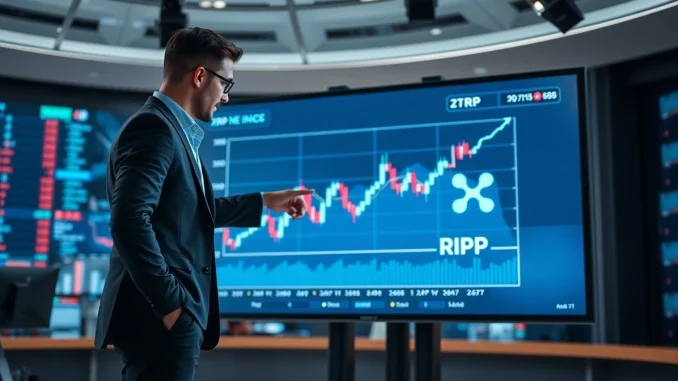
As the cryptocurrency market matures, investors are increasingly focused on long-term price forecasts for major digital assets. Among them, Ripple’s XRP remains one of the most debated tokens, with price predictions ranging from conservative estimates to ambitious targets like $5. This article provides a factual, editorially reviewed analysis of XRP’s potential price trajectory from 2026 through 2030, grounded in market fundamentals, regulatory developments, and real-world adoption metrics.
Current Market Context and Recent Developments
As of early 2026, XRP trades in a range shaped by several key factors. The conclusion of the U.S. Securities and Exchange Commission (SEC) lawsuit against Ripple in 2023 provided legal clarity, ruling that XRP is not a security when sold on secondary markets. This decision removed a major regulatory overhang and allowed Ripple to expand its partnerships with financial institutions globally. However, the token’s price has not yet reflected the full potential of these developments, partly due to broader macroeconomic conditions and ongoing competition from other blockchain networks.
Also read: Notcoin (NOT) Price Prediction 2026-2030: Can the Telegram Gaming Token Stage a Recovery?
Ripple’s focus on cross-border payment solutions and central bank digital currencies (CBDCs) continues to drive its utility. The company’s On-Demand Liquidity (ODL) service, which uses XRP as a bridge currency, has seen increased adoption in regions like the Middle East, Asia, and Africa. These real-world use cases provide a foundation for long-term value, but price predictions must account for market volatility and regulatory shifts in different jurisdictions.
Price Prediction 2026: A Year of Consolidation
For 2026, most analysts expect XRP to trade within a range of $0.80 to $1.50. This forecast is based on the assumption that the broader crypto market will remain in a consolidation phase, with Bitcoin and Ethereum setting the tone. XRP’s price will likely be influenced by:
Also read: Monero (XMR) Price Prediction 2026–2030: Can Privacy Coins Sustain Momentum?
- Regulatory clarity: Continued favorable rulings in the U.S. and emerging frameworks in Europe and Asia could boost investor confidence.
- Institutional adoption: New partnerships with banks and payment providers could increase demand for XRP as a liquidity tool.
- Market sentiment: The overall risk appetite for cryptocurrencies, driven by macroeconomic factors like interest rates and inflation, will play a significant role.
Reaching $5 in 2026 would require a market capitalization of roughly $250 billion, which appears unlikely without a major catalyst such as a widespread regulatory endorsement or a significant technological breakthrough.
Long-Term Outlook: 2027 to 2030
Looking further ahead, the path to $5 becomes more plausible but remains speculative. By 2027, if Ripple’s payment network achieves broader integration with traditional finance, and if XRP is adopted as a reserve asset by central banks or large financial institutions, the token could see substantial price appreciation. Estimates for 2027 range from $1.50 to $3.00, depending on market conditions.
By 2030, the cryptocurrency sector will likely be more regulated and mature. If XRP captures even a small percentage of the global cross-border payment market, which is valued in the trillions of dollars, a price of $5 is within the world of possibility. However, this scenario assumes:
- No major regulatory setbacks in key markets like the U.S. or the European Union.
- Continued technological development and security of the XRP Ledger.
- Sustained demand from both retail and institutional investors.
Risks and Uncertainties
Investors should be aware of the significant risks associated with any cryptocurrency price prediction. XRP’s price is highly volatile and can be affected by factors outside of Ripple’s control, including macroeconomic downturns, changes in government policy, and competition from other digital assets like Stellar (XLM) or emerging CBDCs. Additionally, the token’s supply dynamics, with a large portion held by Ripple, could create selling pressure if the company decides to liquidate its holdings.
Conclusion
While the prospect of XRP reaching $5 by 2030 is not impossible, it is far from guaranteed. The token’s price will depend on a combination of regulatory clarity, real-world adoption, and broader market trends. For now, a more realistic range for 2026 is $0.80 to $1.50, with gradual growth possible in subsequent years. Investors should approach any price prediction with caution and focus on the underlying fundamentals of the Ripple ecosystem rather than short-term price targets.
FAQs
Q1: Is it realistic for XRP to reach $5 by 2026?
Based on current market conditions and adoption rates, reaching $5 by 2026 is highly unlikely. It would require a market capitalization of over $250 billion, which would represent a significant shift in the crypto market sector. A more realistic range for 2026 is $0.80 to $1.50.
Q2: What are the main factors that could drive XRP’s price higher?
The key drivers include widespread adoption of Ripple’s payment network by banks and financial institutions, favorable regulatory decisions in major economies, increased use of XRP as a bridge currency for cross-border payments, and overall bullish sentiment in the cryptocurrency market.
Q3: What are the biggest risks to XRP’s price?
The primary risks include adverse regulatory changes, competition from other blockchain networks, potential selling pressure from Ripple’s large XRP holdings, and broader macroeconomic factors that could reduce investor appetite for risk assets. Additionally, any technical vulnerabilities in the XRP Ledger could negatively impact price.





Be the first to comment