
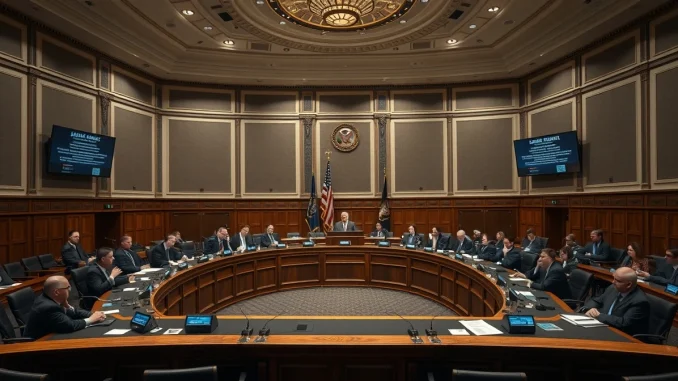
The US Senate Banking Committee voted on Thursday to advance the Digital Asset Market Clarity Act (CLARITY), a landmark crypto market structure bill, moving it closer to a full Senate floor vote. The vote was 15 in favor, with all 13 Republican members joined by Democrats Ruben Gallego and Angela Alsobrooks, while nine Democrats opposed the legislation.
Key details of the markup session
The committee considered over 100 proposed amendments covering stablecoin yield, ethics restrictions, and anti-money laundering provisions. Committee Chair Tim Scott emphasized that the bill aims to protect consumers, retain innovation in the United States, and safeguard national security regarding digital assets. Ranking Member Elizabeth Warren sharply criticized the legislation, calling it “written by the crypto industry for the crypto industry” and alleging it would enable what she described as President Donald Trump’s “crypto grift.”
Also read: DCG-backed Yuma launches institutional fund targeting Bittensor ecosystem
Senator Cynthia Lummis, a chief Republican advocate for the bill, countered that CLARITY is a “pro law enforcement” and “pro consumer” measure. Senator Jack Reed, a Democrat, argued the bill lacked genuine bipartisan input, claiming Chairman Scott had “arbitrarily” dismissed Democratic amendments.
Amendments debated and dismissed
Several high-profile amendments were debated along party lines. Senator Scott’s provision on artificial intelligence sandboxes was included. Warren’s amendments on money laundering, tokenization loopholes, and a demand for banking regulators to report on information related to deceased sex offender Jeffrey Epstein were all rejected. Lummis noted that CLARITY would address crypto mixer regulation, making Warren’s amendment on that topic unnecessary.
Also read: Securitize expects $400M war chest as tokenization platform prepares for NYSE debut
Democratic amendments from Senators Catherine Cortez Masto and Tina Smith, which would have expanded law enforcement authority over crypto cases and prohibited federal bailouts of crypto companies respectively, also failed along party lines. Senator Chris Van Hollen’s amendment addressing potential conflicts of interest involving President Trump’s family crypto business, World Liberty Financial, was voted down by all 13 Republican members.
Ethics concerns remain a sticking point
Ethics remained a central point of contention. Senator Raphael Warnock withdrew an amendment citing what he called “pure corruption” by the Trump administration, stating he would not support any bill without such carveouts. Warren also introduced an amendment to continue funding the Consumer Financial Protection Bureau, which the administration has attempted to shutter since 2025. Both proposals failed.
Next steps for CLARITY
With the bill now advanced by both the Senate Banking and Agriculture Committees, it is expected to head to a Senate floor vote. The bill will require 60 votes to pass. If approved, the US House of Representatives must then pass the amended legislation before it can be sent to the president for signature. Solana Policy Institute President Kristin Smith noted that if the Senate can secure the necessary votes, the House is likely to pass identical language, paving the way for enactment.
Why this matters
The CLARITY Act represents the most significant attempt by Congress to establish a comprehensive regulatory framework for digital assets in the United States. Its passage would clarify jurisdictional boundaries between the Securities and Exchange Commission (SEC) and the Commodity Futures Trading Commission (CFTC), potentially reducing legal uncertainty for crypto companies and investors. However, the partisan nature of the markup and unresolved ethics concerns suggest the bill faces significant hurdles before becoming law.
Conclusion
The Senate Banking Committee’s vote to advance the CLARITY Act marks a decisive moment in US crypto regulation, but deep partisan divisions over ethics, consumer protection, and industry influence remain. The bill’s fate now rests on a Senate floor vote, where it will need bipartisan support to reach the president’s desk.
FAQs
Q1: What is the CLARITY Act?
The Digital Asset Market Clarity Act (CLARITY) is a proposed US law that aims to establish a regulatory framework for digital assets, clarifying the roles of the SEC and CFTC and setting rules for market structure, stablecoins, and consumer protection.
Q2: Why did the Senate Banking Committee vote on this bill?
The committee held a markup session to debate and vote on amendments before advancing the bill to a full Senate floor vote. This is a standard legislative step for major bills.
Q3: What happens next for the CLARITY Act?
The bill will now go to the full Senate for a floor vote, where it needs 60 votes to pass. If approved, it moves to the House of Representatives for consideration before potentially being signed into law by the president.





Be the first to comment