
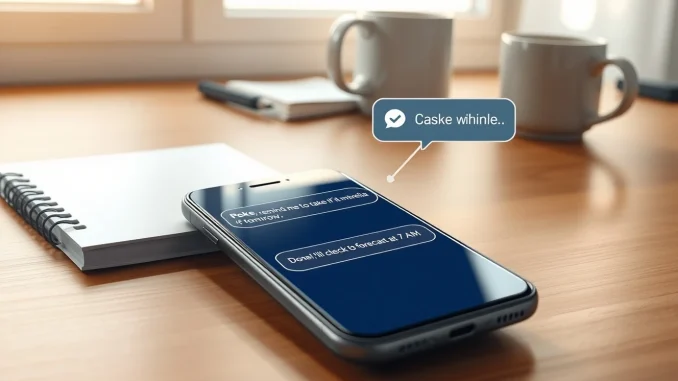
Forget complex installations. A new AI agent called Poke is betting that the future of automation is as simple as sending a text message. Launched publicly in March 2026, the startup offers a personal assistant that users can access through iMessage, SMS, and Telegram, aiming to make agentic AI usable for everyone. This approach arrives as demand for AI that can take action, not just answer questions, is surging across the tech industry.
Poke’s Simple Promise: AI Without the Hassle
You text it. It does things. That’s the core idea behind Poke. While chatbots like ChatGPT handle queries, Poke is designed for action. According to the company, users can ask it to manage calendars, track fitness goals, control smart home devices, edit photos, or send medication reminders—all through a standard messaging thread. The tool requires no app download; users visit Poke.com, enter their phone number, and start texting.
Also read: OpenAI Limits GPT-5.6 Rollout After U.S. Government Request, Calls Restrictions a 'Short-Term Step'
This simplicity is a direct response to the complexity of other agentic systems. “For those less technically inclined, the prospect of having to install software through the terminal, manage dependencies, and troubleshoot errors is daunting,” the original TechCrunch report noted. Systems like OpenClaw, which offer deep system control, also raise security concerns for average users. Poke’s founders believe their text-based interface lowers these barriers dramatically.
From Email Assistant to General-Purpose Agent
The concept for Poke evolved from user behavior. Marvin von Hagen, co-founder of The Interaction Company of California, told TechCrunch that Poke emerged from watching beta testers use the company’s earlier AI assistant for email. “What we noticed there was that people wanted to use Poke for everything,” von Hagen explained. Testers asked the email-focused tool for sports scores, weather-based clothing advice, and medication reminders.
Also read: OpenAI, Google, and SpaceX are all building their own AI chips — here's why that matters
This suggested a clear demand for a general-purpose, proactive assistant. The team pivoted, focusing on making Poke more useful and personable. The goal was to retain the “humanness” users liked while expanding its capabilities. The result is a system that operates over familiar messaging platforms, removing the friction of learning a new app.
A Multi-Model, Platform-Agnostic Approach
Under the hood, Poke selects different AI models for different tasks. It isn’t tied to a single provider like OpenAI or Meta. “I think this is also one of our main strengths in the long run: that almost all of our competitors are just big tech and labs that are bound to a specific provider,” von Hagen pointed out. This flexibility could allow Poke to use the most cost-effective or capable model for any given job, a potential advantage in a rapidly changing market.
To function within iMessage, Poke uses a solution called Linq. Support extends to SMS and Telegram, but WhatsApp access is currently limited. Meta barred general-purpose chatbots from its platform in late 2025. However, antitrust probes in the EU, Italy, and Brazil could pressure Meta to change this policy. Von Hagen called Meta’s high fees for platform access a form of “malicious compliance” that he expects to be addressed.
Recipes: The Building Blocks of Automation
Poke’s functionality is built around “recipes”—pre-made automations users can enable with a click. These span categories including health, productivity, finance, and smart home control. Recipes connect to popular services users already have.
Key Integration Categories:
- Productivity & Scheduling: Gmail, Google Calendar, Outlook, Notion, Linear
- Health & Fitness: Strava, Withings, Oura, Fitbit
- Smart Home: Philips Hue, Sonos
- Developer Tools: GitHub, Vercel, Supabase, Sentry
Users can also write their own automations in plain text and share them. In recent weeks, users have created thousands of new recipes. Poke plans to add these to a public directory. To encourage creation, the company offers a small payment—between 10 cents and a dollar—for every user who signs up via a creator’s shared recipe.
Funding, Growth, and the Road Ahead
The 10-person startup is well-funded. Backed by Spark Capital and General Catalyst, it recently added $10 million to its coffers after a $15 million seed round last year. Its post-money valuation stands at $300 million. A roster of high-profile angels has also invested, including Stripe founders John and Patrick Collison, OpenAI’s Joanne Jang, and Hugging Face co-founder Thomas Wolf.
The company isn’t sharing precise user numbers but says sign-ups have increased tenfold over the past couple of months. TechCrunch noted it appeared at the top of Vercel’s AI Gateway leaderboard, suggesting significant usage among developers.
Poke’s pricing model is unconventional. It’s free to start. Costs are tied to usage, particularly for tasks requiring real-time data or inference, like scanning every incoming email. During beta tests, users negotiated a monthly price with the AI agent itself, typically between $10 and $30. Now, Poke uses guidance on operational costs to determine personalized pricing.
Profitability isn’t the immediate goal. “We really don’t want to make money, but we really want to grow. We want to build a product for a billion people and monetization is really secondary,” von Hagen stated. The focus is on integrating Poke into daily life, partly by working with creators and influencers to showcase use cases.
Security in a Text-Based World
Giving an AI agent permission to act on your behalf requires trust. Poke employs a multi-layered security model that includes penetration testing and strict permission limits. By default, the company’s team cannot see user data inside the AI’s processing tokens. Users must manually opt-in to share log files or analytics. TechCrunch noted it has not performed an independent security audit of the system.
This security posture is less invasive than systems like OpenClaw, which require deep system access. For many consumers, that trade-off—slightly less power for significantly less risk and complexity—could be compelling.
Conclusion
Poke represents a distinct path in the AI agent race. While giants like OpenAI and Nvidia push powerful but complex enterprise tools, Poke is betting on simplicity and accessibility. By employing the universal interface of text messaging, it aims to bring automated assistance to a mass audience that finds current options intimidating. Its agnostic model strategy, recipe-based automation, and flexible pricing could help it carve out a significant niche. The key question is whether this approach can scale to meet its founders’ billion-user ambition while maintaining the ease of use that defines it. For now, Poke makes a compelling case that the most powerful AI might be the one you already know how to use.
FAQs
Q1: What exactly is the Poke AI agent?
Poke is a personal AI assistant that operates entirely through text messaging platforms like iMessage and SMS. Instead of just answering questions, it’s designed to take actions on your behalf, such as managing your calendar, tracking fitness, or controlling smart home devices.
Q2: How is Poke different from ChatGPT or Claude?
While ChatGPT and Claude are general-purpose conversational chatbots, Poke is an “agentic” AI built to execute tasks and automate parts of your life. You use a chatbot for research or conversation, but you might use Poke to automatically remind you to take an umbrella if rain is forecasted.
Q3: How much does Poke cost?
Poke is free to start. Its pricing is usage-based. Simple tasks that don’t require real-time data may remain free. Actions that cost the company money, like real-time email scanning or flight check-ins, incur charges. The AI agent helps determine a personalized price based on your usage patterns.
Q4: Is Poke secure?
According to the company, Poke uses a multi-layered security model with regular testing and strict access controls. By default, human employees cannot see your data. However, as with any service that connects to your personal accounts, users should review permissions carefully. An independent public security audit has not been conducted.
Q5: Can I build my own automations with Poke?
Yes. Users can write their own “recipes” or automations using plain text instructions. You can also share these creations with others. The company is building a public directory for user-generated recipes and even offers a small payment to creators when others sign up using their shared automation.






Be the first to comment