
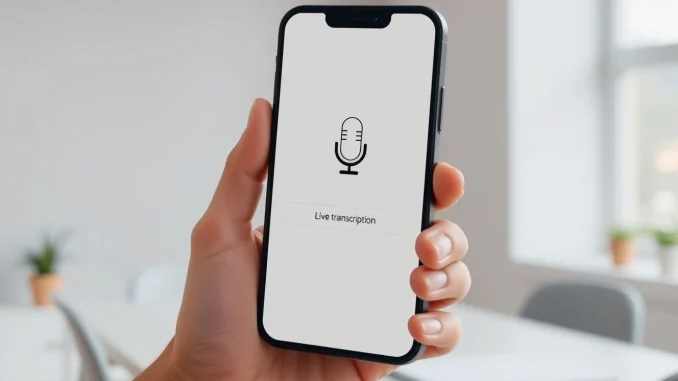
Google has launched a new, privacy-focused dictation application for iPhone users. The app, called Google AI Edge Eloquent, was released on April 7, 2026, and operates primarily on-device, a significant shift from cloud-dependent rivals. This move signals Google’s direct entry into a competitive market for AI-powered speech-to-text tools.
Google Eloquent App Features and Offline Capability
The core appeal of Eloquent is its offline-first approach. According to its App Store description, the app uses Gemma-based automatic speech recognition (ASR) models that download directly to a user’s device. Once installed, dictation works without an internet connection. Users can turn off ‘cloud mode’ entirely for local-only processing. When cloud mode is enabled, the app uses Google’s more powerful Gemini models for text refinement.
Also read: OpenAI Limits GPT-5.6 Rollout After U.S. Government Request, Calls Restrictions a 'Short-Term Step'
This architecture addresses growing user concerns about data privacy. Industry watchers note that processing sensitive audio locally, rather than sending it to remote servers, is a key selling point. “This suggests Google is responding to market demand for AI tools that don’t require constant data uploads,” said one analyst familiar with mobile AI trends.
The app’s functionality extends beyond basic transcription. It provides live transcription and, upon pausing, automatically filters out filler words like “um” and “ah.” It also polishes text by correcting mid-sentence stumbles. Below the transcript, tools labeled “Key points,” “Formal,” “Short,” and “Long” can transform the raw text into different formats.
Also read: OpenAI, Google, and SpaceX are all building their own AI chips — here's why that matters
Competitive Field for AI Transcription
Google Eloquent enters a field with established players like Wispr Flow, SuperWhisper, and Willow. These apps have gained popularity as speech-to-text models have improved. Data from market research firms indicates the mobile dictation software sector saw user growth of over 40% in 2025.
The new app includes features designed to compete directly. It can import specific keywords and jargon from a user’s Gmail account to improve accuracy for personal vocabulary. Users can also add custom words. Furthermore, Eloquent provides detailed session analytics, showing words dictated, words-per-minute speed, and total word count.
What this means for the market is increased pressure on independent developers. Google’s vast resources in AI research could allow for rapid iteration. But the implication for users is more choice and potentially lower costs, as Eloquent is currently free to download.
The Technical Foundation: Gemma and Gemini
The app leverages two distinct AI model families. The on-device work is handled by Gemma, Google’s open-source lightweight language models. For more complex tasks when online, it taps into the cloud-based Gemini models. This hybrid approach balances performance with privacy and battery life.
According to technical documentation, Gemma models are optimized for efficiency on mobile hardware. This allows for capable speech recognition without draining a phone’s battery excessively. The choice reflects a broader industry trend toward efficient, edge-based AI.
Android Integration and Future Roadmap
While currently an iOS-exclusive, the App Store description explicitly references Android. It promises “streamlined Android integration,” where Eloquent could be set as a default keyboard for system-wide dictation. The description also mentions a future floating button feature for easy access, similar to Wispr Flow’s implementation on Android.
This is clearly an experimental release. Google has not made a formal announcement, and the app’s listing carries the hallmarks of a quiet test. The company often uses such low-key launches to gauge user interest and collect feedback before a wider rollout.
If the iOS test is successful, an Android version seems inevitable. This could signal improved native transcription features across Google’s own mobile operating system. For now, Android users must wait or rely on existing alternatives.
Analysis: Why This App Matters Now
The release aligns with several concurrent trends. First, demand for efficient content creation tools on mobile devices is rising. Second, regulatory and consumer pressure for data privacy is pushing companies to offer offline-capable AI. Third, the hardware in modern smartphones is now powerful enough to run sophisticated models locally.
Industry watchers note that Google’s play here is strategic. By offering a free, capable app, it can gather valuable data on how people use speech interfaces in real-world settings. This data, anonymized and aggregated, could inform improvements to its core AI models and assistant products.
For investors, the move highlights the commercial value of edge AI. Companies that can deliver powerful functionality directly on devices may gain a trust advantage over those reliant on the cloud. This could influence investment in semiconductor and software firms specializing in on-device processing.
Conclusion
Google’s Eloquent app is a significant new entry in the AI dictation space. Its offline-first design prioritizes user privacy, while its polishing and editing tools aim for professional-grade text output. As a quiet iOS launch, it serves as a testing ground for technology that will likely influence Google’s broader ecosystem, including Android. The success of this Google AI dictation app will depend on its accuracy, ease of use, and how it evolves in response to a competitive and privacy-conscious market.
FAQs
Q1: Is the Google Eloquent app free?
Yes. The app is free to download from the iOS App Store. There is no mention of in-app purchases or subscription fees in its current description.
Q2: How does the offline functionality work?
The app downloads Gemma-based speech recognition models to your iPhone. Once downloaded, you can dictate and transcribe without an internet connection by disabling ‘cloud mode’ in settings.
Q3: What are the main competitors to Google Eloquent?
Major competitors include Wispr Flow, SuperWhisper, and Willow. These apps also offer AI-powered transcription and text cleanup, though their privacy approaches and pricing models differ.
Q4: Will Google Eloquent be available on Android?
The iOS app description references Android integration and features, strongly suggesting an Android version is planned. Google has not provided a release date.
Q5: Does the app save or upload my audio data?
With ‘cloud mode’ turned off, processing happens locally and audio data does not need to leave your device. The privacy implications of using cloud mode are governed by Google’s general data policies.





Be the first to comment