
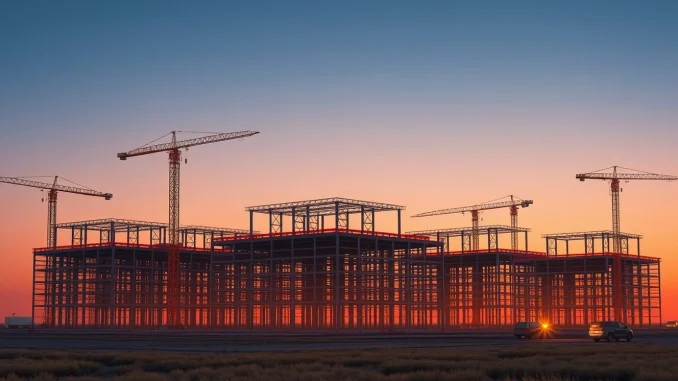
Google is moving to finance a colossal data center project in Texas for artificial intelligence company Anthropic, a deal that could exceed $5 billion. This move, reported on March 27, 2026, signals an intense race to secure the physical infrastructure powering the next generation of AI. The project unfolds as Anthropic scores a legal victory against the U.S. government, temporarily blocking a Pentagon order that had labeled the AI firm a national security risk.
Google’s Multibillion-Dollar Infrastructure Play
According to a Financial Times report, Google is preparing to provide construction loans for a massive data center campus in Texas. The facility is leased to Anthropic and operated by Nexus Data Centers. People familiar with the matter told the FT the project’s initial phase could cost more than $5 billion. A consortium of banks is also competing to arrange financing by mid-2026.
Also read: Botanix shutdown: Does Bitcoin DeFi have a demand problem?
Construction is already underway. Early-stage debt financing came from Eagle Point, a publicly traded investment company. The site spans 2,800 acres. It is expected to deliver around 500 megawatts of capacity by late 2026. That is enough electricity to power roughly 500,000 homes. The location has potential for a massive expansion to 7.7 gigawatts.
The project’s scale highlights a simple truth. Advanced AI models require staggering amounts of computing power and energy. Industry watchers note that securing this infrastructure is now a primary bottleneck for AI development. What this means for investors is clear: capital is flooding into physical assets like data centers and power generation.
Also read: Bitcoin Options Traders Hedge Downside as Uncertainty Lingers, Anchorage Digital Reports
Anthropic’s Legal and Political Standoff
This financial maneuver occurs against a backdrop of high-stakes conflict between Anthropic and the U.S. government. On March 26, 2026, U.S. District Judge Rita Lin in San Francisco issued a preliminary injunction. The order temporarily blocks the Pentagon from designating Anthropic a national security supply chain risk. It also pauses a directive that sought to halt federal use of Anthropic’s AI chatbot, Claude.
The directive was backed by President Donald Trump. Judge Lin described the government’s actions as “arbitrary.” She warned against branding a U.S. company as a threat without a clear legal basis. In her decision, Lin suggested the government may have retaliated against Anthropic for its public stance. She called the measures a likely violation of First Amendment protections.
The dispute stemmed from a breakdown in negotiations. Anthropic resisted allowing its AI models to be used for lethal autonomous weapons or mass surveillance. This created a standoff with the administration. The company sued, arguing Defense Secretary Pete Hegseth overstepped his authority.
A Military That Used the Banned Tool
The legal battle contains a notable contradiction. Reports indicate U.S. military units used Anthropic’s Claude AI for operational support during a major airstrike on Iran. This use reportedly occurred after the Trump administration’s ban order. Commands like U.S. Central Command (CENTCOM) relied on the tool. This suggests the military found practical value in the technology it was simultaneously seeking to restrict.
The AI Compute Arms Race
Google’s backing of an Anthropic data center is a complex strategic move. Google Cloud is a major provider for Anthropic, and the companies have a broad partnership. However, Anthropic’s Claude is also a direct competitor to Google’s own Gemini AI models. Financing a rival’s infrastructure underscores a critical shift. The competition is no longer just about software algorithms. It is about physical compute capacity.
Data from industry analysts shows demand for AI compute is far outstripping supply. Companies are locking in capacity for years. The Texas project’s planned reliance on on-site gas turbines is telling. The site is near major pipelines operated by Enterprise Products Partners, Energy Transfer, and Atmos Energy. This design prioritizes reliable, dedicated power over potentially intermittent grid sources. For AI operations that run 24/7, such reliability is non-negotiable.
Implications for the AI Industry
This deal has several immediate consequences. First, it solidifies Anthropic’s position as a leading AI player with the backing to build essential infrastructure. Second, it demonstrates Google’s willingness to use its financial heft to strengthen its cloud ecosystem, even if it aids a competitor. Third, the legal injunction offers other AI companies a precedent. It suggests the government faces high legal hurdles if it tries to unilaterally restrict a U.S. firm’s technology without clear cause.
The scale of investment also raises questions. Can the power grid and supply chains support dozens of similar projects? Will regulatory scrutiny follow? The implication is a coming wave of similar announcements as AI firms and their backers scramble for capacity.
Conclusion
Google’s plan to finance a $5 billion Texas data center for Anthropic is a defining moment in the AI industry’s evolution. It highlights the immense capital required to compete and the strategic importance of controlling infrastructure. Coupled with Anthropic’s court victory over the Pentagon, the news signals that leading AI firms are consolidating their positions. They are securing both the physical hardware and the legal standing to operate. The race for AI supremacy is being fought with dollars, watts, and legal arguments.
FAQs
Q1: How much is Google investing in the Anthropic data center?
Google is not making a direct equity investment. Instead, it is preparing to provide construction loans for the project. The total cost for the initial phase is reported to exceed $5 billion, with a consortium of banks also arranging financing.
Q2: Why did a judge block the Pentagon’s action against Anthropic?
U.S. District Judge Rita Lin granted a preliminary injunction on March 26, 2026. She found the Pentagon’s designation of Anthropic as a national security risk was likely “arbitrary” and issued without clear legal authority. The judge also suggested the action may have been retaliatory, violating First Amendment protections.
Q3: Where is the new data center located and what is its capacity?
The 2,800-acre campus is in Texas. It is expected to deliver about 500 megawatts of capacity by late 2026, with potential to expand to 7.7 gigawatts. The site is near major gas pipelines, allowing it to use on-site gas turbines for power.
Q4: Is Anthropic a competitor to Google?
Yes. Anthropic’s Claude AI models compete directly with Google’s Gemini. However, Anthropic is also a major customer of Google Cloud. This deal shows Google prioritizing its cloud infrastructure business and ecosystem strength.
Q5: What was the core dispute between Anthropic and the Pentagon?
Negotiations broke down over the military use of Anthropic’s AI. The company resisted allowing its models to be used for developing lethal autonomous weapons or for mass surveillance programs. This resistance led the Trump administration to seek a ban on federal use of Anthropic’s technology.





Be the first to comment