
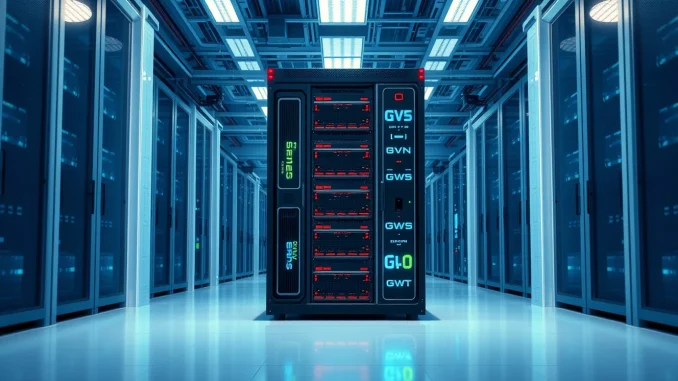
A massive $8.5 billion loan to AI cloud provider CoreWeave is more than just another big tech deal. Financial analysts say it exposes a fundamental weakness in how Wall Street once bankrolled the cryptocurrency mining industry. The financing, backed by Meta Platforms, represents a clear pivot. Lenders are now chasing predictable cash flows from contracted AI workloads instead of betting on volatile crypto assets and depreciating hardware.
The $8.5 Billion Pivot from MinerFi to ComputeFi
According to a report from TheEnergyMag, CoreWeave’s recent financing marks a major transition. Wall Street is moving from “MinerFi” to “ComputeFi.” This shift changes how banks fund digital infrastructure. The deal involved a group of banks and investors. Bloomberg reported it highlights new methods for funding data center construction and expanding GPU capacity.
CoreWeave itself started in the crypto mining space. But it pivoted to providing GPU cloud infrastructure for artificial intelligence. This move offers a broader lesson. It shows the shortcomings of traditional Bitcoin mining finance. Historically, lenders funded mining operations using application-specific integrated circuits (ASICs) as collateral. This model proved fragile. Crypto price swings and rapid hardware depreciation created significant risk. When markets fell, both revenues and collateral values dropped sharply.
TheEnergyMag called CoreWeave’s new structure “what MinerFi tried — and failed — to become.” The key difference is cash flow. Unlike prior models, this deal ties financing to active AI infrastructure. It requires contracted customers and predictable revenue. GPUs must be deployed, operational, and generating income before lenders provide capital. This structure dramatically reduces risk.
Also read: Spain’s CNMV Chair Rules Out MiCA Deadline Extension for Crypto Firms, Impacting Binance
Why Crypto Mining Collateral Failed Lenders
The old model had clear flaws. ASIC miners lose value quickly as newer, more efficient models hit the market. Bitcoin’s price is famously unstable. A downturn can trigger a vicious cycle. Mining revenue falls just as the collateral securing the loan also loses value. This double-whammy left lenders exposed.
Data from crypto lending platforms in recent years shows numerous defaults. Companies like Compute North and Core Scientific faced bankruptcy, partly due to debt loads secured by mining rigs. Their struggles highlighted the model’s inherent instability. Industry watchers note that AI infrastructure presents a different proposition. AI workloads are often tied to long-term contracts with large tech firms. This provides revenue visibility that crypto mining simply cannot match.
“The implication is straightforward,” said one financial analyst who requested anonymity. “Banks prefer a signed contract with Microsoft or Meta over a bet on the future price of Bitcoin. It’s a shift from speculative asset backing to contracted service backing.”
Bernstein Analysis: CoreWeave’s Head Start in the “Neocloud” Race
Analysts at Bernstein recently examined this sector. They describe companies like CoreWeave as “neocloud” providers. These firms offer GPU-based cloud infrastructure specifically for AI workloads. A Bernstein report compared CoreWeave with peers IREN and Nebius. It highlighted differences in scale, infrastructure, and financing.
CoreWeave’s early pivot away from crypto mining gave it a major advantage. The company has a significantly larger backlog of roughly $67 billion in contracted work. Bernstein’s data shows IREN’s backlog is about $9.7 billion. Nebius has a backlog of approximately $47 billion. All three companies are expanding into AI. But IREN still generates most of its current revenue from Bitcoin mining as it transitions.
The Bernstein analysts rated CoreWeave highly for its “commercial model.” They cited its software stack depth, a mix of contracted and on-demand revenue, a strong backlog, and a diversified customer base. However, they noted IREN has an infrastructure advantage. IREN owns a sizable real estate footprint. CoreWeave relies more on leased data center capacity. This distinction could affect long-term margins and control.
Wall Street’s New Lending Checklist for Tech Infrastructure
The CoreWeave deal establishes a new template. What does Wall Street want now? The checklist has changed.
- Contracted Revenue: Long-term customer agreements are paramount. They prove demand and guarantee cash flow to service debt.
- Deployed Assets: Financing is tied to hardware that is already installed, powered on, and earning money. It’s not for speculative future builds.
- Predictable Depreciation: While GPUs also become obsolete, their useful life in AI clusters is more predictable and often longer than ASICs in mining.
- Diverse Customer Base: Reliance on a single client is a risk. Lenders favor providers serving multiple large tech and enterprise customers.
This suggests a more conservative, cash-flow-driven approach has replaced the asset-backed lending of the crypto boom. The fallout from the 2022 crypto market crash made banks wary. The explosive demand for AI compute has given them a new, seemingly safer avenue for deployment.
The Broader Impact on Crypto Mining Companies
This shift creates pressure for Bitcoin mining firms. Their access to traditional debt markets has narrowed. To attract capital, many are now emphasizing their potential in AI. They are retrofitting mining sites to handle high-performance compute workloads. But this transition is costly and technically challenging.
Some miners have advantages. They often own power contracts and real estate in strategic locations. These assets are valuable for data centers. The fight for survival is pushing miners to diversify or partner with AI firms. What this means for investors is a sector in flux. Pure-play Bitcoin mining may struggle to secure cheap capital. Companies that successfully pivot to hybrid models or sell infrastructure to AI could see renewed interest.
Analysts are watching power agreements closely. Access to low-cost, reliable electricity is critical for both mining and AI data centers. Companies that secured favorable terms years ago may now hold a key asset for the AI era.
Conclusion
CoreWeave’s $8.5 billion loan is a signal. It marks a definitive turn in how major financial institutions fund the backbone of the digital economy. The era of lending against volatile crypto assets and fast-depreciating hardware is fading. In its place, a model built on contracted AI workloads and predictable cash flows is rising. This shift, from MinerFi to ComputeFi, redefines risk for Wall Street. It also sets a new benchmark for any tech infrastructure company seeking serious capital. The race for AI compute is not just about technology. It’s increasingly a story of financing.
FAQs
Q1: What was the main problem with lending to Bitcoin mining companies?
The primary issue was collateral risk. Loans were secured by ASIC miners, which lose value quickly due to technological obsolescence. When cryptocurrency prices fell, mining revenue dropped simultaneously, making it hard for companies to service debt while their collateral also depreciated.
Q2: How is CoreWeave’s AI financing deal different?
CoreWeave’s financing is tied to active infrastructure with contracted customers. Lenders provide capital only after GPUs are installed, operational, and generating revenue from pre-agreed contracts. This links repayment directly to predictable cash flows, not speculative asset values.
Q3: What is a “neocloud” provider?
According to Bernstein analysts, a neocloud provider is a company that offers GPU-based cloud infrastructure specifically optimized for artificial intelligence workloads. These are newer, specialized players competing with larger general-purpose cloud providers like AWS or Azure in the AI space.
Q4: Are Bitcoin mining companies completely cut off from financing now?
Not completely, but access to traditional debt has become more difficult and expensive. Many mining firms are now seeking capital by pivoting their business plans to include AI compute services or by tapping into their power and real estate assets, which are also valuable for data centers.
Q5: What does this shift mean for the future of data center construction?
It likely means more project financing will be contingent on securing large, credit-worthy anchor tenants with long-term contracts before breaking ground. This could slow speculative building but may lead to more financially stable infrastructure projects focused on meeting specific, contracted AI demand.





Be the first to comment