
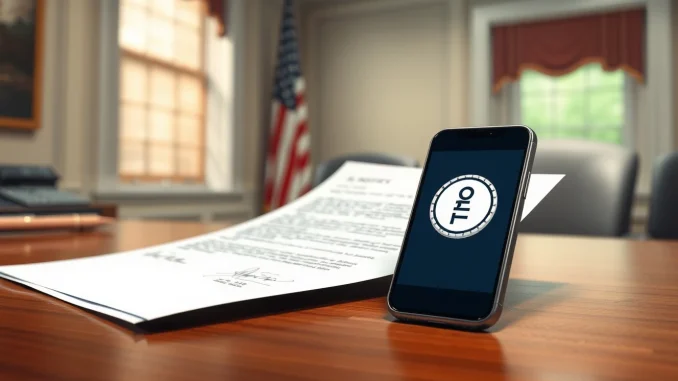
WASHINGTON, D.C. — A planned gathering for holders of a cryptocurrency linked to former President Donald Trump has triggered a formal ethics inquiry from three U.S. senators. They are probing whether the event’s promotion constitutes “dangling access” to the former president for financial gain. The controversy centers on a scheduling conflict between the crypto luncheon and a major Washington dinner, raising fresh questions about the intersection of politics, personal finance, and digital assets.
Senators Target Memecoin Event Promoter
According to a Politico report from April 2025, Senators Elizabeth Warren (D-Mass.), Richard Blumenthal (D-Conn.), and Adam Schiff (D-Calif.) sent a letter to Bill Zanker. Zanker is the individual behind the launch of the ‘Official Trump’ (TRUMP) memecoin. The lawmakers demanded clarity on whether Trump intended to apply his potential appearance at a luncheon scheduled for April 25, 2025, at his Mar-a-Lago property in Florida.
The senators’ letter, cited by Politico, expressed direct concern. “[O]rganizers are promoting a conference by dangling access to President Trump to potential attendees (and in doing so, are encouraging purchases of his meme coin that will generate transaction fees for the President and his family) on a day he may not actually be able to attend,” the letter stated. This suggests a core allegation: that the event’s promotion might be designed to drive token transactions and associated fees, regardless of Trump’s actual participation.
A Glaring Scheduling Conflict
The core of the senators’ concern is a direct calendar clash. The TRUMP memecoin holder event was announced for April 25, 2025. However, the White House Correspondents’ Association Dinner in Washington, D.C., is scheduled for the same evening. On March 2, 2025, Trump publicly stated he planned to attend that dinner, which he boycotted during his first term.
Also read: Spain’s CNMV Chair Rules Out MiCA Deadline Extension for Crypto Firms, Impacting Binance
Data from the TRUMP coin project’s own terms and conditions adds fuel to the fire. The fine print explicitly notes that Trump “may not be able to attend” the April 25 event and that it could be canceled for any reason. This legal disclaimer, combined with the competing high-profile engagement, forms the basis of the senators’ probe into whether promotional materials were misleading.
Trump’s involvement with cryptocurrency events is not new. Even before his 2024 election victory, he appeared at high-profile gatherings like the Bitcoin 2024 conference. He also attended a prior dinner for TRUMP memecoin holders in May 2025. But this latest incident places such activities under a sharper ethical microscope.
The Broader Regulatory Stalemate
This ethics inquiry unfolds against a stalled backdrop for comprehensive U.S. crypto regulation. Industry watchers note that concerns over “selling access” and conflicts of interest complicate an already difficult legislative process.
In July 2025, the House of Representatives passed the CLARITY Act. This bill aimed to create a market structure framework for digital assets. The Senate agriculture committee advanced it in January 2026. Progress then halted. The Senate Banking Committee indefinitely postponed a key markup session, citing disputes over several complex issues.
- Tokenized Equities: How to regulate digital tokens that represent traditional stocks.
- Stablecoin Yield: Whether stablecoins should be allowed to generate interest for holders.
- Ethics and Transparency: Broader concerns about market manipulation and political influence.
As of April 2026, the Banking Committee had not scheduled a new markup. This is a necessary step before any potential Senate floor vote. The White House added to the debate in early April 2026. It released a statement arguing that a proposed ban on stablecoin yield in the CLARITY Act “would do very little to protect bank lending.” This response addressed worries from both banking and crypto sectors.
What This Means for Crypto and Politics
The senators’ letter is more than a simple scheduling inquiry. It signals growing scrutiny of how public figures may use digital assets and related events for personal or political benefit. The implication is that such activities could undermine public trust and create novel conflicts of interest that existing laws do not adequately address.
For investors, the situation highlights the unique risks associated with celebrity or politician-linked cryptocurrencies. These assets can be highly volatile and their value is often tied to perceptions and actions of individuals, not underlying technology or utility. The ethics probe could dampen enthusiasm for similar projects in the future.
This event also tests the boundaries of political fundraising and engagement in the digital age. The use of blockchain-based assets introduces new layers of complexity for transparency and disclosure rules that were written for a pre-crypto world.
Conclusion
The ethics probe into the Trump memecoin event underscores a major moment for digital asset regulation and political ethics. Three U.S. senators are demanding answers about whether access to a former president was used to promote a cryptocurrency for potential fee generation. With a clear scheduling conflict and ambiguous promotional language, the inquiry touches on core issues of transparency and conflict of interest. This incident occurs as broader legislative efforts to regulate the crypto market remain stalled in Congress, highlighting the urgent need for clear rules that address the novel challenges posed by the fusion of politics and digital finance.
FAQs
Q1: What is the ‘Official Trump’ (TRUMP) memecoin?
The TRUMP memecoin is a cryptocurrency token launched in support of former President Donald Trump. It operates on a blockchain network, and its value is largely driven by community sentiment and association with the former president, rather than a specific technological utility or corporate backing.
Q2: Why are the senators concerned about the April 25 event?
The senators are concerned because the event was promoted with the implication of Trump’s attendance, potentially to encourage token purchases that generate transaction fees. However, Trump is also scheduled to attend the White House Correspondents’ Dinner in Washington on the same day, making his appearance in Florida unlikely. They question if this constitutes “dangling access” for financial gain.
Q3: What is the CLARITY Act?
The CLARITY Act is a proposed U.S. law that passed the House of Representatives in July 2025. It seeks to establish a comprehensive regulatory framework for cryptocurrencies, clarifying which agencies oversee different types of digital assets and setting rules for trading, custody, and issuance.
Q4: What are the main issues stalling crypto regulation in the Senate?
Key sticking points include how to handle tokenized traditional securities (equities), whether stablecoins should be allowed to pay yield (interest) to holders, and broader ethical concerns about market manipulation and political influence within the crypto sector.
Q5: Has Trump been involved with cryptocurrency before?
Yes. Trump has attended several cryptocurrency conferences, including Bitcoin 2024, and participated in a previous dinner for TRUMP memecoin holders in May 2025. His engagement with the sector has been a notable aspect of his post-presidency activities.





Be the first to comment