
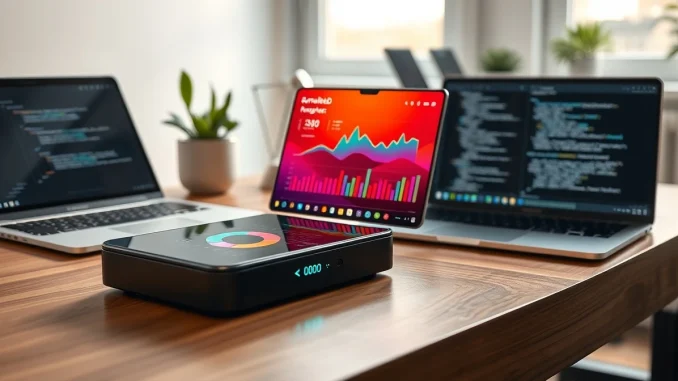
Silicon Valley’s tokenmaxxing era now has its own hardware. A new open source project brings your Claude Code utilization stats into a tiny desktop dashboard, allowing AI power users to keep an eye on their usage in real time.
Sure, you can track Claude Code usage directly in the terminal using commands or other external tools and apps. But that’s not as fun as seeing a pixel-art version of the Clawd sprite dance on a screen before showing at-a-glance token usage info. The device, called the Clawdmeter, is both a playful side project for AI power users and a timely indication of how thoroughly Anthropic’s Claude has infiltrated the developer community.
Also read: Ford rehires 350 veteran engineers after AI quality systems fall short
What is the Clawdmeter?
The Clawdmeter is a small, battery-powered display that pairs with your laptop over Bluetooth. It reads your Claude Code OAuth token to make an API call, pulling usage numbers from the response headers. When turned on, the splash screen plays pixel-art Clawd animations that become more frantic as your usage rate climbs. A middle button cycles through different animation styles or displays session and weekly Claude utilization data in simple charts.
Two additional side buttons send Space and Shift+Tab over Bluetooth for Claude Code’s voice mode and mode-toggle shortcuts, letting you move between Normal mode, Accept Edits mode, Plan Mode, and Auto Mode.
Who built it and why
The project comes from Reykjavik, Iceland-based software developer Hermann Haraldsson. He told TechCrunch he had always wanted to experiment with embedded devices but never found the time. Claude itself helped him build the device in just a few days.
“It’s really democratized access to programming, so that anyone can now do what developers used to do. I think that’s really positive, actually,” Haraldsson said.
Most of his development time went into design — getting the font, colors, and animations just right. He describes the device as a “little dopamine loop” that makes working more engaging.
The tokenmaxxing trend
The Clawdmeter arrives amid growing interest in “tokenmaxxing,” a trend where software engineers at various tech companies maximize the number of AI tokens consumed at work as a measure of AI adoption. One Reddit user joked: “At this point, Anthropic should just mail these to us for free.” Another suggested adding a button to increase capacity using your card on file.
Haraldsson says he was surprised to see over 800 people star the project on GitHub since its May 10 launch, with 50 already forking it for their own development. He attributes the appeal to nostalgia.
“There’s a kind of nostalgia for when you used to have a hardware device for everything — like a Walkman to play music, or an iPod,” he said. One Redditor called it a “hardware Tamagotchi for my context window.”
How to build your own
To build a Clawdmeter, you need a small lithium-ion battery-powered display like the Waveshare ESP32-S3-Touch-AMOLED-2.16. The open source project is available on GitHub, and anyone can fork it to add custom features, animations, and screens.
Haraldsson acknowledges the device isn’t strictly necessary. “I know it’s not replacing anything — like, you could have this on your computer — but it’s just fun,” he said.
Conclusion
The Clawdmeter represents a unique intersection of AI-assisted development, hardware tinkering, and the playful side of productivity culture. While it may not be essential, it highlights how deeply tools like Claude Code have integrated into developer workflows and how the community continues to innovate around them.
FAQs
Q1: What hardware do I need to build a Clawdmeter?
A small lithium-ion battery-powered display like the Waveshare ESP32-S3-Touch-AMOLED-2.16, which pairs with your laptop over Bluetooth.
Q2: How does the Clawdmeter track Claude Code usage?
It reads your Claude Code OAuth token to make an API call, then pulls usage numbers from the response headers.
Q3: Is the Clawdmeter open source?
Yes. The project is available on GitHub and anyone can fork it to add custom features, animations, and screens.






Be the first to comment