
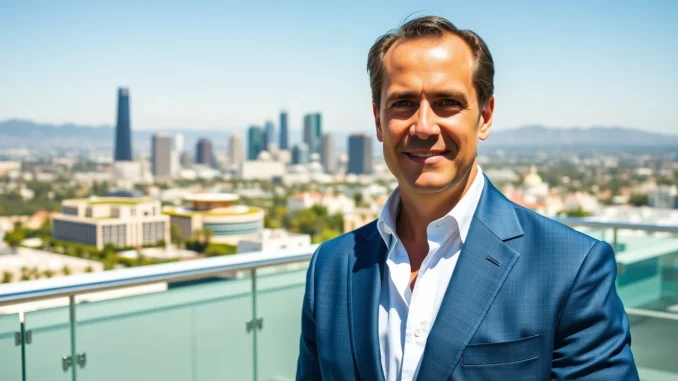
ASML CEO Christophe Fouquet is not worried about competitors. The Dutch company, which holds a monopoly on extreme ultraviolet (EUV) lithography machines essential for advanced AI chips, faces challengers from startups to state-backed efforts. Yet Fouquet remains confident that no one can replicate ASML’s technology anytime soon.
ASML’s Unrivaled EUV Monopoly Powers AI Chip Production
ASML, headquartered in Veldhoven, Netherlands, is the only company in the world that builds EUV lithography machines. These school-bus-sized systems cost between $200 million and $400 million each. They print microscopic patterns on silicon wafers, enabling the most advanced semiconductors used in AI, cloud computing, and smartphones.
Also read: Claude is quietly winning over paying AI consumers, data shows, even as ChatGPT still dominates
The company spends €4.5 billion annually on R&D. It employs 44,000 people and has a market value exceeding $530 billion. This makes ASML the most valuable company in Europe.
Demand for its machines has surged. Four of the largest American tech companies—Microsoft, Meta, Amazon, and Google—have committed over $600 billion in AI infrastructure spending this year alone. ASML has publicly stated that the world will not have enough chips for years due to supply constraints.
Also read: Databricks' former AI chief claims his new chip can cut AI's energy bill by 1,000x
AI Demand Caught ASML Off Guard
Fouquet admitted that ASML did not anticipate the AI explosion. “No, not at all,” he said during an interview on the rooftop deck of his Beverly Hills hotel. “We worked very hard, but not with the idea that this would come.”
He described ChatGPT as the first clear demonstration of AI’s potential. “Now I think we look at AI as the next revolution, not only industrial but societal,” he added. “Sitting in the middle of it every day, sometimes we wake up in the morning and still check that what is happening is really happening.”
Supply Chain Bottleneck Will Last Years
Fouquet confirmed that the chip supply chain will remain constrained. “The demand is such that the market overall will be supply-limited for quite a bit,” he said. “Right now, the biggest bottleneck seems to be in chip manufacturing.”
He added that hyperscalers will not get enough chips for the next two to five years. ASML must step up its entire supply chain and capacity to meet demand.
High-NA EUV: Expensive but Cheaper Per Chip
TSMC recently criticized ASML’s latest high-NA EUV machines as too expensive. Fouquet defended the pricing, arguing that the cost per wafer is lower.
“An EUV system, if you look at the price, is going to be more expensive than a low-NA system, but the cost of making a wafer with this tool on some advanced layers will be cheaper,” he explained. “We can get 20%, 30% cost reduction.”
High-NA EUV machines cost $350 million or more. Low-NA EUV is the current generation. High-NA prints finer patterns, enabling smaller, faster, and more energy-efficient chips.
Fouquet dismissed concerns about timing. “We designed high-NA for the next 10, 20 years,” he said. “You can go back to the press from 2016, 2017, and you’ll find the same quotes—low-NA EUV was very pricey. We know what happened after that. The same will happen with high-NA.”
Startup Substrate Claims Rival Lithography Machine
Substrate, a San Francisco startup backed by Peter Thiel protégé, has raised over $100 million and reached a $1 billion valuation. It claims it can build a rival lithography machine.
Fouquet was skeptical. “Wanting to have it and having it—that’s still a huge difference,” he said. “The challenges of lithography are many. Being able to make an image is a starting point, but you need to make that image in very high quantity, at very low cost, at high speed, and with nanometer accuracy.”
He noted that ASML’s EUV machine succeeded because 80% of it already existed. “We had to solve one problem—getting EUV light—and that alone took 20 years,” he said. “When you start from scratch, the challenge is enormous.”
xLight: A U.S.-Backed Laser Startup
xLight, a laser startup partly backed by the U.S. government, focuses on one element of ASML’s EUV machine—the light source. Fouquet said ASML is working with them to demonstrate their technology, but the jury is still out on whether it provides a performance or cost advantage.
Reverse Engineering Claims Dismissed
Reports claim former ASML engineers in China have partly reverse-engineered EUV technology. Fouquet dismissed these claims as false.
“To reverse-engineer anything, you first need to have the machine,” he said. “There is no EUV machine in China—we never shipped any tools there. All the tools we have shipped, we know where they are.”
ASML created a complete separation within the company between those who can access EUV technology and those who cannot. “Our team in China sits on the other side of that line,” Fouquet said. “The facts point to very little, if any, progress at all.”
Export Controls: Finding the Right Balance
Nvidia CEO Jensen Huang argued that companies should sell globally but keep the best technology closer to home. Fouquet agreed.
“What he adds—and I think this is what Nvidia has done—is that you can keep a technological advantage by maintaining a generation gap in what you sell,” Fouquet said. “Nvidia sells a few generations back, and that lets them find the balance between still doing business and not handing a strong competitive advantage to countries where you won’t sell the latest.”
ASML currently ships tools to China that were first shipped in 2015. Nvidia works with roughly an eight-generation gap. ASML is looking at two or three. “There’s room for rationalization,” Fouquet said.
Conclusion
ASML CEO Christophe Fouquet remains confident that no competitor can challenge the company’s EUV monopoly. The combination of decades of R&D, a complex supply chain, and strict export controls creates a formidable barrier to entry. As AI chip demand continues to surge, ASML’s position as the sole provider of advanced lithography machines appears secure for the foreseeable future.
FAQs
Q1: What is ASML’s main product?
A1: ASML makes extreme ultraviolet (EUV) lithography machines used to print microscopic patterns on silicon wafers for the most advanced semiconductors.
Q2: Why is ASML considered a monopoly?
A2: ASML is the only company in the world that builds EUV lithography machines, which are essential for producing leading AI chips.
Q3: How much does an ASML EUV machine cost?
A3: Prices range from $200 million to over $400 million, depending on the generation. High-NA EUV machines cost $350 million or more.
Q4: Can competitors replicate ASML’s technology?
A4: ASML CEO Christophe Fouquet says the challenges are enormous, requiring decades of R&D and a complex supply chain. He believes no one can replicate it soon.
Q5: What is the outlook for AI chip supply?
A5: ASML expects the chip supply chain to remain constrained for two to five years due to surging AI demand.



Be the first to comment