
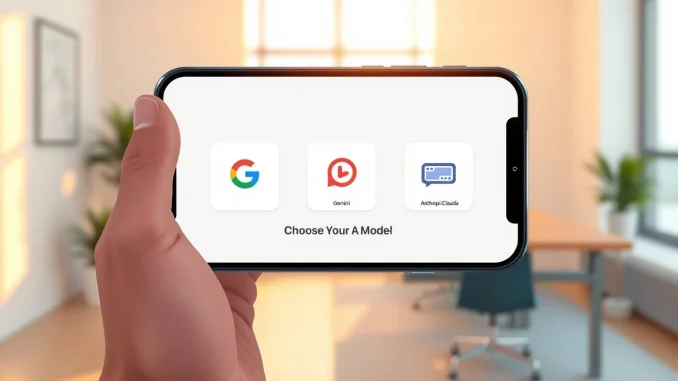
Apple plans to make iOS 27 a choose your own adventure of AI models, giving iPhone users remarkable control over on-device artificial intelligence. This move marks a significant shift in Apple AI strategy, allowing users to pick from multiple third-party large language models (LLMs) to power core system features.
Apple iOS 27: A New Era of AI Choice
When iOS 27 releases later this year, iPhone users will reportedly have extensive choice over which AI models they use on-device. A new report from Bloomberg reveals that Apple plans to offer a selection of third-party LLMs. These models will power various functions within the iPhone’s operating system. The new feature, internally dubbed “Extensions,” will let users access generative AI capabilities from installed apps on demand. This access will work through Apple Intelligence features such as Siri, Writing Tools, and Image Playground. A message shown in test versions of the software confirms this capability. The feature will also be available for iPadOS 27 and macOS 27. Apple is currently testing models from Google and Anthropic. The status of ChatGPT remains less clear. Since it is currently the available model, one implication is that it will remain a choice. TechCrunch reached out to Apple for more information.
Also read: OpenAI Limits GPT-5.6 Rollout After U.S. Government Request, Calls Restrictions a 'Short-Term Step'
The Apple AI Strategy Behind the Shift
This development arrives at a major moment for Apple. Long-serving CEO Tim Cook is soon stepping down. The incoming top executive, John Ternus, is tasked with charting the company’s future, including its AI strategy. Apple is widely perceived to be “behind” on AI compared to competitors like Google and Microsoft. The company is not launching as many new AI services. However, Apple is still generating a generous amount of AI-based revenue. The company’s plan is less about spending money building out AI infrastructure and services. Instead, it focuses on turning existing hardware into an AI-centric experience for users. This strategy emphasizes user choice and privacy, a core Apple differentiator.
Why Apple Chose a Multi-Model Approach
Several factors drive this decision. First, it allows Apple to tap into the best models for specific tasks. Different LLMs excel at different functions. For example, Google’s Gemini might be superior for search-related queries. Anthropic’s Claude could be better for creative writing or safety-focused interactions. Second, this approach reduces Apple’s dependency on a single AI provider. It also hedges against potential regulatory issues. Third, it aligns with Apple’s long-standing philosophy of user empowerment. Users can choose the AI model that best fits their needs and values. This strategy mirrors the App Store model, where users choose their apps.
Also read: OpenAI, Google, and SpaceX are all building their own AI chips — here's why that matters
How iOS 27 Extensions Will Work
The Extensions feature will integrate deeply with the operating system. Users will select their preferred AI model for each Apple Intelligence feature. Siri, for example, could use a different model than Writing Tools. The system will call the appropriate model on demand. This process will happen seamlessly in the background. Apple will likely provide a dedicated settings panel for managing these choices. The company will also ensure that all models meet its strict privacy and security standards. Apple has a strong track record of on-device processing. This approach minimizes data sent to the cloud. The company will likely extend this philosophy to the new AI models.
Timeline and Availability
Apple plans to release iOS 27 later this year. The beta version will likely debut at the Worldwide Developers Conference (WWDC) in June 2026. Developers will then test the Extensions feature. A public beta will follow in July. The final release will come in September, alongside the new iPhone lineup. The feature will also be available on compatible iPads and Macs. Apple will need to secure agreements with AI model providers. This process includes technical integration and licensing terms. The company is already testing models from Google and Anthropic. Other providers may join the platform later.
Impact on the AI Arena
Apple’s move could reshape the AI market. It creates a new distribution channel for AI models. Companies like Google and Anthropic gain access to hundreds of millions of Apple users. This access is valuable for training and monetization. It also increases competition among AI providers. Users can easily switch between models. This flexibility pressures providers to improve quality and reduce costs. The move could also accelerate AI adoption. Users who are hesitant about AI may feel more comfortable with a choice. It also reduces the risk of vendor lock-in.
Challenges and Considerations
Several challenges remain. First, ensuring consistent user experience across different models is difficult. Each model has its own strengths and weaknesses. Apple must provide clear guidance to users. Second, privacy implications are complex. Different models may have different data handling practices. Apple must enforce its privacy standards across all providers. Third, technical integration is demanding. Each model requires optimization for Apple’s hardware and software. Fourth, cost is a factor. Apple may need to subsidize model usage or share revenue with providers. Fifth, regulatory scrutiny is likely. Allowing multiple AI models on a single platform raises antitrust questions.
Expert Perspectives and Industry Reaction
Industry analysts have mixed reactions. Some praise the move as innovative and user-centric. Others see it as a defensive strategy. Apple is catching up to competitors who already offer extensive AI features. The company’s focus on choice may differentiate it. However, it also adds complexity. Users may feel overwhelmed by too many options. Apple will need to design the interface carefully. The company has a strong track record of simplifying complex technology. The Extensions feature will likely be intuitive.
Comparison with Competitors
Apple’s approach differs significantly from competitors. Google tightly integrates its Gemini model into Android and Pixel devices. Microsoft embeds Copilot into Windows and Office. These companies control the AI experience end-to-end. Apple offers a more open platform. This approach aligns with its historical strategy. The company has always prioritized user choice and ecosystem control. However, it also means Apple has less control over the AI experience. The company must rely on third-party providers for quality and innovation.
| Company | AI Strategy | Key Differentiator |
|---|---|---|
| Apple | Multi-model choice via Extensions | User empowerment and privacy |
| Integrated Gemini model | Deep system integration | |
| Microsoft | Copilot across products | Productivity and enterprise focus |
| Samsung | Galaxy AI with Google partnership | On-device AI features |
What This Means for Users
For everyday iPhone users, this change brings significant benefits. They will have more control over their AI experience. They can choose models that align with their values. For example, privacy-conscious users might prefer models with strong data protection. Creative users might choose models with superior image generation. The feature also future-proofs the iPhone. As new AI models emerge, users can easily adopt them. This flexibility is a major advantage over competing platforms.
Privacy and Security Implications
Apple’s privacy stance is central to this feature. The company will likely require all models to process data on-device when possible. This approach minimizes data exposure. Apple will also enforce strict privacy policies. Users will have clear information about how each model handles data. The company’s reputation for privacy will be a key selling point. However, some users may still be wary. Third-party models may have different privacy practices. Apple must provide transparent controls and disclosures.
Conclusion
Apple’s plan to make iOS 27 a choose your own adventure of AI models represents a bold and user-centric strategy. By allowing users to select from multiple third-party LLMs, Apple differentiates itself in the competitive AI space. This approach empowers users, reduces vendor lock-in, and leverages the best AI technology available. Under incoming CEO John Ternus, Apple is charting a unique path forward. The company focuses on turning existing hardware into an AI-centric experience. This strategy prioritizes user choice and privacy. As iOS 27 launches later this year, it will set a new standard for AI integration in consumer devices.
FAQs
Q1: What is the new AI feature in iOS 27?
A: iOS 27 introduces a feature called Extensions. It allows users to choose which third-party AI model powers Apple Intelligence features like Siri and Writing Tools.
Q2: Which AI models will be available in iOS 27?
A: Apple is currently testing models from Google and Anthropic. ChatGPT may remain as an option, but its status is not yet confirmed.
Q3: How does Apple’s AI strategy differ from competitors?
A: Apple offers users a choice of multiple AI models. Competitors like Google and Microsoft integrate their own proprietary models deeply into their systems.
Q4: When will iOS 27 be released?
A: iOS 27 is expected to launch in September 2026. A beta version will likely debut at WWDC in June 2026.
Q5: Will the Extensions feature be available on other Apple devices?
A: Yes, the feature will also be available on iPadOS 27 and macOS 27.
Q6: How will Apple protect user privacy with third-party AI models?
A: Apple will likely require on-device processing where possible and enforce strict privacy policies for all third-party models.






Be the first to comment