
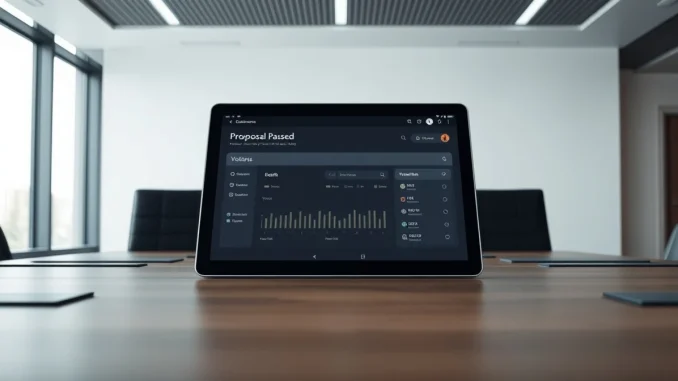
March 16, 2026 — World Liberty Financial (WLFI) token holders have ratified a major governance change, mandating a 180-day lock-up period for voting privileges. The proposal passed with overwhelming support, marking a significant shift for the cryptocurrency project backed by members of the Trump family.
Governance Overhaul Receives Near-Unanimous Support
The snapshot governance vote concluded on Friday, March 13, 2026, with 99.12% approval. A total of 1,800 votes were cast in favor of the new staking rule. Blockchain data indicates that over 76% of the voting power came from just ten wallet addresses.
Also read: CFTC hires SEC crypto adviser with blockchain forensics expertise; Strategy adds 1,587 BTC
Under the new rules, WLFI holders must stake their tokens for a minimum of 180 days to participate in protocol governance. The project stated the measure aims to ensure decision-making power rests with those having “long-term alignment to the protocol.” Users with tokens already locked in existing contracts are unaffected and retain their voting rights.
Incentives and Access for Major Stakers
The proposal includes a 2% annual percentage yield reward for stakers who participate in at least two governance votes during their lock-up period. A separate clause offers “guaranteed direct access” to the WLFI business development team for entities staking 50 million WLFI tokens, valued at approximately $5 million.
Also read: SpaceX goes public in historic IPO: Key numbers, share price, and what comes next
WLFI spokesman David Wachsman clarified to Reuters that this access is for business development executives and does not guarantee a partnership. He also stated it does not provide special access to specific founders named in the project’s documentation.
The WLFI “Gold Paper” lists Eric Trump and Baron Trump as co-founders supporting the project. Zach Witkoff and Alex Witkoff, sons of investor Steven Witkoff, are also named as co-founders.
Addressing DAO Voter Apathy
The move presents a distinct approach to low voter turnout, a persistent challenge for decentralized autonomous organizations (DAOs). Industry analyses frequently cite average DAO participation rates between 15% and 25%.
Other industry figures have proposed different solutions. Ethereum co-founder Vitalik Buterin suggested in February 2026 that AI assistants could help members engage with governance. Aave founder Stani Kulechov has previously discussed potentially scaling back token-based voting in favor of greater leadership input.
Broader Strategic Goals: Bank Charter and USD1
WLFI’s governance shift occurs alongside broader ambitions to build a crypto financial ecosystem. Central to this plan is its USD1 stablecoin and supporting other DeFi applications that “seek to preserve the US Dollar’s status,” according to its official documentation.
In January 2026, the project applied to the Office of the Comptroller of the Currency for a national trust bank charter to expand USD1 use. A decision on that application is still pending. The project has also launched rewards programs and institutional partnerships to drive adoption of its stablecoin.
CEO Zach Witkoff has discussed potential tokenization of assets like real estate and oil and gas. The project is also exploring creating a publicly traded company to hold its WLFI tokens.
Governance Track Record
This marks the sixth snapshot vote completed by WLFI. Past successful proposals included using unlocked WLFI tokens to grow the USD1 stablecoin ecosystem and making the governance token tradable on exchanges.
The project’s foundational document promises token holders the “right to vote on certain WLF Protocol matters.” The new lock-up rule fundamentally alters the requirements for exercising that right, tying it directly to long-term staking commitments.
For more information on the proposal and its mechanics, refer to the official Snapshot governance platform. Details on the national trust bank charter application can be found through the Office of the Comptroller of the Currency.



Be the first to comment