
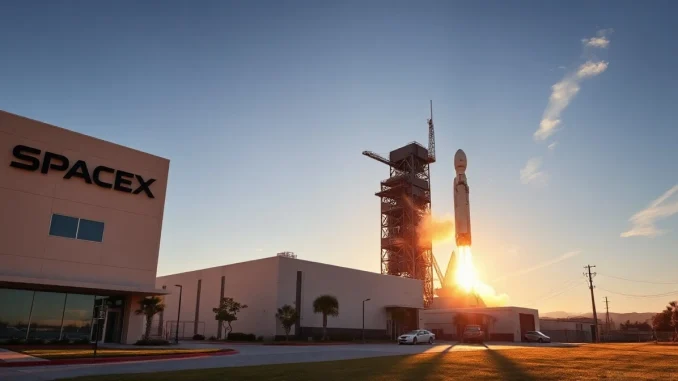
SpaceX priced 555.6 million shares at $135 each on Tuesday, raising $75 billion in what is now the largest initial public offering in history. The deal values the company at roughly $750 billion and positions founder Elon Musk to become the world’s first trillionaire on paper, assuming the stock holds its opening price when trading begins on NASDAQ under the ticker SPCE.
The offering surpasses the previous record held by Saudi Aramco’s $29.4 billion IPO in 2019, and it caps a 24-year journey from a startup that nearly went bankrupt in 2008 to a company that now operates the world’s largest satellite constellation and a reusable rocket fleet that has transformed the launch industry.
Also read: Crypto Biz: Tokenized RWAs surge 589% as Kraken tokenizes SpaceX IPO
What the S-1 reveals about SpaceX’s finances
The company’s S-1 registration statement, filed with the SEC and amended several times before the pricing, provides the most detailed public look at SpaceX’s operations. Key figures from the filing:
- Revenue: $18 billion in 2025, driven primarily by Starlink subscriber growth and launch contracts.
- Net loss: $4.9 billion in 2025, though the company notes this includes heavy capital expenditure on Starship development and Starlink satellite manufacturing.
- Cumulative losses: More than $37 billion since inception, reflecting the capital-intensive nature of aerospace manufacturing.
- Starlink subscribers: Exceeded 4 million active users as of March 2026, generating roughly $12 billion in annual revenue.
SpaceX warned investors in its S-1 that future dilution is likely, a disclosure that added fuel to persistent rumors of a potential merger with Tesla. The company also disclosed that it holds significant computing infrastructure through its xAI division, which has signed major compute lease agreements with Anthropic and Google in the months leading up to the IPO.
Also read: US lawmakers push for federal crypto crime task force as Hungary reverses trading ban
Who holds power — and who gets paid
Elon Musk controls approximately 85.1% of the company’s voting power through a dual-class share structure, a concentration that exceeds even Meta’s Mark Zuckerberg or Snap’s Evan Spiegel. After the IPO, Musk will retain more than 50% of voting power, giving him near-monarchical control over board composition, strategic decisions, and potential future mergers.
The NYT reported that approximately 4,400 SpaceX employees could become millionaires through the IPO, based on their vested stock options and the offering price. Early institutional investors including Founders Fund and Alphabet’s venture arm also stand to realize significant gains.
Lower-tier investors who participated through special purpose vehicles (SPVs) face a less certain outcome. SPV investors typically cannot sell shares during the lock-up period, which runs 180 days after the listing, and may face hidden fees and payout delays from the intermediary funds that organized their participation.
Pre-IPO deals and the AI compute play
In the weeks before the IPO, SpaceX locked in several large compute lease agreements through its xAI division:
- Anthropic agreed to pay $1.25 billion per month for compute capacity, a deal that Musk has publicly downplayed in duration.
- Google signed a $920 million per month lease, which a Google representative described as a short-term arrangement to address unexpected demand for its recently launched AI products.
These deals improve SpaceX’s balance sheet ahead of the listing and signal that the company sees its computing infrastructure — built originally for satellite data processing — as a growing revenue stream independent of its launch and Starlink businesses.
Starship’s path and investor expectations
The S-1 also offers a sobering assessment of Starship’s development timeline. The company’s fully reusable rocket, which completed its fifth integrated test flight in early 2026, still faces significant technical hurdles before it can carry payloads or crew. The filing notes that Starship’s path to operational reusability is uncertain and may disappoint both boosters who expected rapid deployment and critics who question the program’s economics.
For investors, the bet on SpaceX is largely a bet on Starlink’s continued growth and the eventual success of Starship — two businesses that require massive ongoing capital expenditure. The IPO proceeds, combined with the compute lease revenue, give the company a cash runway that CEO Elon Musk has said should fund Starship development through its first operational flights.
Trading on NASDAQ is expected to begin Thursday morning. Bloomberg and CNBC will carry live coverage of the opening bell, and NASDAQ’s official listing page will post the first trade price. Whether the stock pops, drops, or holds its $135 price will be the first test of public market appetite for a company that has lost $37 billion but may define the next era of space transportation.


Be the first to comment