
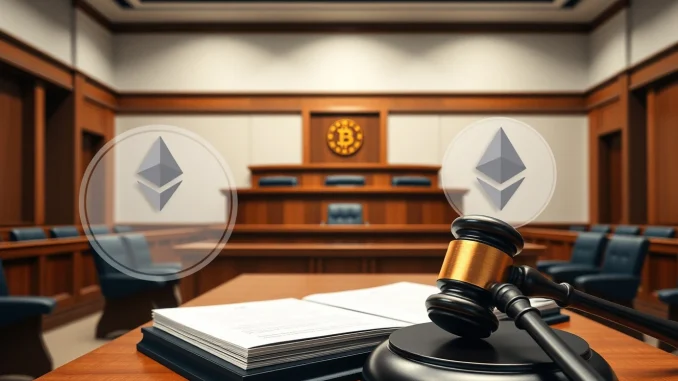
A US law firm has taken legal action to prevent the transfer of frozen Ether (ETH) linked to the recent Kelp exploit, arguing that its clients have a claim to the funds as compensation for damages owed by North Korea. The move adds a new layer of complexity to efforts to recover assets for victims of the hack.
Restraining Notice Targets Frozen Funds
Charlie Gerstein, a lawyer for Gerstein Harrow LLP, announced on the Arbitrum DAO forum that a New York district court had approved a restraining notice and three writs of execution. These orders prevent the Arbitrum DAO from moving approximately 30,766 ETH, worth over $73 million, which was frozen after the Kelp exploit on April 18. The law firm argues that its clients, who were not affected by the exploit, hold default judgments against North Korea from three separate US court cases in 2010, 2015, and 2016, totaling $877 million in compensatory and punitive damages, plus interest. Gerstein contends that the frozen ETH constitutes “property” in which North Korea has a stake due to the hacker group’s affiliation with the state.
Impact on Kelp Exploit Victims
The Kelp DAO suffered a $292 million hack on April 18, believed to be carried out by TraderTraitor, a subgroup of North Korea’s Lazarus Group. In response, the Arbitrum Security Council froze the ETH in a wallet linked to the exploit. Aave Labs later proposed unfreezing the funds to direct them to “DeFi United,” a fund aimed at compensating rsETH holders. However, the law firm’s action could delay or redirect these funds. Arbitrum DAO member Zeptimus expressed concern, stating that if the law firm succeeds, the DPRK debt would effectively be transferred to the Kelp victims, compounding the original harm rather than redressing it.
Precedent of Similar Claims
Gerstein Harrow has a history of filing claims against frozen cryptocurrency tied to North Korean hacks. In February, the firm targeted funds frozen by Tether from the 2023 Heco Bridge hack. It has also filed class-action suits against multiple DAOs. Onchain sleuth ZachXBT accused the firm of using his research in court documents to stake a claim on funds from the $1.5 billion Bybit hack. The firm currently lists three live cases against DAOs on its website. North Korea-affiliated actors have been accused of stealing at least $578 million in April alone, highlighting the scale of the issue.
Also read: Spain’s CNMV Chair Rules Out MiCA Deadline Extension for Crypto Firms, Impacting Binance
Why This Matters
This legal battle raises critical questions about asset recovery in the wake of state-backed cyberattacks. It pits the rights of victims of the original hack against those holding unrelated judgments against North Korea. The outcome could set a precedent for how frozen cryptocurrency is handled in similar cases, potentially affecting future efforts to return stolen funds to their rightful owners. For the crypto community, it underscores the ongoing challenges of addressing legal systems while trying to protect user assets from sophisticated hacking groups.
Conclusion
The Gerstein Harrow LLP action introduces a significant legal hurdle for the recovery of funds from the Kelp exploit. As the case unfolds, it will test the boundaries of US court jurisdiction over decentralized organizations and frozen digital assets. The crypto industry will be watching closely to see whether the funds ultimately reach the victims of the hack or are diverted to satisfy unrelated claims against North Korea.
FAQs
Q1: What is the Kelp exploit?
The Kelp exploit refers to a $292 million hack on Kelp DAO on April 18, 2026, believed to be carried out by North Korea’s Lazarus Group. The Arbitrum Security Council froze 30,766 ETH (over $73 million) linked to the exploit.
Q2: Why is a US law firm trying to block the frozen ETH?
Gerstein Harrow LLP argues that its clients won default judgments against North Korea totaling $877 million and that the frozen ETH is property in which North Korea has a stake, giving them a claim to the funds.
Q3: How could this affect the victims of the Kelp exploit?
If the law firm succeeds, the frozen ETH could be used to satisfy the clients’ claims against North Korea, potentially delaying or preventing the return of funds to the actual victims of the hack.





Be the first to comment