
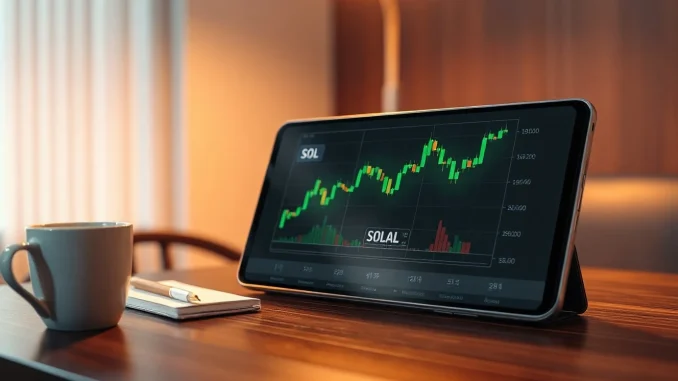
Solana (SOL) has established itself as one of the most actively traded cryptocurrencies, known for its high throughput and low transaction costs. As the market evolves through regulatory shifts, technological upgrades, and changing investor sentiment, understanding where SOL may head in the coming years requires a grounded look at technical indicators, network fundamentals, and broader market cycles.
Technical Context and Current Market Position
Solana’s price action has historically been volatile, reflecting both its rapid adoption and the broader crypto market’s cyclical nature. As of early 2026, SOL trades within a range that technical analysts often describe as a consolidation phase following significant moves in prior years. Key support levels have formed near the $80–$100 zone, while resistance has been tested around $160–$180. The Relative Strength Index (RSI) and moving average convergence divergence (MACD) indicators suggest neutral to slightly bullish momentum, though no clear breakout pattern has emerged.
Also read: Notcoin (NOT) Price Prediction 2026-2030: Can the Telegram Gaming Token Stage a Recovery?
Network fundamentals remain strong. Solana continues to process thousands of transactions per second with low fees, attracting decentralized finance (DeFi) projects, non-fungible token (NFT) marketplaces, and gaming applications. The network’s uptime and reliability have improved notably since earlier congestion issues, bolstering confidence among developers and institutional investors.
2026 Price Outlook: Realistic Scenarios
For 2026, analysts generally agree that SOL’s price will be influenced by macroeconomic conditions, regulatory clarity in major markets like the United States and the European Union, and the overall trajectory of Bitcoin and Ethereum. A conservative scenario sees SOL trading between $90 and $150, assuming a stable or mildly bearish macro environment. A moderate bullish scenario, driven by increased DeFi adoption and positive regulatory news, could push prices into the $160–$220 range. An aggressive upside, though less probable, would require a sustained crypto bull market and significant institutional inflows, potentially taking SOL above $250.
Also read: Monero (XMR) Price Prediction 2026–2030: Can Privacy Coins Sustain Momentum?
Worth mentioning that these are projections based on current data and trend analysis. Cryptocurrency markets remain highly unpredictable, and price forecasts should not be interpreted as financial advice.
Long-Term Forecast: 2027 to 2030
Looking further ahead, Solana’s long-term value proposition hinges on its ability to maintain technical superiority and grow its ecosystem. By 2027–2028, if Solana continues to capture market share from slower or more expensive blockchains, SOL could see a gradual upward trend, with potential ranges between $200 and $350, depending on market cycles. The next Bitcoin halving, expected around 2028, historically triggers broader crypto market rallies, which could lift SOL along with the sector.
By 2030, the field may look very different. If Solana achieves widespread adoption in areas like decentralized physical infrastructure networks (DePIN), real-world asset tokenization, and enterprise blockchain solutions, some models project SOL trading between $400 and $600. However, these longer-term forecasts carry significant uncertainty. Competition from Ethereum, layer-2 solutions, and emerging blockchains like Sui and Aptos could cap Solana’s growth. Regulatory changes, technological breakthroughs, or security incidents could also alter the trajectory dramatically.
Key Factors to Watch
Investors and analysts should monitor several developments: Solana’s network upgrade roadmap, particularly improvements in scalability and validator decentralization; the growth of its DeFi total value locked (TVL); institutional adoption through ETFs or custody solutions; and regulatory decisions in major economies. Each of these factors can materially affect SOL’s price direction.
Conclusion
Solana’s price outlook from 2026 through 2030 presents a mix of cautious optimism and acknowledged risk. Near-term consolidation may give way to gradual appreciation if network fundamentals and market conditions align. Longer-term projections remain speculative but suggest potential for significant growth if Solana maintains its competitive edge. Readers should approach all price predictions with skepticism, diversify research, and consult financial professionals before making investment decisions.
FAQs
Q1: Is Solana a good long-term investment?
Solana has strong technical fundamentals and a growing ecosystem, but like all cryptocurrencies, it carries high risk. Long-term potential depends on adoption, competition, and regulatory developments. No investment is guaranteed.
Q2: What is the highest price Solana could reach by 2030?
Some optimistic models project SOL reaching $400–$600 by 2030, assuming widespread adoption and favorable market conditions. However, these are speculative and should not be relied upon for financial planning.
Q3: How does Solana compare to Ethereum?
Solana offers higher transaction throughput and lower fees than Ethereum, but Ethereum has a larger developer community, more decentralized applications, and greater institutional adoption. Each blockchain has distinct trade-offs in speed, security, and decentralization.





Be the first to comment