
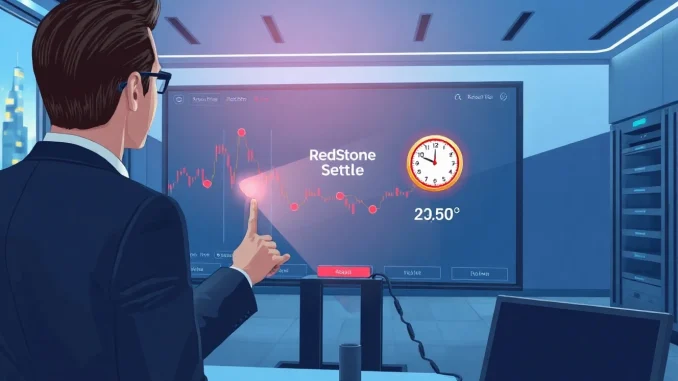
RedStone, a decentralized oracle provider, has launched a settlement layer designed to fix the RWA liquidity gap in DeFi lending. The system, called RedStone Settle, targets a key barrier: the mismatch between fast DeFi liquidations and slow asset redemptions.
RedStone Settlement Layer Targets RWA Liquidity Gap
Tokenized real-world assets, such as bonds and funds, have redemption periods of 60 to 180 days. DeFi lending protocols like Aave need near-instant liquidations to manage risk. This conflict has kept RWAs from being used as collateral. RedStone Settle introduces an onchain auction mechanism to solve this.
During a liquidation event, liquidity providers can buy positions immediately. They supply protocols with liquidity while taking on the delayed redemption risk. The Baar, Switzerland-based company said this could unlock over $30 billion in tokenized RWAs currently idle in DeFi.
Data from RWA.xyz shows tokenized real-world assets, excluding stablecoins, are valued at over $30 billion. Products like US Treasury exposure and private credit lead the market.
Also read: Spain’s CNMV Chair Rules Out MiCA Deadline Extension for Crypto Firms, Impacting Binance
Tokenization Alone Doesn’t Solve Liquidity Constraints
Industry participants at Paris Blockchain Week said tokenization does not automatically improve liquidity. Oya Celiktemur of Ondo Finance noted during a Cointelegraph panel that tokenizing an illiquid asset does not magically make it liquid.
This suggests structural limitations remain. Liquidity and settlement speed are still challenges for tokenized RWAs. RedStone’s approach could bridge this gap.
DeFi Lending Growth and Institutional Interest
DeFi lending has grown 72% year-over-year through September, according to Binance Research. Institutional use of stablecoins and tokenized assets drives this expansion. The RedStone settlement layer could accelerate adoption by making RWAs more usable as collateral.
What this means for investors is that more efficient borrowing against yield-generating positions is possible. The system could also attract more institutional capital into DeFi.
How RedStone Settle Works
The auction mechanism triggers during liquidation events. Liquidity providers step in to purchase positions, supplying immediate liquidity. They assume the risk of delayed redemption from the underlying assets.
This design addresses the core issue: the speed mismatch between DeFi and traditional asset settlement. Industry watchers note that this could be a turning point for RWA adoption in lending.
Conclusion
RedStone’s settlement layer tackles the RWA liquidity gap in DeFi lending by introducing an onchain auction mechanism. This could unlock billions in tokenized assets and improve borrowing efficiency. The launch signals growing maturity in DeFi infrastructure.
FAQs
Q1: What is RedStone Settle?
RedStone Settle is a settlement layer that uses an onchain auction mechanism to provide liquidity during liquidation events, addressing the RWA liquidity gap in DeFi lending.
Q2: How does RedStone Settle solve the liquidity mismatch?
It allows liquidity providers to purchase positions immediately during liquidations, assuming the delayed redemption risk of tokenized real-world assets.
Q3: What is the RWA liquidity gap?
The gap refers to the mismatch between fast DeFi liquidations and slow redemption periods of RWAs, which can be 60 to 180 days.
Q4: How much value could RedStone Settle unlock?
RedStone estimates over $30 billion in tokenized RWAs currently idle in DeFi could become usable as collateral.
Q5: Why is tokenization alone not enough for liquidity?
Tokenization does not automatically improve liquidity; structural issues like settlement speed and redemption periods remain, as noted by industry experts.





Be the first to comment