

Institutional investors are beginning to enter prediction markets, a sector long dominated by retail users, as block trades, custom contracts, and evolving U.S. regulatory frameworks create new opportunities for hedging and investment. A May 4 report from Bernstein highlights this shift, pointing to the first bespoke institutional block trade executed on Kalshi as a key milestone.
Block trades mark a turning point for prediction markets
Bernstein analysts noted that the introduction of block trading and bespoke contracts could significantly expand participation from institutional investors seeking targeted exposure to event risks. The first block trade on Kalshi, brokered by Greenlight Commodities, involved a Houston-based environmental hedge fund and Jump Trading as the liquidity provider. The custom contract was tied to the clearing price of California’s May carbon allowance auction, illustrating how prediction markets can be tailored to specific client needs.
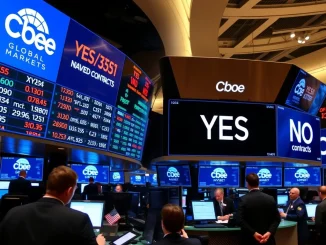
Unlike retail-focused platforms, block trades are privately negotiated, large transactions typically arranged between institutional counterparties. This structure allows for precise hedging of event risks such as tariffs, elections, and geopolitical developments, using contracts that resolve to simple yes-or-no outcomes.
Regulatory momentum and institutional access
Clear Street’s partnership with Kalshi gives institutional investors a regulated way to access prediction markets, allowing them to trade these contracts alongside traditional assets like stocks and futures. Kalshi operates as a federally regulated exchange under the Commodity Futures Trading Commission, while Polymarket received conditional approval in late 2025 to offer event contracts in the U.S. through regulated channels.
Also read: Spain’s CNMV Chair Rules Out MiCA Deadline Extension for Crypto Firms, Impacting Binance
Despite these advances, prediction markets remain largely retail-driven. A report by Bitget Wallet and Polymarket found that retail users accounted for more than 80% of the $25.7 billion in prediction market volumes recorded in March. Bernstein projects that prediction markets could evolve into a trillion-dollar industry by the end of the decade, driven by greater institutional participation.
What this means for investors and the market
The entry of institutional investors into prediction markets signals a maturation of the asset class. For investors, these markets offer a way to hedge specific risks that traditional financial instruments may not cover. For the broader market, institutional involvement could bring greater liquidity, stability, and credibility, though regulatory unevenness remains a challenge.
Conclusion
The first institutional block trade on Kalshi, combined with regulatory progress and partnerships like Clear Street’s, marks a decisive moment for prediction markets. While retail users still dominate, the infrastructure for institutional participation is taking shape. If current trends continue, prediction markets could become a standard tool for hedging event risk, potentially growing into a trillion-dollar industry by 2030.
FAQs
Q1: What is a block trade in prediction markets?
A block trade is a privately negotiated, large transaction between institutional counterparties, often arranged through a broker. In prediction markets, it allows institutions to hedge specific event risks with custom contracts.
Q2: How are U.S. regulations affecting prediction markets?
Kalshi is federally regulated by the CFTC, and Polymarket received conditional approval in 2025 to offer event contracts in the U.S. through regulated channels. This regulatory clarity is attracting institutional investors.
Q3: Why are prediction markets attractive to institutional investors?
They allow precise hedging of event risks like tariffs, elections, and geopolitical developments using simple yes-or-no contracts. Bespoke block trades can be tailored to specific client needs, offering a new tool for risk management.




Be the first to comment