
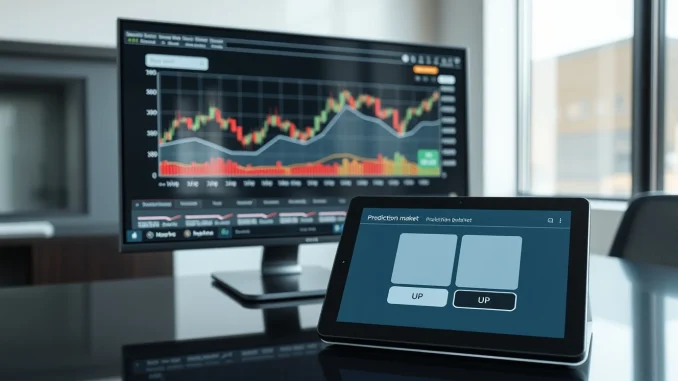
In a significant expansion of its platform, prediction market Polymarket has begun offering contracts tied to traditional equities and commodities. The move, announced on April 3, 2026, uses real-time price data from blockchain oracle provider Pyth Network to automatically settle daily market outcomes. This integration marks a direct bridge between speculative prediction markets and the foundational assets of global finance.
Polymarket’s New Financial Contracts
Polymarket’s new offering includes daily up-or-down and closing price contracts for major assets. According to the company’s announcement, these cover US equity indexes, commodities like gold and oil, and over a dozen US-listed stocks. Key names include Tesla, Nvidia, and Apple. Each contract resets at the end of a trading session. Outcomes are settled automatically based on Pyth’s aggregated price feeds, removing the need for manual resolution.
This shift is notable. Previously, prediction markets often relied on specific exchange data or manual input for settlement. By standardizing on Pyth, Polymarket creates a transparent and consistent resolution layer. Data from Pyth is sourced from over 90 first-party data providers, including major trading firms and market makers. This suggests a push for institutional-grade reliability in a space often viewed as retail-focused.
The Pyth Network as the Resolution Engine
The core of this expansion is the technical integration with Pyth Network. Based in Zug, Switzerland, Pyth provides real-time market data on-chain. For these new Polymarket contracts, Pyth’s feeds act as the single source of truth. To support users, Pyth also launched a data interface called Pyth Terminal. Here, traders can track live price feeds and the exact reference values used to settle Polymarket contracts.
Also read: Spain’s CNMV Chair Rules Out MiCA Deadline Extension for Crypto Firms, Impacting Binance
A key feature is the live “price to beat” display. This updates continuously as markets move, giving traders clear parameters for their positions. The arrangement shows how oracle networks are evolving. They are no longer just infrastructure for decentralized finance (DeFi) apps. Industry watchers note that their role is extending into official data systems and now, sophisticated prediction markets.
A Signal of Mainstream Validation
The expansion follows a major vote of confidence from traditional finance. Just last week, Intercontinental Exchange (ICE), the parent company of the New York Stock Exchange, completed a $600 million cash investment in Polymarket. ICE plans to acquire up to an additional $40 million in shares from existing holders. This is part of a broader, multi-billion-dollar commitment to the platform. The involvement of a giant like ICE is not trivial. It implies that established financial institutions see long-term value and legitimacy in prediction markets.
Market reaction was immediate. The announcement sent the PYTH token soaring more than 70% in a single day. Its market capitalization crossed the $1 billion threshold. This investor enthusiasm highlights the perceived significance of the deal. What this means for investors is a clearer path for oracle networks beyond their native crypto ecosystems.
The Competitive Oracle Space
Pyth’s partnership with Polymarket occurs within a highly competitive sector. Oracle networks are essential for connecting blockchains with real-world data. Data from DeFiLlama shows a concentrated market. Chainlink commands a dominant position, accounting for roughly 64% of the total value secured across all protocols. Other providers, including Pyth Network and RedStone, hold smaller but growing shares of around 5% each.
This competition is driving innovation beyond crypto. For instance, in January 2026, Chainlink announced plans to roll out 24/5 price data for US equities and ETFs to crypto platforms. This would enable trading and derivatives tied to tokenized stocks outside standard market hours. The following month, Ondo Finance integrated Chainlink as the data provider for tokenized US equities on its platform. The implication is clear: a race is on to provide the most reliable bridges between traditional and digital finance.
Broader Implications for Prediction Markets
Polymarket’s move is part of a larger trend. Prediction markets are gaining traction for hedging and speculation on real-world events. These range from elections and sports to financial outcomes and weather. The use of automated, on-chain data for settlement reduces ambiguity and potential disputes. This could signal a maturation phase for the entire sector.
Other platforms are making similar strides. In October 2025, RedStone oracle integrated data from Kalshi, a CFTC-regulated prediction market. This data was made available across more than 110 blockchains. The goal is similar: to use authoritative, real-world data to settle complex contracts automatically. The growing role of oracles in this space suggests a future where vast arrays of events can be traded with transparency and efficiency previously unseen.
Regulatory Context and Future Challenges
This expansion does not occur in a vacuum. Prediction markets, especially those touching traditional securities, operate under intense regulatory scrutiny. Polymarket has faced regulatory pressure in the past. Its recent fee expansion was seen by analysts as a move to boost revenue amid these ongoing challenges. The partnership with Pyth and the backing from ICE could be strategic assets. They provide a layer of operational rigor and mainstream credibility that may be valuable in discussions with regulators.
The path forward is not without obstacles. Regulators will likely examine how these daily equity contracts are structured and whether they comply with existing securities laws. However, the automated, data-driven settlement mechanism might address some concerns about manipulation or fraud. The coming months will be critical in observing how this new offering is received by both the market and oversight bodies.
Conclusion
Polymarket’s expansion into equities and commodities using Pyth price feeds represents a major moment. It blends the speculative nature of prediction markets with the concrete data streams of traditional finance. The backing from Intercontinental Exchange adds substantial weight to this experiment. For the broader industry, it demonstrates the expanding utility of blockchain oracles. They are becoming indispensable pipes for real-world data, powering everything from DeFi loans to bets on stock price movements. This integration suggests a future where the lines between different forms of financial markets continue to blur, driven by reliable, on-chain data.
FAQs
Q1: What exactly did Polymarket announce?
Polymarket announced it is now offering daily prediction contracts on traditional financial assets. This includes major stocks like Apple and Tesla, commodities like gold and oil, and equity indices. These contracts settle automatically using price data from Pyth Network.
Q2: How does Pyth Network’s data settle the contracts?
Pyth Network aggregates price data in real-time from over 90 professional trading firms and market makers. This data is published on-chain. Polymarket’s smart contracts use these Pyth price feeds as the definitive “resolution source” to determine if a daily contract finished up or down, enabling automatic payout without manual intervention.
Q3: Why is Intercontinental Exchange’s (ICE) investment significant?
ICE is the parent company of the New York Stock Exchange. Its $600 million investment in Polymarket signals serious institutional belief in the future of prediction markets. This kind of backing from a traditional finance giant provides credibility and resources that can help manage regulatory and scaling challenges.
Q4: How does this affect the oracle market competition?
The deal is a major partnership win for Pyth Network, which trails market leader Chainlink in overall adoption. It demonstrates a high-profile use case for Pyth’s data outside of pure DeFi. The move intensifies the competition among oracle providers to secure partnerships that connect crypto platforms with real-world financial data.
Q5: Are there regulatory risks with these new contracts?
Yes. Offering contracts based on stock prices may attract scrutiny from securities regulators like the SEC. Polymarket’s past regulatory issues highlight this ongoing challenge. However, using a transparent, automated settlement system based on reputable data may help address some regulatory concerns about fairness and manipulation.





Be the first to comment