
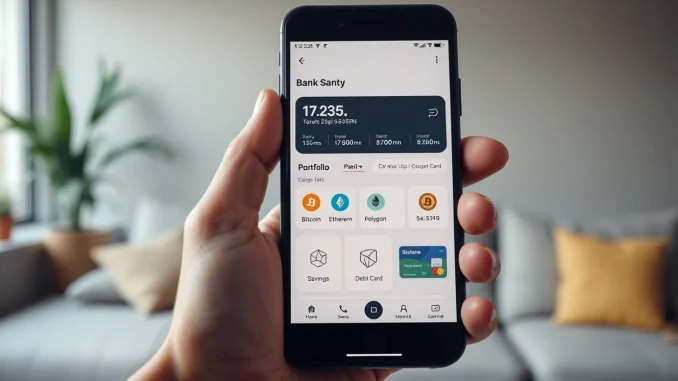
OnePay, the financial platform majority-owned by retail titan Walmart, is accelerating its move into digital assets. The company has added more than a dozen new cryptocurrency tokens, including Polygon (POL), Arbitrum (ARB), and Solana (SOL), to its offerings. This strategic expansion, confirmed on March 26, 2026, targets customers who are unfamiliar with crypto but want an easy entry point through a trusted banking app.
OnePay’s Curated Crypto Strategy Takes Shape
Since introducing Bitcoin and Ethereum in January 2026, OnePay has methodically broadened its digital asset menu. The latest additions follow a batch of ten tokens listed just days prior, which included Cardano (ADA), Bitcoin Cash (BCH), and the gold-backed PAX Gold (PAXG). Ron Rojany, OnePay’s General Manager for Core App & Crypto, outlined the company’s philosophy in a statement. “We plan on continuing to expand thoughtfully, prioritizing assets that meet a high bar: demand, liquidity, regulatory clarity and long-term utility,” Rojany told Cointelegraph. He emphasized a focus on a “curated set of assets” that align with customer behavior over chasing speculative trends.
This curated approach is a direct response to user demand. While Rojany did not share specific adoption figures, he noted “strong engagement, particularly among customers who are newer to crypto.” The implication is clear: OnePay is not building for crypto veterans. Instead, it’s constructing a bridge for Walmart’s massive customer base. The app’s integration with Walmart’s retail ecosystem—allowing the digital wallet to be used in-store and online—provides a unique on-ramp. Industry watchers note that this built-in utility could be a significant differentiator in a crowded market.
The Superapp Vision in American Banking
OnePay’s broader ambition is to become a U.S. version of a “superapp,” a model popularized in Asia by platforms like China’s WeChat. The app already consolidates services like high-yield savings, credit cards, loans, and mobile plans. Adding cryptocurrency trading and custody is a logical step in creating a comprehensive financial hub. Data from Walmart’s latest annual report shows the scale of the potential audience: its U.S. operations generated net sales of $462.4 billion in fiscal 2025.
Also read: Spain’s CNMV Chair Rules Out MiCA Deadline Extension for Crypto Firms, Impacting Binance
OnePay is not alone in this pursuit. Earlier in March 2026, Japan’s Startale Group announced plans to use a $50 million funding round to develop its own superapp integrating payments and asset management. In late September 2025, Coinbase CEO Brian Armstrong detailed a vision for a crypto superapp to rival traditional banks. This suggests a growing consensus that bundled financial services represent the next phase of digital finance.
Regulatory Winds Shift Toward Integration
A key development supporting this trend came from U.S. regulators. In September 2025, Securities and Exchange Commission Chairman Paul Atkins expressed support for platforms operating under a unified regulatory framework. He directed staff to develop guidance to make the “super-app” vision a reality, potentially allowing combined trading, lending, and staking services. This regulatory shift could lower barriers for integrated platforms like OnePay. What this means for investors is a potential acceleration in mainstream crypto adoption, driven by familiar, regulated interfaces rather than specialized exchanges.
Analysis: Why Token Selection Matters
OnePay’s specific token choices reveal its strategy. The inclusion of Polygon and Arbitrum, both leading Ethereum scaling solutions, points to a focus on assets with established ecosystems and developer activity. Solana’s addition acknowledges its popularity for high-speed, low-cost transactions. The selection of PAX Gold, a regulated commodity-backed token, appeals to a conservative mindset. This balanced portfolio aims to mitigate risk while offering growth potential.
OnePay’s Initial & Expanded Crypto Offerings:
- Launched January 2026: Bitcoin (BTC), Ethereum (ETH)
- Added March 2026: Solana (SOL), Cardano (ADA), Bitcoin Cash (BCH), PAX Gold (PAXG), and six others.
- Added March 26, 2026: Polygon (POL), Arbitrum (ARB), SUI (SUI).
The company’s criteria—customer demand, liquidity, and regulatory clarity—signal a institutional-grade approach. This could help build trust. But challenges remain. Crypto markets are volatile, and regulatory clarity in the U.S. is still evolving. OnePay’s success hinges on executing its “trusted, safe and intuitive experience” promise while working through these uncertainties.
Broader Context and Market Impact
The move by a Walmart-backed entity carries weight beyond its own user base. It signals a maturation point where major retail conglomerates see digital assets as a necessary component of consumer finance. Other traditional financial institutions are making similar moves. For instance, BNP Paribas recently added Bitcoin and Ether exchange-traded notes for retail clients in France. This pattern suggests crypto services are shifting from niche offerings to standard features.
For competitors, OnePay’s integrated model sets a new benchmark. Pure-play crypto exchanges may need to add more traditional banking services to retain users seeking convenience. Conversely, traditional banks may feel pressure to rapidly develop or partner for crypto capabilities. The battleground is becoming the all-in-one app. Ron Rojany’s comment that OnePay is “still early” underscores this. The platform is laying groundwork in a sector that is still defining itself.
Conclusion
OnePay’s expansion into a wider array of cryptocurrencies is a significant step in Walmart’s strategy to build a financial superapp. By focusing on a curated list of tokens and prioritizing ease of use for newcomers, the platform aims to demystify digital assets for millions of customers. This development, supported by evolving regulatory attitudes, highlights a broader trend of consolidation in fintech. The success of OnePay’s crypto push will depend on maintaining user trust, managing regulation, and proving that integrated banking truly meets everyday financial needs.
FAQs
Q1: What is OnePay and who owns it?
OnePay is a financial services application often described as a “superapp.” It offers banking, lending, and payment services. Walmart holds a majority ownership stake in the company.
Q2: Which new cryptocurrencies did OnePay add?
In late March 2026, OnePay added Polygon (POL), Arbitrum (ARB), and SUI (SUI). This followed an earlier March expansion that included Solana (SOL), Cardano (ADA), Bitcoin Cash (BCH), and PAX Gold (PAXG), among others.
Q3: How can OnePay users access these crypto features?
The cryptocurrencies are available for trading and holding within the OnePay app. The app’s digital wallet can also be used for payments at Walmart stores and on Walmart’s website, though specific crypto payment functionality was not detailed in the announcement.
Q4: Why is OnePay’s expansion significant?
It represents a major retail-backed platform moving deeper into crypto, targeting mainstream users who are new to digital assets. Its integrated approach, combining crypto with traditional banking, could accelerate broader adoption.
Q5: What are the risks of using OnePay for cryptocurrency?
As with any crypto platform, risks include market volatility, potential security vulnerabilities, and regulatory changes. OnePay emphasizes its focus on safety, regulatory clarity, and curated assets to mitigate some of these concerns for new users.




Be the first to comment