
The National Transportation Safety Board temporarily shut down public access to its accident docket system last week after discovering that people used artificial intelligence tools to recreate the voices of two pilots killed in a UPS cargo plane crash in Louisville, Kentucky, last year.
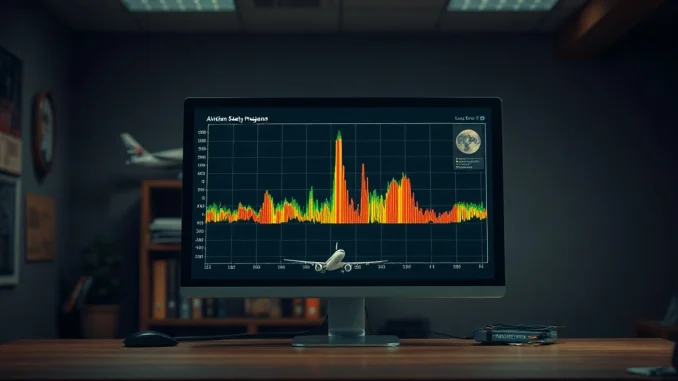
The agency confirmed that individuals took a spectrogram file — a visual representation of sound frequencies — from the public docket for UPS Flight 2976 and combined it with the official transcript to generate approximations of the cockpit voice recorder audio. Posts on social media identified AI tools including Codex as being used in the process.
Also read: White House says it received no Democratic nominees for SEC, CFTC vacancies
Federal law prohibits the NTSB from releasing cockpit voice recordings as part of its public docket, which otherwise contains detailed investigative materials. The spectrogram file, which converts sound signals into an image using a mathematical process, was included in the docket. Scott Manley, a YouTuber known for covering physics and astronomy, noted on X that the data encoded in the image could be used to reconstruct audio.
The NTSB restored access to the docket system on Friday but kept 42 investigations closed pending review, including the one for Flight 2976. The agency stated it is reviewing its procedures for what data is included in public dockets moving forward.
Also read: Phantom and Hyperliquid Urge CFTC to Modernize Rules for Onchain Derivatives
How the recreation worked
A spectrogram uses Fourier transforms to break sound into its component frequencies, displaying them as a time-frequency image. The file included in the docket contained enough data for someone with technical knowledge to reverse the process and generate a rough audio approximation. With the transcript as a guide, AI tools were then used to synthesize speech that matched the cockpit recording’s content and timing.
The result was not a perfect reproduction, but it was convincing enough to raise serious privacy and ethical concerns for the families of the deceased and for aviation investigators.
Broader implications for aviation safety and privacy
The incident highlights a growing tension between transparency in accident investigations and the privacy rights of those involved. Cockpit voice recorders are considered highly sensitive because they capture every word and sound in the cockpit during the final moments of a flight. Federal law has long treated these recordings differently from other investigative data for exactly this reason.
Aviation safety experts say the episode could lead to stricter controls on what data is made public during investigations, potentially limiting access to raw sensor data or audio-derived files that could be reverse-engineered.
The NTSB has not announced any policy changes beyond the temporary closure, but the incident is likely to prompt a formal review of docket procedures. The agency’s docket system has historically been a valuable resource for journalists, researchers, and the public, providing access to thousands of investigative documents.






Be the first to comment